

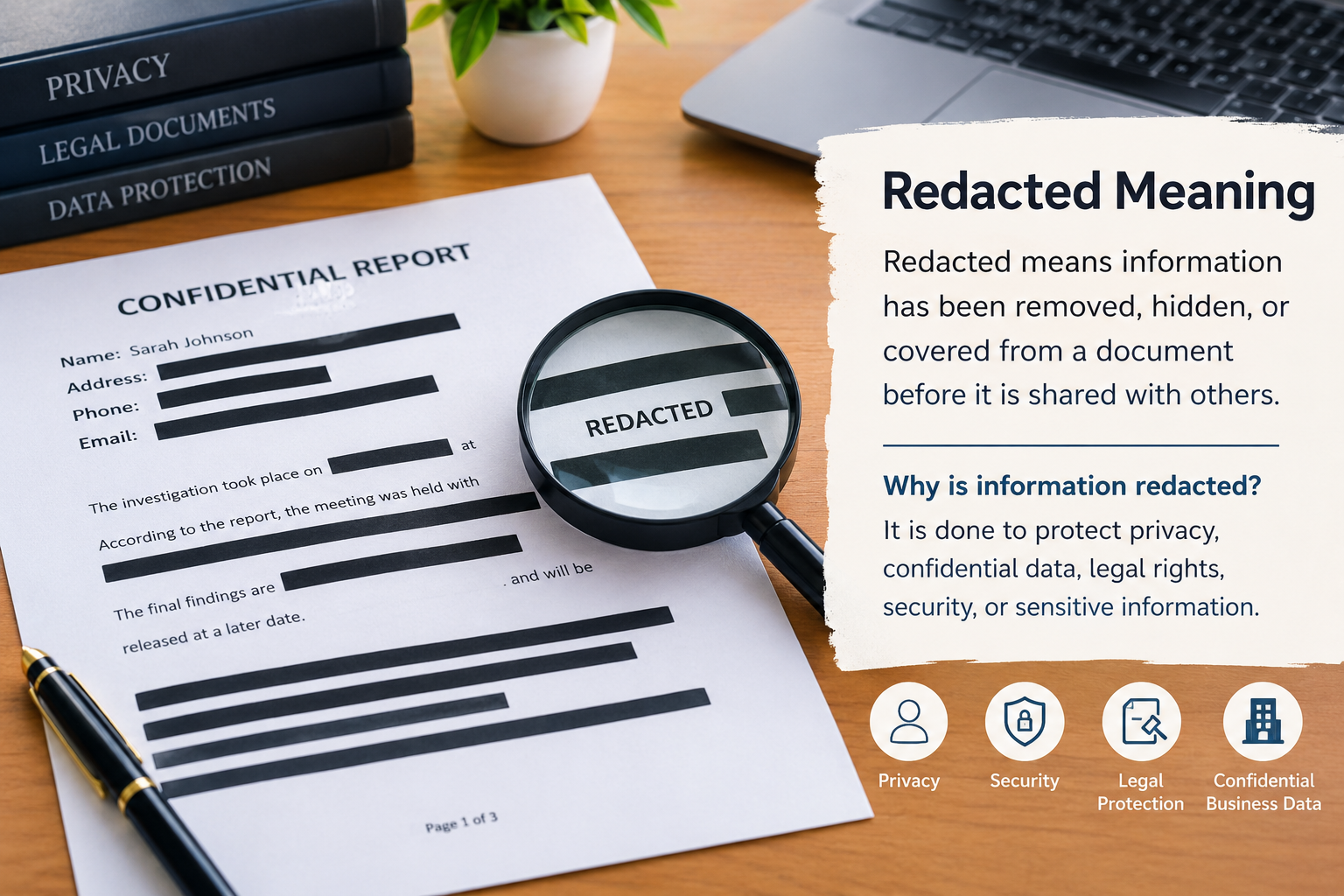
Learn the redacted meaning, why information is redacted, how redaction works, and 7 important facts about the term in documents and online content.
Redacted Meaning: A Simple Guide to What “Redacted” Means in Documents
The word “redacted” often appears in official documents, legal records, news reports, and online content when certain information has been hidden or removed. Understanding the redacted meaning can help readers recognize why names, addresses, sensitive details, or confidential information may not be visible. Redaction is generally used to protect privacy, security, or other sensitive information while allowing the rest of a document to be shared. This guide explains what redacted means, why information is redacted, and how the process works.
Have you ever opened a document and found black boxes covering names, numbers, or whole sections of text? You may have wondered what happened to the missing information. This is where the word redacted comes in.
The word “redacted” means that information has been removed, hidden, or covered before a document is shared with other people. It is often used when sensitive or private information needs protection. Government agencies, courts, businesses, schools, and other organizations may redact information from documents.
For example, a public report might show a person’s name but hide their home address. A legal document may contain blacked-out sections that include private details. An online article may also use the word “redacted” when some information has been deliberately withheld.
Understanding the redacted meaning is useful because you may see this term in legal documents, news reports, government records, emails, contracts, and digital files. This guide explains what redacted means, why information is redacted, how redaction works, and what the term means in different situations.
What Does Redacted Meaning?
Redacted means information has been removed, concealed, or blocked from a document before the document is released or shared.
The information may be hidden because it is private, confidential, legally protected, or sensitive. The original document may contain the information, but the public version does not show it.
For example, imagine a document that originally says:
“Sarah Johnson lives at 25 Green Street.”
If the address is redacted, the public version could appear as:
“Sarah Johnson lives at █████████████.”
The black area represents information that has been removed from the visible version of the document.
Redaction does not always mean that something is illegal or secret. Information can be redacted for many valid reasons, including privacy, security, business confidentiality, and legal requirements.
Redacted Meaning in Simple English
In simple English, redacted means hidden or removed information from a document.
If someone says, “The report was redacted,” they mean that some parts of the report were covered or removed before it was given to someone else.
A simple example is a school record that contains a student’s private information. If the school needs to share the record for another purpose, it may remove the student’s phone number, home address, or other private details.
Understanding redaction is an important part of protecting sensitive information and maintaining data privacy and protection.
So, when you see the word “redacted,” think:
Some information was intentionally hidden or removed.
What Is the Difference Between Redacted and Deleted?
Redacted and deleted may sound similar, but they do not always mean the same thing.
When information is deleted, it is generally removed from the document, file, or system. Depending on the situation, the deleted information may no longer be part of the document.
When information is redacted meaning, the information is specifically hidden from the version being shared. The original document may still contain the information.
For example, a company may have a contract containing a customer’s phone number. The company can create a public version of the contract with the phone number redacted. The original contract can still exist internally.
This distinction matters in legal, government, and business settings.
Why Is Information Redacted?
Information is usually redacted to protect something that should not be publicly available.
Privacy is one of the most common reasons. A document may contain personal information such as phone numbers, home addresses, email addresses, identification numbers, or financial details.
Legal protection is another major reason. Court records can contain information that is protected by law. A court may require certain details to be hidden before a document becomes publicly available.
Government agencies may also redact information related to national security, confidential investigations, intelligence sources, or sensitive operations.
Businesses use redaction to protect trade secrets, customer information, financial records, and confidential agreements.
The purpose is usually not to change the meaning of the document. Instead, the goal is to prevent sensitive information from being exposed.
What Does Redacted Mean in Legal Documents?
The term redacted is very common in legal documents.
Court records can contain private information about people involved in a case. When a document becomes available to the public, certain details may need to be hidden.
For example, a court document might show:
“John Smith’s bank account number is [redacted].”
The original document may contain the complete number, but the publicly available version does not.
Legal redacted meaning can also apply to medical information, information about minors, addresses, personal identification numbers, and other protected details.
The exact rules vary by jurisdiction and type of legal proceeding. A court or legal authority may provide specific requirements for what information must be removed.
What Does Redacted Mean in Government Documents?
Government documents are another common place where you will see the word redacted meaning.
Government agencies sometimes release documents to the public while removing information that cannot legally or safely be disclosed.
For example, a government report could contain hundreds of pages of information. Some parts may be visible, while other parts are blacked out.
A document could look like this:
“According to the investigation, the meeting took place on ███████.”
The hidden section may contain information that the agency is not allowed to release.
Government redactions can be related to personal privacy, security concerns, confidential sources, ongoing investigations, or other legally protected information.
What Does Redacted Mean in News Reports?
News organizations often use the word “redacted” when discussing documents released by governments, courts, companies, or other institutions.
A journalist may receive a document containing several pages of information. Some parts may be covered with black boxes. The journalist can describe the document as “partially redacted meaning.”
For example, a news report might say that officials released a 100-page report, but several pages contained redacted meaning sections.
This tells readers that the released document is not the complete unedited version.
It does not automatically mean that the hidden information is dramatic or suspicious. Sometimes the redacted meaning information is simply personal or legally protected.
What Does a Redacted Document Look Like?
A redacted document can look different depending on how the information was removed.
The most familiar form uses black rectangles over text. This is why people often describe redacted meaning documents as “blacked-out documents.”
However, redaction can also appear as blank spaces, removed names, replaced characters, or labels such as “[REDACTED].”
For example:
“The employee’s identification number is [REDACTED].”
Another example could be:
“The confidential witness lives at ███████████████.”
The important point is that the hidden information has been intentionally withheld from the version being viewed.
How Does Digital Redaction Work?
Digital redaction is more than simply placing a black shape over text.
A proper digital redacted meaning permanently removes the underlying sensitive information from the document. This is important because some basic editing methods only hide the information visually.
For example, placing a black rectangle over text in a PDF may not actually remove the text underneath. Someone with the right software might be able to copy the hidden text or remove the covering shape.
A proper redaction tool removes the selected content and replaces it with a redacted area.
This is especially important for legal, government, financial, and business documents.
Why Proper Digital Redaction Matters
Poor redaction can create serious privacy and security problems.
Imagine a company sends a PDF to the public. It places black boxes over customer names and account numbers but does not actually remove the text underneath. If the hidden text remains in the file, someone may be able to extract it.
That means the document may appear safe while still containing sensitive information.
Professional organizations therefore use dedicated redaction tools and review documents before publishing them.
A good redaction process should make sure the hidden information cannot be recovered through normal editing, copying, searching, or document inspection.
Redacted vs. Censored: Are They the Same?
Redacted and censored are related, but they are not always interchangeable.
Redaction usually refers to removing specific information from a document before it is shared.
Censorship is a broader term. It can involve suppressing, restricting, or removing content from public communication.
For example, a court document may have someone’s home address redacted to protect privacy.
A government may censor certain content in a publication because it violates a law or policy.
The reason and context are therefore important.
Redacted vs. Confidential
Redacted and confidential also have different meanings.
Confidential means information is intended to remain private or restricted.
Redacted means information has been removed or hidden from a particular version of a document.
A document can be confidential without being redacted meaning. For example, a confidential company report may be available to authorized employees in full.
A public version of that same report may have confidential sections redacted.
This shows why the two terms should not be treated as exact synonyms.
Common Examples of Redacted Information
Personal identification details are often redacted. This can include government identification numbers, passport information, addresses, and personal phone numbers.
Financial information may also be redacted. Bank account numbers, credit card details, transaction information, and private financial records can require protection.
Medical records may contain protected health information that should not be publicly disclosed.
Information about children and minors may receive special protection, especially in legal and government records.
Businesses may redact confidential pricing, trade secrets, customer information, internal strategies, or contract details.
The exact information that can or must be redacted meaning depends on the document, organization, and applicable laws.
A Real-Life Example of Redaction
Consider a company that wants to publish an old employment contract as part of a public case study.
The contract contains the employee’s name, address, phone number, salary information, and signature.
The company may create a public version in which private information is hidden.
The final document might show the general terms of employment while hiding personal details.
This allows people to understand the contract without exposing unnecessary private information.
The example shows the main purpose of redaction: share useful information while protecting information that should remain private.
What Does “Heavily Redacted” Mean?
If a document is described as heavily redacted, it means a large amount of information has been removed or hidden.
For example, a 50-page report might contain blacked-out sections on many pages. Readers could see the general structure of the document, but much of its content would be unavailable.
A lightly redacted document, by contrast, may have only a few names, numbers, or sentences removed.
“Heavily redacted” does not necessarily tell you why the information was hidden. It only describes the extent of the redaction.
What Does “Partially Redacted” Mean?
A partially redacted document contains both visible and hidden information.
For example, a report may show most of its text but hide the names of private individuals.
A partially redacted meaning document can still be useful because readers can access the information that was approved for release.
This approach is common when an organization wants to balance transparency with privacy or security.
Can Redacted Information Be Revealed?
Sometimes people ask whether redacted text can be uncovered.
The answer depends on how the redaction was performed.
If someone simply places a black shape over text in an editable document, the original text might still exist underneath. That is not secure redaction.
Proper redaction removes the underlying information from the released file.
In a professionally redacted meaning document, the hidden content should not be recoverable through ordinary methods.
Trying to uncover protected information may also create legal or ethical problems, especially when the information was intentionally withheld for privacy or security reasons.
Redacted Meaning in Everyday Conversation
People sometimes use “redacted” outside formal documents.
For example, someone might jokingly say:
“My weekend plans are classified and heavily redacted.”
In this context, the speaker is simply saying that they are not sharing the details.
The word has therefore developed a broader informal meaning: something that has been deliberately hidden or withheld.
However, in legal, government, and professional documents, redaction usually has a more specific meaning.
Why Do Documents Use Black Boxes?
Black boxes are popular because they make it immediately clear that information has been removed.
Instead of leaving an unexplained blank space, a black rectangle visually signals that something was intentionally concealed.
However, the black box itself is not what makes redaction secure.
A secure redaction process removes the underlying content. The black appearance is simply the visible representation of the redacted meaning area.
This distinction is especially important when working with PDFs and other digital documents.
How to Use “Redacted” in a Sentence
The word “redacted” can be used in several natural ways.
You could say, “The government released a redacted meaning version of the report.”
You could also say, “The employee’s personal information was redacted before the document was published.”
Another example is, “Several sections of the court record were heavily redacted.”
These examples all communicate that some information was intentionally hidden or removed.
Is “Redacted” a Negative Word?
Not necessarily.
Redaction itself is not automatically a negative action. In many cases, it is a normal and necessary way to protect people.
For example, removing someone’s home address from a public document can protect their privacy.
Similarly, hiding a bank account number can help prevent financial abuse.
The context determines whether redaction is appropriate. Some people may view extensive redaction as a lack of transparency, while organizations may consider it necessary to follow privacy or security rules.
Why Redaction Is Important in the Digital Age
Digital documents can spread quickly. Once a file is uploaded online, it can be copied, downloaded, and shared around the world.
This makes careful handling of private information more important than ever.
Companies, government agencies, law firms, schools, and other organizations often deal with documents containing sensitive information. Before those documents are shared publicly, they need to determine what can safely be disclosed.
Proper redaction helps reduce the risk of exposing information that does not belong in the public version.
It is therefore an important part of modern document management, privacy protection, and information security.
Redacted Meaning: Key Takeaway
The simplest definition of redacted is information that has been intentionally removed or hidden from a document before it is shared.
You may see redacted meaning information in legal records, government reports, business documents, news stories, contracts, and digital files.
Redaction is often used to protect personal information, confidential business data, financial details, security-related information, or legally protected material.
The word does not automatically mean that something suspicious has happened. In many cases, redaction is a routine step used to balance information sharing with privacy and security.
Understanding this term can make legal documents, news reports, government records, and online information much easier to understand.
FAQs About Redacted Meaning
What does redacted mean in simple terms?
Redacted means that information has been deliberately hidden or removed from a document before the document is shared or published.
What does redacted meaning in a document?
In a document, redacted meaning that certain text, numbers, images, or other information has been hidden because it should not be visible to the intended audience.
Does redacted meaning deleted?
Not exactly. Deleted information may be removed from a file, while redacted information is specifically hidden from the version of a document being shared. The original information may still exist in a separate version.
Why do people redact documents?
People redact documents to protect private, confidential, sensitive, or legally protected information while still allowing the rest of the document to be shared.
What does a blacked-out document mean?
A blacked-out document usually contains redacted information. Black boxes are commonly used to show that certain parts of the original document have been intentionally hidden.
Can a redacted PDF be unredacted?
It depends on how the PDF was created. If information was only covered visually, the underlying content might remain. Proper digital redaction permanently removes the sensitive information from the released file.
What is a redacted name?
A redacted name is a person’s name that has been hidden or removed from a document. This may be done to protect the person’s identity or privacy.
What does heavily redacted meaning?
Heavily redacted meaning that a significant amount of information has been removed or hidden from a document. Large sections or many pages may be affected.
Is redaction the same as censorship?
No. Redaction usually means removing specific information from a document, while censorship is a broader term for restricting or suppressing content.
What is the opposite of redacted?
Depending on the context, the opposite could be described as unredacted, fully disclosed, or visible. An unredacted document contains the information that was hidden in the redacted version.
Conclusion
The redacted meaning is simple: information has been intentionally hidden or removed from a document before it is shared. You will often encounter the term in legal records, government reports, news stories, contracts, business files, and online documents.
Redaction plays an important role in protecting privacy, confidential information, and sensitive data. A document can still provide useful information even when some details have been removed.
The next time you see “[REDACTED]” or a blacked-out section, you will know exactly what it means: the original information exists or existed, but it has been deliberately withheld from the version you are viewing. Understanding this small but common term can help you read documents and online information with much greater confidence.
