
Discover how performance management systems improve employee performance, set clear goals, support feedback, and help businesses build stronger teams.
Introduction
A business can have talented employees and still struggle if people do not know what is expected of them. When goals are unclear, feedback is rare, and performance reviews happen only once a year, small problems can grow into major ones.
This is why performance management systems matter.
A modern performance management system helps organizations connect employee goals with business goals. It gives managers a structured way to set expectations, track progress, provide feedback, recognize good work, and support employees who need help.
Performance management is also changing. Many organizations are moving away from a single annual appraisal and toward regular conversations throughout the year. The Chartered Institute of Personnel and Development (CIPD) describes performance management as a continuous process that includes objectives, feedback, development, performance reviews, and accountability.
The right system does more than record employee ratings. It helps people understand what success looks like and gives them the support needed to achieve it.
What Are Performance Management Systems?
Performance management systems are structured processes and technologies that organizations use to manage, measure, and improve employee performance.
A performance management system can help managers set employee goals, monitor progress, conduct reviews, give feedback, identify skill gaps, recognize achievements, and create development plans.
The term can describe both a management process and the software used to support that process.
For example, a company may use performance management software where every employee has a profile containing their goals, key performance indicators, feedback, review history, development plans, and progress records.
However, software alone does not create good performance management.
An organization can buy expensive HR software and still have a weak performance process if managers rarely communicate with employees or set unclear goals.
CIPD notes that performance management is broader than formal reviews. It includes regular performance discussions, objective setting, learning and development, performance measurement, and organizational development.
This means the technology should support good management rather than replace it.
Why Are Performance Management Systems Important?
Employees perform better when they understand what they need to achieve.
Imagine a marketing employee who is told to “improve online marketing.” That goal sounds reasonable, but it is difficult to measure. What does improvement mean? More website visitors? More leads? Better conversion rates? Stronger social media engagement?
A performance management system can turn a general expectation into a clear goal.
The employee might have a target to increase qualified leads by a specific percentage within a defined period while maintaining a required lead quality level.
Now both the employee and manager have a clearer understanding of success.
Effective performance management systems can also help managers identify problems earlier. If an employee is falling behind, a manager can discuss the issue before the annual review.
CIPD explains that effective performance management systems can help align employee efforts with organizational goals, support skill development, address underperformance fairly, recognize strong performance, and create clear expectations.
For businesses, this can create a more focused and accountable workforce.
How Do Performance Management Systems Work?
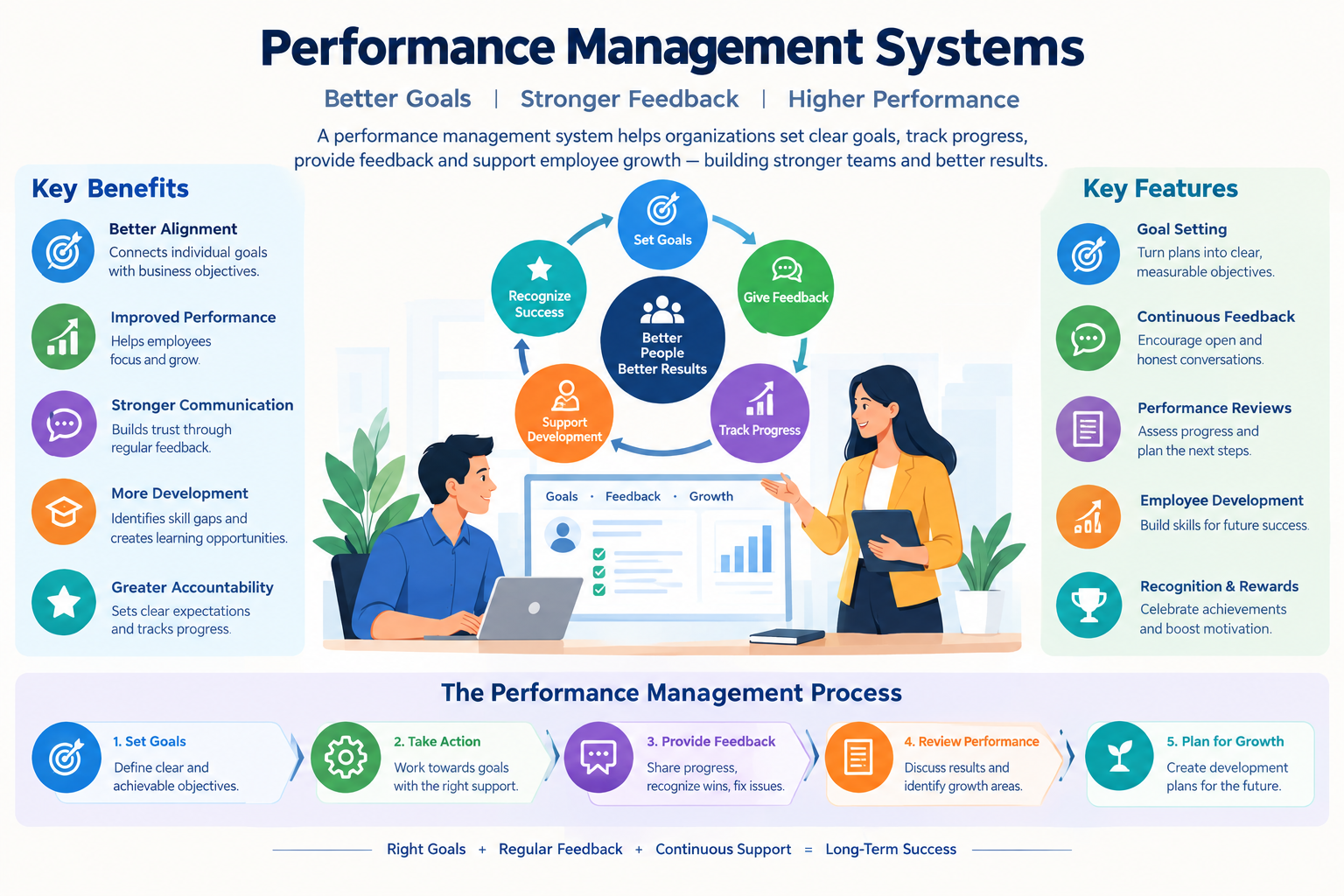
A modern performance management system usually follows a continuous cycle.
The process begins with organizational goals. These goals are then translated into team and individual objectives. Employees work toward those objectives while managers monitor progress and provide feedback.
Performance information is reviewed during regular conversations. If priorities change, goals can be updated.
At the end of a review period, managers and employees can assess results, discuss strengths and challenges, and create development plans for the next period.
This cycle can continue throughout the year.
The important point is that performance management systems should not become a form that employees complete once every twelve months.
CIPD’s current guidance emphasizes that performance management should be a continuous cycle, with regular, timely feedback and objectives that can change as business priorities change.
Key Features of Performance Management Systems
Goal Setting and Objective Management
Goal setting is one of the most important parts of performance management systems.
Employees need goals that explain what they are expected to achieve. These goals should connect with the organization’s broader priorities.
For example, a customer support team may have a company goal of improving customer satisfaction. A support employee might then have objectives related to response time, issue resolution, customer feedback, and service quality.
Goals should be measurable when measurement makes sense. However, not every job can be reduced to a simple number.
CIPD notes that performance can include task performance, behaviors that support the organization, and adaptive performance, such as responding well to change. It also warns that excessive focus on targets can become counterproductive.
This is especially important for creative and knowledge-based jobs.
Continuous Feedback
Feedback is another core part of an effective performance management system.
Instead of waiting for an annual review, managers can give employees useful feedback throughout the year.
Suppose a sales employee gives a strong presentation to a major customer. The manager can recognize the specific behavior soon after the meeting.
If the same employee struggles with follow-up communication, the manager can discuss the issue quickly and provide guidance.
This creates a feedback loop.
Regular feedback also reduces surprises during formal performance reviews because employees already know how they are doing.
CIPD’s recent guidance reflects this shift toward regular performance conversations rather than relying only on traditional annual appraisals.
Performance Reviews
Performance reviews remain an important part of performance management systems, but their role is changing.
A review should not simply produce a score.
A useful review should discuss achievements, challenges, goals, development, support, and future priorities.
The manager and employee can look at evidence from the review period and discuss what worked well and what needs improvement.
A good performance review should also create a clear path forward.
CIPD describes performance reviews as part of a broader performance management systems cycle and notes the growing focus on regular conversations and improvement rather than only judging past performance.
Employee Development
Strong performance management systems connect performance with employee development.
If an employee wants to move into a management role, the system can help identify the skills needed for that position.
The manager might recommend leadership training, project ownership, mentoring, or opportunities to lead a small team.
Development plans can also address current performance gaps.
For example, if a customer service employee needs stronger communication skills, the manager can create a development goal involving training, coaching, and regular review.
This turns performance management systems into a growth process rather than a punishment system.
Recognition and Rewards
Employees should know when their work is valued.
Recognition can be formal or informal. A manager might recognize an employee during a team meeting, give a performance award, recommend a promotion, or connect strong performance with a reward system.
However, reward systems should be designed carefully.
CIPD notes that performance-related pay can create problems when narrow targets encourage unwanted behavior or fail to capture the full meaning of good performance.
For example, if a sales employee is rewarded only for the number of sales, they may focus on closing deals without considering customer satisfaction.
A balanced system should consider both results and how those results were achieved.
Types of Performance Management Systems
Traditional Annual Performance Management Systems
Traditional systems often focus on an annual performance appraisal.
Employees and managers meet once or twice a year, review previous results, assign ratings, and discuss future goals.
This approach can provide structure, but it may fail to address problems quickly.
If an employee makes the same mistake for nine months before receiving feedback, the review comes too late to be useful.
Continuous Performance Management Systems
Continuous performance management uses regular conversations and frequent feedback.
Managers can hold monthly or quarterly check-ins instead of relying on one large annual meeting.
Employees can update goals, discuss obstacles, request support, and receive feedback throughout the year.
This approach is increasingly common because it better matches modern workplaces where priorities can change quickly.
Competency-Based Performance Management
A competency-based system evaluates both results and the skills or behaviors needed to perform a role effectively.
For example, a manager may be assessed on team leadership, communication, decision-making, coaching, and business results.
CIPD explains that competency frameworks can increase clarity around performance expectations and help connect individual performance with organizational performance when they are designed carefully.
360-Degree Performance Management
A 360-degree system collects feedback from several sources.
An employee may receive feedback from a manager, colleagues, direct reports, and sometimes customers.
This can provide a broader view of workplace behavior.
However, organizations need clear guidelines to reduce bias and ensure that feedback is useful and fair.
OKR-Based Performance Management Systems
Objectives and Key Results, commonly known as OKRs, connect ambitious objectives with measurable results.
An organization may set a major objective such as improving customer retention. Teams and individuals can then create measurable results that contribute to that objective.
OKRs can be useful in fast-moving organizations because they help connect individual work with broader strategic priorities.
Benefits of Performance Management Systems
Better Goal Alignment
One major benefit is alignment.
Employees can see how their work contributes to team and business objectives.
A software developer may not directly think about company revenue, for example. But a goal related to reducing application errors can improve customer experience and reduce support costs.
The system creates a connection between daily work and business outcomes.
Improved Employee Performance
Clear expectations and regular feedback can help employees understand where they are doing well and where they need to improve.
Managers can also provide resources, training, or coaching when performance problems appear.
Better Manager-Employee Communication
Performance management systems creates regular opportunities for meaningful conversations.
Employees can discuss challenges before they become serious problems.
Managers can also learn what prevents employees from reaching their goals.
Sometimes poor performance is not caused by a lack of effort. An employee may lack training, tools, information, authority, or time.
A good system helps uncover these issues.
More Effective Employee Development
Performance data can help organizations identify common skill gaps.
If many employees in a department need stronger data analysis skills, the company may create a training program.
This makes learning and development more connected to real business needs.
Stronger Accountability
Performance management systems creates clearer expectations.
Employees know what they are responsible for, while managers have a structured way to review progress.
Accountability does not mean constant pressure. It means people understand their responsibilities and receive support to meet them.
Real-Life Example of a Performance Management System
Consider a growing software company with 150 employees.
The company previously used an annual performance review. Employees often complained that the review did not reflect their current work because goals had changed several times during the year.
The company introduces a continuous performance management system.
At the start of each quarter, employees and managers agree on three or four major goals. Employees update their progress during the quarter, while managers hold short monthly check-ins.
A developer might have a goal related to improving application reliability. A customer support employee might have a goal related to reducing response time while maintaining customer satisfaction.
At the end of the quarter, the manager and employee review the results.
If business priorities have changed, the next quarter’s goals can be adjusted.
The company still conducts a formal annual review, but it is now based on information and conversations collected throughout the year.
This approach gives managers a clearer picture of performance and gives employees more chances to improve.
Common Problems With Performance Management Systems
Unclear Goals
A system cannot solve unclear expectations.
If employees receive vague goals, performance data will not provide much value.
Goals should be understandable, relevant, and connected to the employee’s role.
Too Much Focus on Numbers
Numbers are useful, but they do not tell the entire story.
A customer support agent might close many tickets but provide poor customer service.
A salesperson might exceed a sales target but create long-term customer problems by making unrealistic promises.
Performance systems should balance measurable outcomes with quality and appropriate workplace behaviors.
Infrequent Feedback
A company may have advanced performance management systems software but still fail if managers do not communicate with employees.
Technology can remind managers about reviews, but meaningful feedback still requires human judgment.
Poor Manager Training
Managers need skills to set goals, give feedback, conduct difficult conversations, recognize good work, and handle underperformance.
Without manager training, even a well-designed performance management system can fail.
CIPD identifies managers as central to effective performance management systems and emphasizes the need for managers to be supported and equipped to manage performance well.
Employee Resistance
Employees may resist a new system if they believe it exists only to monitor or punish them.
Organizations should explain why the system is being introduced and how it will support employees.
Transparency can make adoption easier.
How to Choose the Right Performance Management Software
Organizations should choose software based on their actual needs rather than selecting the platform with the longest feature list.
A small company may need simple goal tracking, employee reviews, feedback, and development plans.
A larger organization may need advanced reporting, competency frameworks, workforce analytics, integrations with HR systems, and different workflows for different departments.
Ease of use is also important.
If managers need twenty steps to record a simple feedback conversation, they may stop using the system.
Organizations should also consider data security, access controls, reporting, mobile access, integrations, customization, employee experience, and scalability.
Before buying software, it is useful to define the performance process first.
Then the organization can select technology that supports that process.
How AI Is Changing Performance Management Systems
Artificial intelligence is becoming more relevant to HR technology, including performance management.
AI can help analyze large amounts of performance information, identify patterns, summarize feedback, suggest development resources, and support managers with insights.
However, AI should not automatically decide an employee’s future.
Performance decisions can affect promotions, compensation, career opportunities, and employment. Human review is therefore essential.
Organizations also need to consider privacy, bias, transparency, data quality, and appropriate use of employee information.
AI can support managers, but it should not replace thoughtful conversations between managers and employees.
How to Implement a Performance Management System
The first step is to define what the organization wants to improve.
The company might want clearer goals, better employee development, stronger accountability, more frequent feedback, or better alignment with business strategy.
Next, define the performance cycle.
Decide how goals will be created, how often managers will check progress, when formal reviews will happen, and how development plans will be handled.
The organization should then train managers.
Managers need to know how to set useful goals, give specific feedback, document performance, recognize achievement, and handle performance problems fairly.
After that, introduce the technology.
Employees should receive clear instructions and understand what information will be recorded and how it will be used.
Finally, measure whether the new system is working.
Organizations can look at participation rates, goal completion, employee feedback, manager adoption, development activity, and other relevant measures.
The process should then be improved based on evidence.
Measuring the Success of Performance Management
A performance management system should be evaluated like any other business process.
Organizations can examine whether employees understand their goals and whether managers are holding regular performance management systems conversations.
They can also track whether development plans are being completed and whether employees report receiving useful feedback.
Business outcomes can provide another layer of evidence.
Depending on the organization, these may include productivity, customer satisfaction, quality, employee retention, sales performance, project delivery, or other relevant measures.
There is no universal metric that proves a performance management system works.
The measures should match the organization’s goals and the nature of the work.
CIPD also warns that performance management systems measures need to be carefully chosen because excessive or poorly designed targets can become counterproductive.
The Future of Performance Management Systems
The future of performance management systems is moving toward more continuous, flexible, and data-informed processes.
Annual reviews are not necessarily disappearing, but organizations are increasingly placing greater value on regular conversations and ongoing development.
CIPD’s 2026 guidance identifies a shift toward continuous performance discussions, less emphasis on lengthy review processes, and greater focus on helping employees improve.
AI will likely add new capabilities to performance management platforms, but human judgment will remain important.
The strongest systems will not simply collect more employee data. They will help managers use useful information to have better conversations and make better decisions.
Conclusion
Performance management systems can help businesses turn employee goals into measurable business progress. They bring together goal setting, feedback, performance reviews, development, recognition, and accountability in a structured process.
The most effective systems are not built around annual forms. They create an ongoing cycle where employees know what is expected, managers provide timely feedback, and goals can change as business needs change.
Technology can make this process easier, but the human side remains essential. Managers need to communicate clearly, employees need opportunities to grow, and performance measures need to reflect real work rather than simply producing numbers.
If your organization still depends on a once-a-year performance review, now is a good time to examine the process. Start by defining clear goals, introduce regular check-ins, train managers to give useful feedback, and choose technology that supports your approach.
Ready to improve employee performance? Build a performance management system that connects clear goals, continuous feedback, employee development, and business results—and turn performance management into an ongoing tool for growth.
Frequently Asked Questions About Performance Management Systems
What is a performance management system?
A performance management system is a structured process or software solution that helps organizations set employee goals, track progress, provide feedback, conduct performance reviews, support development, and manage performance.
What is the main purpose of a performance management system?
The main purpose is to align employee performance with organizational goals while helping employees understand expectations, improve their skills, receive feedback, and contribute more effectively.
What are the main components of performance management?
Common components include goal setting, performance tracking, continuous feedback, performance reviews, employee development, recognition, coaching, and performance improvement plans.
Are performance management systems the same as performance reviews?
No. A performance review is one part of performance management. Performance management is a broader, ongoing process that includes goals, feedback, development, reviews, recognition, and accountability.
How often should performance reviews happen?
There is no single schedule that works for every organization. Many modern approaches use regular check-ins throughout the year, supported by more formal reviews at suitable intervals. The right schedule depends on the organization, role, and business needs.
What are the benefits of performance management software?
Performance management software can centralize employee goals, feedback, reviews, development plans, performance records, and reporting. It can also automate reminders and make it easier for managers and employees to track progress.
What are SMART goals in performance management?
SMART goals are goals designed to be Specific, Measurable, Achievable, Relevant, and Time-bound. They can help clarify expectations, although not every type of work should be measured through rigid targets.
Can performance management improve employee engagement?
A well-designed process can support engagement by giving employees clear expectations, useful feedback, development opportunities, recognition, and stronger communication with managers. However, software alone does not guarantee higher engagement.
How does AI help performance management?
AI can help analyze performance information, summarize feedback, identify patterns, suggest development opportunities, and support managers with insights. Human review remains important because performance decisions can have significant effects on employees.
What makes a performance management system effective?
An effective system combines clear goals, regular communication, useful feedback, fair performance evaluation, employee development, trained managers, appropriate measures, and technology that is easy to use. The process should be continuous and connected to real business goals.
