
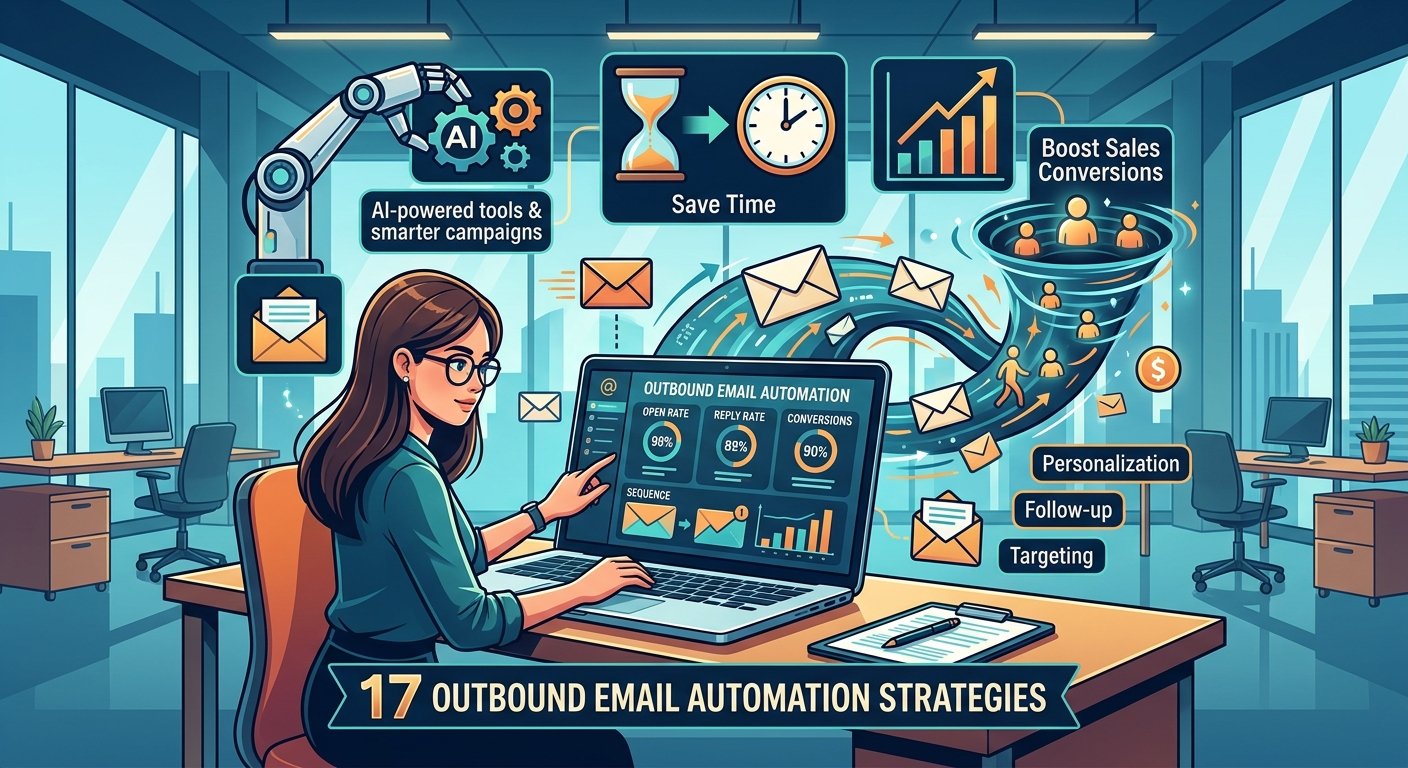
Discover 17 outbound email automation strategies for 2026 to improve targeting, personalize campaigns, save time, generate leads, and increase sales.
Outbound Email Automation
Introduction
Outbound email automation can help businesses reach potential customers consistently without spending hours sending and managing every message manually. In 2026, modern automation tools make it easier to personalize emails, segment prospects, follow up at the right time, and track campaign performance. By using the right outbound email automation strategies, businesses can build stronger prospect relationships, generate qualified leads, and create more opportunities for sales and conversions.
Reaching the right people at the right time is one of the biggest challenges in digital marketing. Many businesses struggle to connect with potential clients because manual outreach is slow, inconsistent, and difficult to scale. This is where outbound email automation changes everything.
Outbound email automation has become one of the most effective ways for businesses to reach potential customers, build relationships, and generate more sales opportunities. In 2026, companies are using AI-powered tools, personalization, and smart automation workflows to improve email outreach and increase conversion rates. This guide covers 17 proven outbound email automation strategies that can help businesses save time, improve engagement, and turn more prospects into loyal customers.
Outbound email automation allows you to send personalized emails to hundreds or even thousands of prospects without doing everything manually. It helps you stay consistent, save time, and improve your chances of getting replies.
In 2026, businesses that rely on smart systems instead of manual effort are growing faster. Whether you are a freelancer, a startup founder, or running a best account based marketing marketing agency, outbound email automation can become your most powerful growth tool.
This guide will help you understand how it works, how to use it effectively, and how to turn your email campaigns into a reliable source of leads and revenue.
What Is Outbound Email Automation
Outbound email automation is the process of sending emails automatically to a targeted group of people using specialized tools. These emails are not random. They are part of a structured sequence designed to start conversations, build trust, and convert prospects into customers.
Instead of writing each email one by one, you create a sequence in advance. The system then sends emails at specific times based on your settings. If a person does not reply, the system sends a follow-up automatically.
This approach ensures that every lead gets proper attention without requiring constant manual effort.
Why Outbound Email Automation Is Important in 2026
The digital world is becoming more competitive every day. Businesses are fighting for attention, and customers are receiving more messages than ever before. In such an environment, consistency and relevance are key.
Outbound email automation helps you maintain both.
It allows you to reach a larger audience without increasing your workload. It also ensures that your messaging remains consistent across all prospects.
Studies show that automated email campaigns can increase reply rates significantly when combined with personalization. Businesses using automation often report higher engagement and better conversion rates compared to manual outreach.
Another important factor is scalability. Manual outreach may work for small campaigns, but it becomes impossible to manage as your business grows. Automation solves this problem by handling large volumes of communication efficiently.
How Outbound Email Automation Works
The process of outbound email automation is simple but highly effective when executed properly.
First, you build a list of potential prospects. These could be business owners, decision-makers, or individuals interested in your product or service.
Next, you create an email sequence. This sequence usually includes an introduction email, one or more follow-ups, and a closing message.
Then, you use an automation tool to send these emails at scheduled intervals. The tool tracks important metrics such as open rates, click rates, and replies.
Based on these insights, you can adjust your campaign to improve performance.
This cycle of testing and improving is what makes outbound email automation so powerful.
Benefits of Outbound Email Automation
One of the biggest benefits is time-saving. Instead of sending emails manually, you can focus on strategy and content creation.
Another advantage is consistency. Every prospect receives a well-crafted message, which helps build a professional image.
Automation also improves follow-ups. Many deals are closed after multiple follow-ups, and automation ensures that you never miss these opportunities.
It also provides valuable data. You can see what works and what does not, allowing you to refine your campaigns over time.
Creating a High-Converting Email Sequence
Writing a Strong First Email
The first email is your first impression. It should be clear, short, and focused on the recipient.
Avoid long introductions. Get straight to the point and explain why you are reaching out.
Focus on value. Show how you can solve a problem or improve their situation.
A good first email increases the chances of getting a reply.
Crafting Effective Follow-Ups
Follow-ups are where most conversions happen.
Many people do not respond to the first email, but they may reply after a reminder. This is why follow-ups are essential.
Keep them polite and helpful. Do not sound desperate or pushy.
Each follow-up should add some value, such as a new insight or a different angle.
Spacing is important. Sending emails too frequently can annoy prospects, while sending them too late can reduce effectiveness.
Personalization for Better Results
Personalization is the key to success in outbound email automation.
Generic emails are easy to ignore. Personalized emails feel more relevant and engaging.
You can personalize emails by using the recipient’s name, company, or specific details about their work.
Advanced tools allow you to add dynamic fields, making personalization easier even at scale.
When done correctly, personalization can significantly increase reply rates.
Best Practices for Outbound Email Automation
Simplicity works best. Keep your emails easy to read and understand.
Focus on one goal per email. Trying to achieve too much in a single message can confuse the reader.
Use clear subject lines. A strong subject line increases the chances of your email being opened.
Test different versions of your emails. Small changes in wording or timing can make a big difference.
Always provide value. People are more likely to respond when they see a clear benefit.
Real-Life Example of Success
A small SaaS company wanted to increase its customer base. They decided to use outbound email automation instead of traditional marketing.
They created a targeted list of businesses and designed a simple email sequence.
Within a few months, they saw a noticeable increase in engagement. Their reply rate improved, and they were able to convert several leads into paying customers.
This example shows that even small businesses can achieve significant results with the right strategy.
Common Mistakes to Avoid
One common mistake is sending irrelevant emails. If your message does not match the recipient’s needs, it will not get a response.
Another mistake is over-automation. Relying too much on automation without personalization can make your emails feel robotic.
Ignoring follow-ups is also a major issue. Many people give up too early and miss potential opportunities.
Poor subject lines can reduce open rates. Even a great email will not perform well if it is not opened.
Outbound Email Automation for Different Use Cases
Outbound email automation can be used in many ways.
Freelancers use it to find clients.
Agencies use it to generate leads.
Tech bloggers use it for outreach and partnerships.
Businesses use it to promote products and services.
Each use case requires a slightly different approach, but the core principles remain the same.
Tools That Help With Email Automation
There are many tools available that simplify outbound email automation.
These tools help you manage contacts, create email sequences, and track performance.
Some tools are designed for beginners, while others offer advanced features for larger campaigns.
Choosing the right tool depends on your goals and experience level.
Measuring and Improving Performance
To succeed with outbound email automation, you need to track your results.
Key metrics include open rates, reply rates, and conversion rates.
If your open rate is low, you may need to improve your subject lines.
If your reply rate is low, your email content may need improvement.
Continuous testing and optimization are essential for long-term success.
Future of Outbound Email Automation
The future of outbound email automation is closely linked with AI.
Automation tools are becoming smarter and more efficient.
They can analyze data, predict user behavior, and create more personalized experiences.
This will make email campaigns even more effective.
Businesses that adopt these technologies early will have a competitive advantage.
Conclusion
Outbound email automation is a powerful way to grow your business in 2026.
It allows you to reach more people, save time, and improve your results.
By focusing on personalization, consistency, and value, you can create campaigns that generate real leads and conversions.
Start with a simple strategy, test your approach, and keep improving.
The sooner you begin, the sooner you will see results.
Take action today and build your first outbound email automation campaign.
FAQs
What is outbound email automation
Outbound email automation is the process of sending automated emails to potential clients using software tools to save time and improve efficiency.
Is outbound email automation effective
Yes, it is highly effective when combined with personalization and proper targeting.
How many emails should be in a sequence
A typical sequence includes three to five emails, including follow-ups.
How long does it take to see results
Results can appear within a few weeks, but consistent effort leads to better outcomes over time.
Can beginners use outbound email automation
Yes, many tools are beginner-friendly and make it easy to get started.
