

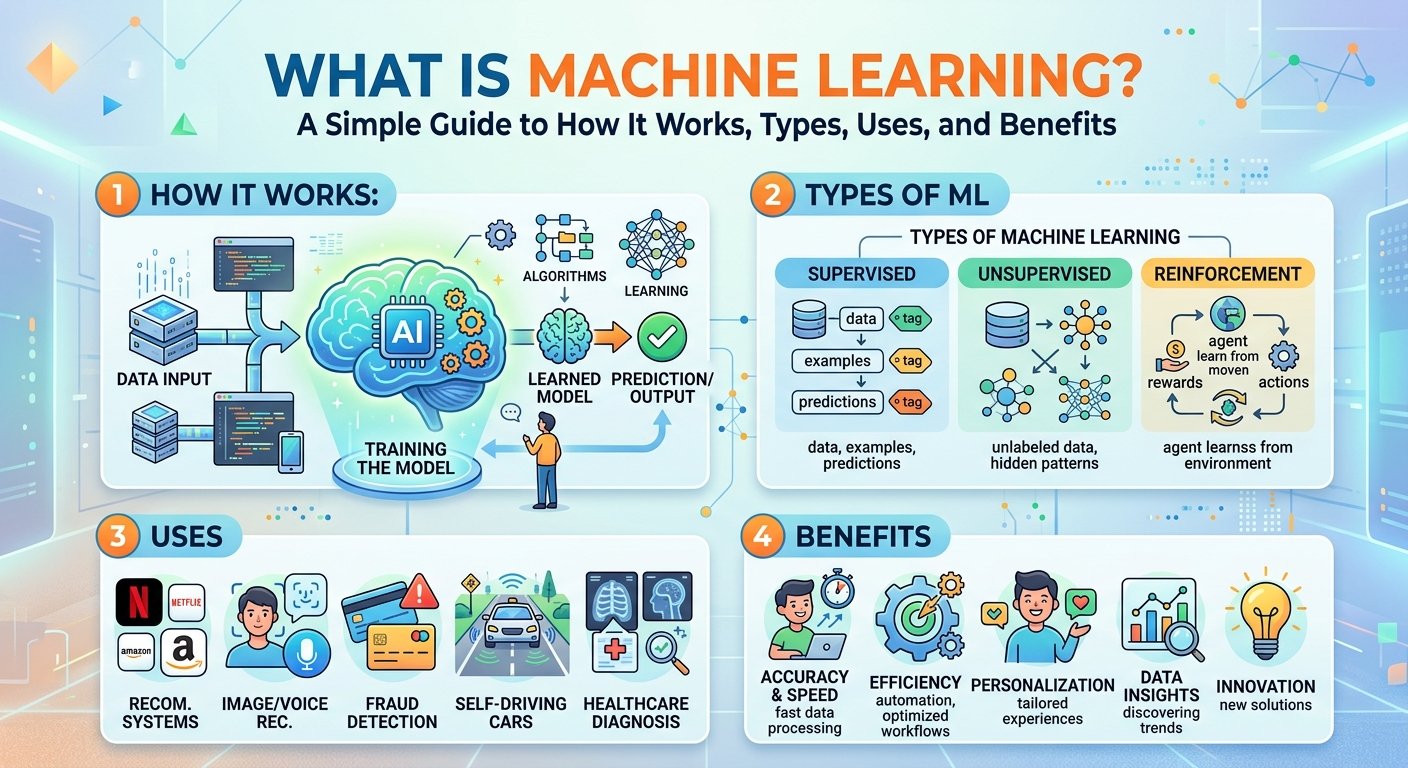
Learn what machine learning is, how it works, its main types, real-world uses, key benefits, and why it matters for modern technology.
Introduction
Machine learning is a major part of modern artificial intelligence that allows computers to learn from data and improve their performance without being explicitly programmed for every task. It is used in many everyday technologies, from recommendation systems and voice assistants to fraud detection and image recognition. Understanding what machine learning is can help beginners see how intelligent systems make predictions and support automated decisions. This guide explains its key facts, types, common uses, and benefits in simple terms.
Machines learning is one of the most important technologies behind the digital tools we use every day. When Netflix recommends a movie, Google filters spam, or a phone recognizes your face, machine learning may be working in the background.
But what is machine learning, exactly?
In simple words, machne learning is a way to teach computers to learn from data and improve their performance without giving them a separate instruction for every possible situation. Instead of following only fixed rules, a machine learning system finds patterns in data and uses those patterns to make predictions or decisions.
Machines learning is now used in business, healthcare, banking, education, cybersecurity, transportation, marketing, and many other fields. It is also a major part of artificial intelligence and is helping businesses automate tasks that once required a lot of human effort.
This guide explains what machine learning means, how it works, the main types of machine learning, real-world examples, benefits, limitations, and what the future may look like.
What Is Machine Learning?
Machine learning is a branch of artificial intelligence that allows computers to learn patterns from data and use those patterns to make predictions, recommendations, classifications, or decisions.
Traditional software usually works with a simple structure: a programmer creates rules, the computer follows those rules, and the system produces an output.
For a deeper explanation of machine learning, its types, algorithms, and real-world applications, you can explore this detailed guide from IBM: What Is Machine Learning?.
Machine learning takes a different approach. Instead of manually creating every rule, developers provide data and an appropriate learning method. The machine learning model studies the data and learns relationships within it.
For example, imagine you want a computer to identify spam emails. You could try to create hundreds of rules such as checking for certain words, suspicious links, or unusual senders. However, spam can change over time.
With machne learning, you can train a model using examples of spam and legitimate emails. The model can learn patterns that often appear in spam messages. When a new email arrives, it can estimate whether that email is likely to be spam.
This is why machine learning is so useful. It can handle situations where writing every possible rule would be difficult or impossible.
How Does Machine Learning Work?
Machine learning may sound complicated, but its basic process is easier to understand.
A machine learning system starts with data. The data could be text, images, numbers, audio, videos, customer records, or other information.
The system then uses an algorithm to find patterns in that data. These patterns are used to create a machine learning model.
Once trained, the model can receive new information and produce an output.
For example, suppose an online store wants to predict whether a customer will buy a product. The company could provide historical information such as previous purchases, browsing activity, product categories, and purchase frequency.
The model studies these examples and learns relationships between customer behavior and purchases.
When a new customer visits the website, the model can use available information to predict which products might interest that customer.
The prediction is not always correct. Machne learning works with probabilities and patterns rather than perfect knowledge. The quality of the result depends heavily on the quality and amount of data used to train the model.
What Is the Difference Between AI and Machine Learning?
Artificial intelligence and machine learning are closely related, but they are not exactly the same thing.
Artificial intelligence is the broader field. It focuses on creating systems that can perform tasks that normally require human intelligence, such as understanding language, recognizing images, solving problems, planning, and making decisions.
Machne learning is one method used to build AI systems.
A simple way to understand the relationship is this: artificial intelligence is the larger concept, while machine learning is one of the technologies used to achieve it.
Not every AI system has to learn from data in the same way. Some systems can use predefined rules, logic, search methods, or other techniques.
Machine learning has become a major part of modern AI because it allows systems to learn from large amounts of information.
What Are the Main Types of Machine Learning?
Machne learning is commonly divided into supervised learning, unsupervised learning, semi-supervised learning, and reinforcement learning.
Supervised Learning
Supervised learning uses labeled training data.
This means the system receives examples where the desired answer is already known.
For example, imagine training a model to recognize cats and dogs. You could provide thousands of images labeled “cat” or “dog.” The model studies the images and learns patterns associated with each category.
After training, you can give it a new image. The model can then predict whether the image contains a cat or a dog.
Supervised learning is widely used for classification and prediction.
It can help predict customer churn, classify emails, estimate prices, identify fraudulent transactions, and forecast demand.
Unsupervised Learning
Unsupervised learning works with data that does not have predefined labels.
The goal is often to discover hidden patterns or groups within the data.
For example, an online business may have information about thousands of customers but may not know how to divide them into useful groups.
An unsupervised learning algorithm can analyze customer behavior and identify groups with similar characteristics.
One common use is customer segmentation. A business might discover one group of customers that frequently buys premium products and another group that mainly responds to discounts.
This information can help businesses create more targeted marketing strategies.
Semi-Supervised Learning
Semi-supervised learning combines labeled and unlabeled data.
This approach can be useful when obtaining labels for every piece of data is expensive or time-consuming.
For example, a company might have 10,000 images but only 1,000 of them have been manually labeled. A semi-supervised approach can use the labeled images along with the larger collection of unlabeled images.
This can help the model learn more effectively without requiring humans to label every example.
Reinforcement Learning
Reinforcement learning is based on interaction and feedback.
An agent performs an action in an environment and receives feedback. Good actions can receive a reward, while poor actions can receive a negative result.
Over time, the system learns which actions are more likely to produce useful outcomes.
Reinforcement learning has been used in areas such as robotics, game-playing systems, resource management, and some optimization problems.
A simple example is a computer learning to play a game. It tries different actions and learns from the results.
What Is a Machine Learning Model?
A machne learning model is a trained system that has learned patterns from data.
Think of the model as the part that turns learned patterns into useful predictions.
Suppose you want to predict house prices. You might train a model using information about previous houses, including their size, location, number of rooms, age, and sale price.
After learning from historical examples, the model can estimate the price of another house based on its characteristics.
The model does not simply memorize one answer. A well-designed model attempts to learn patterns that can be applied to new data.
What Is Training in Machine Learning?
Training is the process of teaching a machine learning model using data.
During training, the model makes predictions and compares those predictions with the available information. Depending on the learning method, the system adjusts its internal parameters to improve its performance.
This process can happen many times.
For example, if a model is learning to identify images, it may process thousands or millions of examples. Each training step can help the model improve its ability to recognize relevant patterns.
Training can require significant computing power, especially for large models and complex tasks.
What Is Machine Learning Data?
Data is the foundation of machine learning.
A model cannot learn useful patterns without suitable information. Data may include numbers, text, images, audio, video, customer records, sensor readings, or website activity.
For example, a bank could use transaction data to develop systems that identify unusual activity.
A healthcare organization could use medical images to train an image recognition system.
An ecommerce company could use browsing and purchasing behavior to create recommendation systems.
The important point is that machne learning quality depends strongly on data quality.
Poor, incomplete, biased, or incorrect data can lead to poor predictions.
What Is Deep Learning?
Deep learning is a specialized area of machine learning that uses neural networks with multiple layers.
These networks are designed to learn complex patterns from large amounts of data.
Deep learning has played an important role in modern advances in computer vision, speech recognition, natural language processing, and generative AI.
For example, deep learning can help a system identify objects in images. It can also help computers process human language and recognize spoken words.
Deep learning often requires substantial amounts of training data and computing resources, especially for large models.
What Are Neural Networks?
Neural networks are machne learning models inspired loosely by the way biological nervous systems process information.
They contain connected computational units arranged into layers.
The input layer receives information. Hidden layers process patterns, and the output layer produces a result.
For example, when a neural network analyzes an image, early layers may learn simple visual features. Later layers can combine those features into more complex patterns.
Modern neural networks can contain many layers and millions or even billions of adjustable parameters.
They are widely used in computer vision, language processing, speech recognition, recommendation systems, and other AI applications.
Real-World Examples of Machine Learning
Machine learning is already part of many everyday technologies.
Search Engines
Search engines use machne learning to understand queries, identify useful information, and improve search results.
When you type a question into a search engine, the system needs to interpret what you mean and determine which results are likely to be useful.
Machine learning can help with this process.
Streaming Recommendations
Streaming platforms use recommendation systems to suggest movies, shows, songs, or other content.
These systems can consider viewing history, listening habits, ratings, and interactions with content.
The goal is to predict what a user may want to watch or listen to next.
Online Shopping
Ecommerce websites use machne learning to recommend products, detect unusual activity, predict demand, personalize search results, and improve customer experiences.
For example, if a customer repeatedly views a particular product category, a recommendation system may suggest similar products.
Email Spam Detection
Spam filters use machine learning techniques to identify suspicious emails.
The system can analyze patterns in messages, senders, links, and other signals to estimate whether a message is legitimate or unwanted.
Fraud Detection
Banks and payment companies can use machne learning to identify unusual transactions.
A model can learn normal patterns and flag transactions that appear significantly different.
For example, a sudden unusual purchase may receive additional attention.
Machine learning does not automatically prove that a transaction is fraudulent. Instead, it can help identify activity that deserves further review.
Healthcare
Machine learning is being explored and used in areas such as medical imaging, risk prediction, drug research, and clinical decision support.
For example, machine learning models can analyze medical images to help identify patterns that may be difficult to detect quickly.
However, healthcare applications require strong testing, expert oversight, privacy protection, and careful validation.
Cybersecurity
Cybersecurity systems can use machine learning to identify unusual network activity, suspicious behavior, and potential threats.
Attackers often change their methods, so systems that can learn patterns can be valuable for security teams.
Transportation
Machine learning can support route planning, traffic prediction, demand forecasting, driver assistance, and other transportation applications.
Ride-sharing services, for example, can use predictive models to estimate demand in different areas.
Why Is Machine Learning Important?
Machine learning is important because modern organizations generate enormous amounts of data.
Humans cannot manually examine every piece of information at scale. Machne learning can process large datasets and identify patterns that can support decisions.
It can also automate repetitive tasks and improve personalization.
For businesses, this may mean faster analysis, better customer experiences, improved forecasting, and more efficient operations.
For consumers, machine learning can make digital products more convenient.
The technology is not valuable simply because it is “smart.” Its real value comes from solving useful problems with reliable data and appropriate methods.
Benefits of Machine Learning
Machine learning can provide several practical benefits.
One major benefit is automation. Tasks that require repeated analysis can sometimes be handled by trained models.
Another benefit is speed. A machne learning system can analyze huge amounts of information much faster than a person performing the same task manually.
Machine learning can also support personalization. Businesses can use models to provide recommendations based on individual behavior.
It can improve prediction as well. Companies can use historical data to forecast demand, identify risks, and estimate future outcomes.
Machine learning can also help discover patterns that humans might overlook, especially when working with large and complex datasets.
What Are the Challenges of Machine Learning?
Machine learning has many benefits, but it also has limitations.
One major challenge is data quality. If training data contains errors or strong bias, the model may produce unreliable results.
Another challenge is overfitting. This can happen when a model learns the training data too closely and performs poorly on new data.
Privacy is also important. Machne learning systems may process sensitive information, so organizations need appropriate security and data protection practices.
Some models can also be difficult to explain. If users cannot understand why a system made a particular prediction, it may create trust and accountability problems.
Cost can be another issue. Large machine learning systems may require expensive computing resources, skilled professionals, and ongoing maintenance.
What Is Machine Learning Used for in Business?
Businesses use machine learning in many ways.
Marketing teams can use predictive models to understand customer behavior and improve campaign targeting.
Sales teams can use machne learning to identify leads that may be more likely to convert.
Customer service teams can use AI-powered systems to classify requests and provide automated support.
Financial teams can use predictive models for forecasting and risk analysis.
Operations teams can use machine learning to predict demand and improve resource planning.
For example, a retailer could analyze years of sales data to estimate how many products it may need during a holiday season. Better forecasting can reduce both excess inventory and stock shortages.
Machine Learning and Generative AI
Generative AI is another major area where machine learning plays an important role.
Generative AI systems can create text, images, audio, video, software code, and other content.
Large AI models learn patterns from very large datasets during training. After training, they can generate new outputs based on user instructions.
This has created new possibilities for content creation, software development, education, customer service, research, and business automation.
However, generated content can contain mistakes. Human review remains important when accuracy matters.
Is Machine Learning the Same as Automation?
Machine learning and automation are related but different.
Traditional automation follows predefined rules.
For example, a system might automatically send an email when a customer submits a form.
Machne learning can make automation more adaptive. Instead of following only fixed instructions, a model can use learned patterns to predict what might happen or decide which action is more appropriate.
This makes machine learning useful for complex tasks where simple rules may not be enough.
What Skills Are Needed to Learn Machine Learning?
People who want to learn machine learning can start with basic programming and mathematics.
Python is one of the most widely used programming languages in machine learning.
Basic knowledge of statistics, probability, algebra, and data analysis can also help.
Beginners should not feel that they need to master advanced mathematics before starting. A practical learning path can begin with simple concepts such as datasets, variables, predictions, training, testing, and model evaluation.
After learning the fundamentals, students can explore popular machin learning libraries and frameworks.
Practical projects are especially useful because they turn theoretical ideas into real skills.
The Future of Machine Learning
Machine learning is likely to remain an important part of technology for years to come.
As computing power improves and more data becomes available, machine learning systems may become more capable and efficient.
Businesses are likely to continue using machine learning for automation, forecasting, personalization, fraud detection, cybersecurity, and customer support.
At the same time, responsible development will become increasingly important. Organizations need to consider privacy, security, fairness, transparency, reliability, and human oversight.
The future of machine learning is not only about creating more powerful models. It is also about using those models safely and effectively.
Frequently Asked Questions About Machine Learning
What is machine learning in simple words?
Machine learning is a technology that allows computers to learn patterns from data and use those patterns to make predictions or decisions without being explicitly programmed for every situation.
What is machine learning with an example?
A spam filter is a simple example. A machin learning model can study examples of spam and legitimate emails and learn patterns that help it predict whether a new email is likely to be spam.
Is machine learning AI?
Yes. Machine learning is a major branch or approach within artificial intelligence. AI is the broader field, while machine learning focuses on systems that learn patterns from data.
What are the four types of machine learning?
The four commonly discussed types are supervised learning, unsupervised learning, semi-supervised learning, and reinforcement learning.
Is machine learning hard to learn?
Machine learning can become advanced, but beginners can learn the basic concepts step by step. Starting with Python, basic statistics, data handling, and simple projects can make the subject easier to understand.
Where is machine learning used?
Machne learning is used in search engines, recommendation systems, banking, healthcare, cybersecurity, ecommerce, marketing, transportation, manufacturing, education, and many other areas.
What is the difference between AI and ML?
AI is the broader concept of creating systems that perform tasks associated with intelligence. Machines learning is a technique that allows systems to learn patterns from data.
Why is data important in machine learning?
Data provides the examples from which a machne learning model learns. High-quality and relevant data can help produce better results, while poor data can lead to inaccurate or biased predictions.
Conclusion
So, what is machine learning?
Machine learning is a powerful technology that allows computers to learn from data and use what they learn to make predictions, recognize patterns, and support decisions. From spam filters and product recommendations to fraud detection and advanced AI systems, machine learning is already part of many technologies we use every day.
Its biggest strength is its ability to work with large amounts of data and find useful patterns. But machne learning is not magic. Good results require good data, suitable models, careful testing, and responsible use.
If you are interested in AI and technology, learning machne learning is a valuable step. Start with the basics, practice with small datasets, build simple projects, and gradually move toward more advanced concepts. The sooner you understand how machine learning works, the better prepared you will be for a technology-driven future.
