

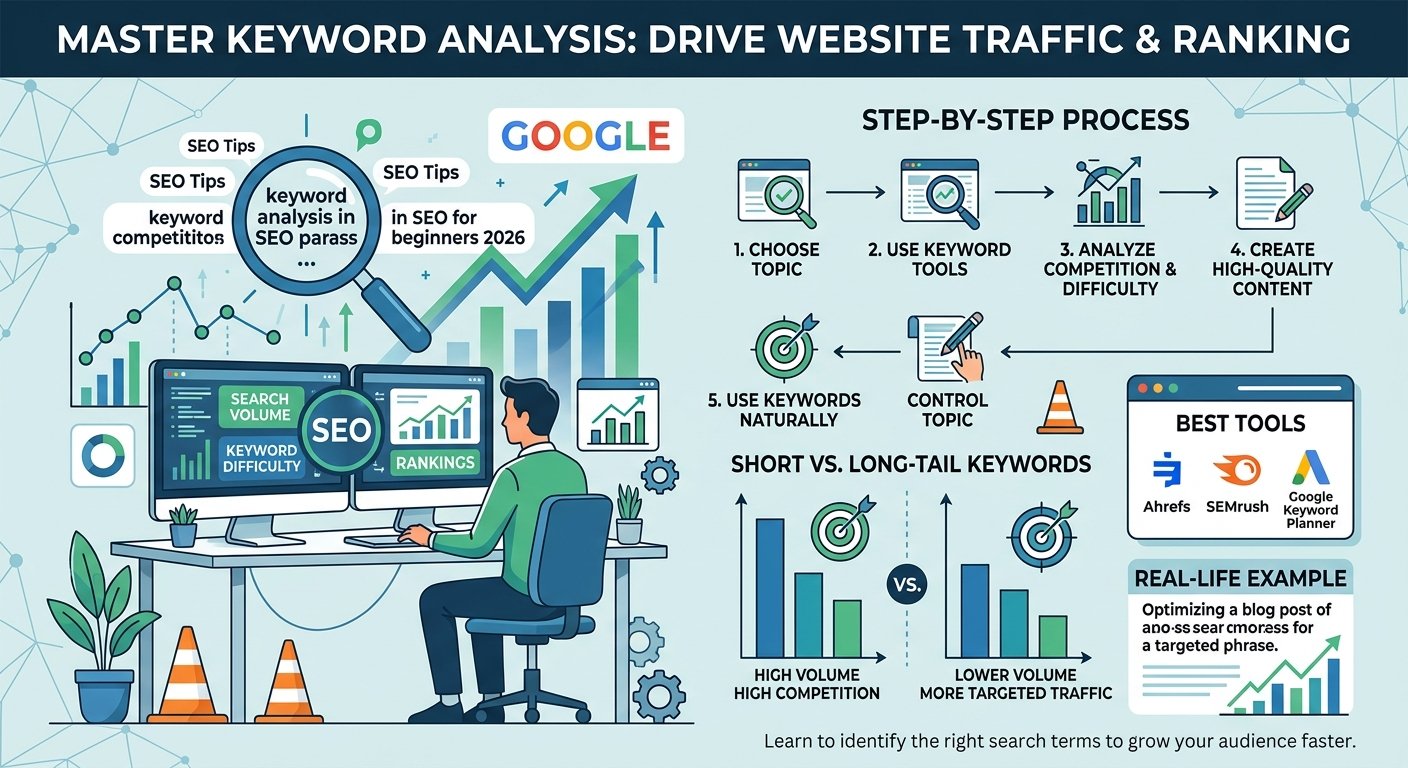
Learn what keyword analysis in SEO is and discover 15 powerful strategies to find relevant keywords, understand search intent, and improve rankings in 2026.
Introduction
Keyword analysis in SEO is one of the most important steps in creating a successful search strategy. It helps businesses and content creators discover what people search for, understand their search intent, and choose relevant terms to target in their content. In 2026, effective keyword analysis goes beyond simply finding keywords with high search volume. It also considers competition, relevance, user intent, trends, and the overall value a keyword can bring to a website. By using a smarter approach, businesses can create content that attracts the right audience and improves organic visibility.
If you want your website to appear on Google and attract the right audience, you need more than just good content. You need the right strategy behind that content. This is where keyword analysis in SEO becomes essential. It helps you understand what people are searching for and how you can position your content to meet those needs.
Many beginners create articles without researching keywords, and as a result, their content never gets traffic. On the other hand, websites that perform proper keyword analysis often rank higher, gain consistent visitors, and grow faster. In this guide, you will learn everything about keyword analysis in a simple and practical way so you can apply it immediately.
What Is Keyword Analysis in SEO
Keyword analysis in SEO is the process of researching, evaluating, and selecting the best search terms that people use on search engines like Google. These keywords are then used strategically in your content to improve visibility and rankings.
The goal is not just to find popular keywords, but to identify the ones that match your content, have manageable competition, and bring the right audience to your site. It is a mix of data analysis and understanding user behaviour.
Why Keyword Analysis Matters
Keyword analysis in SEO is the foundation of SEO. Without it, your content is like a shop in the desert where no one visits. With the right keywords, your content becomes visible to people who are actively searching for your topic.
It helps you target the right audience, improve search rankings, and increase organic traffic. It also ensures that your content answers real user questions instead of guessing what people might want.
For example, writing an article about “SEO tips” is very broad and competitive. But targeting “SEO tips for beginners in 2026” is more specific and easier to rank.
Understanding Search Intent
One of the most important parts of keyword analysis in SEO is understanding search intent. This means knowing why someone is searching for a particular keyword.
Some users want information, such as learning a concept. Others want to compare tools or make a purchase. If your content matches the user’s intent, Google is more likely to rank it higher.
For instance, someone searching “what is keyword analysis in SEO” wants a clear explanation. But someone searching “best SEO tools” is likely looking for recommendations.
Types of Keywords You Should Know
Not all keywords are the same. Each type serves a different purpose in your content strategy.
Short keywords are broad and usually have high competition. They bring a lot of traffic but are harder to rank for.
Long-tail keywords are more specific and often easier to rank. They may have lower search volume, but they bring targeted visitors who are more likely to engage.
There are also informational keywords used for learning, and commercial keywords used when users are ready to buy or compare services. A balanced strategy includes a mix of all types.
Key Factors in Keyword Analysis
When analysing keywords, several factors determine whether a keyword is worth targeting.
Search volume shows how many people search for that keyword each month. Higher volume means more potential traffic, but often more competition.
Keyword difficulty indicates how hard it is to rank for a keyword. Beginners should focus on low to medium difficulty keywords.
Competition refers to the quality of websites already ranking for that keyword. If top results are dominated by strong authority sites, ranking becomes harder.
Relevance ensures that the keyword matches your content and audience. Even a high-volume keyword is useless if it does not fit your niche.
How to Do Keyword Analysis Step by Step
The process of keyword analysis in SEO becomes easier when you follow a clear structure.
Start by choosing a topic related to your niche. For example, if your site is about AI and technology, pick a topic like AI tools or SEO basics.
Then use keyword research tools to generate ideas. These tools provide data on search volume, competition, and keyword variations.
After collecting keywords, filter them based on difficulty and relevance. Focus on keywords that have decent search volume but lower competition.
Next, search your chosen keyword on Google and analyse the top results. Look at what type of content is ranking and how you can create something better.
According to Ahrefs Keyword Research Guide, keyword research is the foundation of SEO.
Finally, use the keyword naturally in your article, including the title, headings, and content.
Best Tools for Keyword Analysis
There are many tools available that can help you perform keyword analysis effectively. Some tools provide detailed insights, while others are simple and beginner-friendly.
Popular tools include Ahrefs, SEMrush, and Ubersuggest. These tools allow you to check keyword difficulty, search volume, and competitor data.
Google Keyword Planner is also useful for beginners, especially for understanding basic keyword trends.
Using these tools regularly helps you discover new opportunities and stay ahead of your competition.
Real-Life Example of Keyword Analysis
Imagine you run a blog about AI tools. Instead of writing a general article like “AI tools,” you perform keyword analysis.
You find that “free AI tools for students” has lower competition and decent search volume. This keyword is more targeted and easier to rank.
You create a detailed article around this keyword, including examples, benefits, and comparisons. As a result, your article attracts the right audience and starts ranking on Google.
This is the power of keyword analysis when applied correctly.
Common Mistakes to Avoid
Many beginners make the mistake of targeting only high-volume keywords. These keywords are often too competitive and difficult to rank.
Another mistake is ignoring search intent. Even if you rank, users will leave your page if your content does not match what they are looking for.
Keyword stuffing is also a major issue. Overusing keywords makes your content unnatural and can harm your rankings.
Finally, not updating keyword strategy regularly can limit your growth. SEO trends change, and staying updated is important.
How Keyword Analysis Supports Content Strategy
Keyword analysis is not just about ranking a single article. It helps you build a complete content strategy.
By identifying multiple related keywords, you can create a series of articles that cover a topic in depth. This builds authority and increases your chances of ranking for multiple keywords.
It also helps you plan content in advance, ensuring consistency and better organisation.
Role of Keyword Analysis in Business Growth
For businesses, keyword analysis in SEO plays a direct role in generating leads and sales. When you target the right keywords, you attract users who are already interested in your product or service.
For example, a company offering marketing services can benefit from targeting specific phrases like best account based marketing marketing agency. This type of keyword brings users who are actively looking for services, increasing the chances of conversion.
This shows how keyword analysis in SEO connects SEO with real business outcomes.
Future of Keyword Analysis
Keyword analysis is evolving with advancements in AI and search algorithms. Search engines are becoming smarter and focusing more on user intent and content quality.
This means that simply adding keywords is not enough. You need to create valuable, helpful, and well-structured content.
Voice search and conversational queries are also changing how people search. Long-tail and natural language keywords are becoming more important.
Staying updated with these trends will help you maintain your rankings and continue growing.
Conclusion
Keyword analysis in SEO is the backbone of successful online content. It helps you understand your audience, create relevant content, and improve your search rankings.
By focusing on the right keywords, understanding user intent, and using data-driven strategies, you can turn your website into a powerful traffic source.
Start applying keyword analysis in SEO today, experiment with different strategies, and continuously improve your approach. The sooner you begin, the faster you will see results.
FAQs
What is keyword analysis in SEO simple words
Keyword analysis is the process of finding and choosing the best search terms that people use on Google to improve your website’s visibility.
How do beginners start keyword analysis in SEO
Beginners can start by choosing a topic, using free tools like Google Keyword Planner, and targeting low competition keywords.
How many keywords should I use in one article
It is best to focus on one main keyword and a few related keywords used naturally throughout the content.
Is keyword analysis in SEO still important in 2026
Yes, keyword analysis in SEO remains essential, but it now focuses more on user intent and content quality rather than just keywords.
Can I rank without keyword analysis
It is possible but very difficult. Without keyword analysis, you are guessing what users want, which reduces your chances of ranking.
How long does it take to see results from keyword analysis
SEO results usually take a few weeks to a few months, depending on competition and content quality.
