
Learn 10 important facts about IQ tests, including how IQ scores work, what they measure, how testing is conducted, and what results can mean.
IQ tests are designed to assess certain cognitive abilities, such as reasoning, problem-solving, memory, and pattern recognition. Although an IQ score is often used as a general measure of cognitive performance, it does not describe every aspect of a person’s intelligence, creativity, or abilities. Understanding how IQ tests work can help people interpret scores more accurately and avoid common misconceptions. This guide explores key facts about IQ testing, scoring, intelligence, and what these assessments can actually tell us.
An IQ test is one of the most well-known ways to measure certain types of cognitive ability. You may have seen an online IQ quiz, taken an aptitude test for school, or heard someone say that they have a high IQ. But what does an IQ score really tell us?
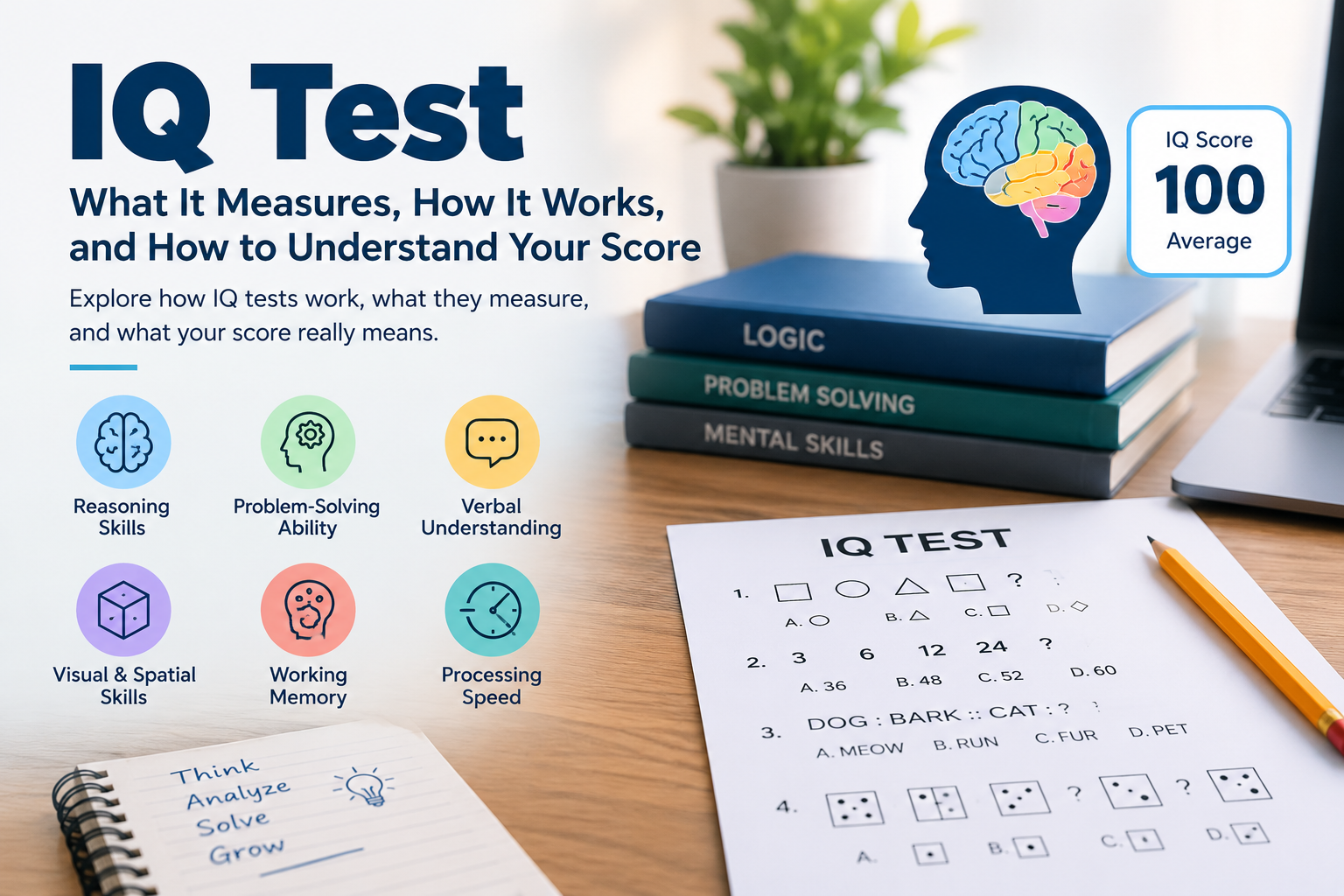
An IQ test does not measure everything that makes a person intelligent. It focuses on specific mental skills such as reasoning, problem-solving, working memory, verbal understanding, and the ability to recognize patterns.
A good IQ test is carefully designed and scored against a large reference group. This makes the result more meaningful than a quick online quiz that simply gives you a number.
Understanding how IQ testing works can help you read your score correctly and avoid common myths about intelligence. In this guide, we will explain what an IQ tests is, how IQ scores work, what different scores mean, how accurate online tests can be, and what factors can affect performance.
What Is an IQ Tests?
An IQ test is a standardized assessment designed to measure certain cognitive abilities. IQ stands for intelligence quotient.
Modern intelligence tests usually contain several types of tasks. These tasks can examine how well a person reasons, understands language, remembers information, solves problems, and identifies relationships between ideas.
For example, an IQ tests may show a series of shapes and ask you to select the next shape in the pattern. Another question may ask you to identify the relationship between words or numbers.
The goal is not simply to see how much information you have memorized. Instead, many IQ tests focus on how you process and use information.
Professional IQ tests are standardized. This means that the test is given and scored using carefully developed procedures. The person’s performance is then compared with results from an appropriate reference population.
What Does IQ Mean?
IQ means intelligence quotient, but the modern meaning of an IQ score is more complex than simply dividing one number by another.
Modern IQ scores are generally based on standardized scoring systems. The average score is usually set at 100, with a standard deviation of 15 on many widely used intelligence tests.
This means that a score of 100 represents performance around the average for the relevant reference group.
A score of 115 is above the average, while a score of 85 is below the average. These numbers do not mean that a person is “good” or “bad” at everything related to intelligence.
An IQ score describes performance on a particular standardized assessment. It should be interpreted in context rather than treated as a complete description of a person’s abilities.
How Does an IQ Tests Work?
An IQ tests normally contains different sections that assess different mental abilities.
The exact design depends on the test. Some assessments focus more heavily on verbal reasoning, while others include visual puzzles, memory tasks, processing speed, and quantitative reasoning.
A person may be asked to solve problems within a specific amount of time. Some questions become harder as the test continues.
The test is then scored according to standardized rules.
Professional assessment can take much longer than a short online quiz. A trained psychologist or qualified professional may also consider background information, behavior during testing, educational history, and other relevant factors when interpreting the results.
What Does an IQ Tests Measure?
An IQ test can measure several areas of cognitive performance.
Verbal Reasoning
Verbal reasoning involves understanding language and using words to solve problems.
A test may ask you to explain how two concepts are similar, define a word, or understand relationships between ideas.
For example, you might be asked what two objects have in common. The task is not simply about knowing definitions. It can also involve understanding concepts and forming logical relationships.
Visual and Spatial Reasoning
Visual reasoning involves understanding shapes, patterns, positions, and relationships between objects.
A common task may show several images and ask you to choose which image completes a pattern.
These questions test your ability to analyze visual information and recognize relationships.
Working Memory
Working memory is the ability to hold information in your mind and use it for a short period.
For example, you might hear a series of numbers and then be asked to repeat them in a particular order.
Working memory is useful in many everyday situations. It helps when following instructions, doing mental calculations, reading complex information, and solving multi-step problems.
Processing Speed
Some intelligence tests measure how quickly a person can process simple information accurately.
A task may require you to identify symbols, match information, or make quick decisions under time limits.
Processing speed is different from overall reasoning ability. Someone may reason very well but work more slowly on simple timed tasks.
Fluid Reasoning
Fluid reasoning refers to the ability to solve new problems without depending entirely on previously learned information.
Pattern questions are often used to examine this skill.
For example, you might see:
2, 4, 8, 16, ?
The answer is 32 because each number doubles.
More advanced questions can involve several rules at the same time.
What Is a Good IQ Score?
There is no single score that makes someone intelligent.
On many modern IQ tests, 100 is the average score. A large portion of the population scores within a range around the average.
Scores around 90 to 109 are often described as falling within the average range, although exact labels can vary between tests.
Scores around 110 to 119 are commonly described as above average.
Scores around 120 to 129 may be described as superior on some scoring systems.
Scores of 130 or higher are sometimes described as very high or gifted, but interpretation depends on the specific assessment, its norms, and the purpose of testing.
The important point is that these labels should not be treated as absolute judgments about a person’s potential.
Is an IQ Score of 100 Good?
Yes. An IQ score of 100 is considered average on the standard scoring system used by many modern intelligence tests.
It does not mean that the person is exactly average in every mental skill.
For example, someone with an overall IQ of 100 could have stronger verbal reasoning than processing speed or stronger visual reasoning than working memory.
An overall score combines performance across different areas.
What Is a High IQ?
A high IQ generally means that a person’s performance on a standardized intelligence test is significantly above the average of the relevant reference group.
However, the meaning of “high” depends on the test.
A score of 120 is clearly above the average on a typical scale, while a score of 130 is considerably higher.
High IQ scores can indicate strong performance in areas such as abstract reasoning, pattern recognition, verbal understanding, and problem-solving.
But a high IQ does not guarantee success in school, work, relationships, business, or life.
Many real-world skills are not fully captured by IQ testing.
What Is a Low IQ?
A score below the average does not automatically mean that someone cannot learn or succeed.
Test performance can be affected by education, language, culture, health, sleep, anxiety, attention, motivation, and familiarity with the testing environment.
For this reason, a single score should not be used to make broad conclusions about a person’s abilities.
When cognitive assessment is being used for an important decision, professionals usually consider more than one piece of information.
Are Online IQ Tests Accurate?
This is one of the most common questions about IQ testing.
The answer depends on the test.
Some online IQ tests are designed mainly for entertainment. They may give you a score after a few questions, but that number may not be equivalent to a professionally administered IQ score.
A reliable intelligence assessment requires careful development, standardized administration, appropriate norms, and evidence that the test measures what it claims to measure.
An online quiz can be fun and may give you an idea of how you perform on certain puzzles, but you should be cautious about treating the result as a formal diagnosis or professional assessment.
If you need an IQ score for educational, clinical, or legal purposes, a properly administered assessment from a qualified professional is more appropriate.
Why Can Your IQ Tests Score Change?
People sometimes take two tests and receive different scores. This does not necessarily mean that one test is wrong.
Different tests measure different abilities.
Even when the same test is used, performance can vary.
Imagine taking an IQ tests after sleeping for only four hours. You may have trouble concentrating and working quickly.
Now imagine taking a similar assessment after a good night’s sleep when you are calm and focused. Your performance may be different.
Practice can also matter. If you have recently completed many pattern puzzles, you may become more familiar with the types of questions used in similar tests.
Testing conditions therefore matter when interpreting results.
Does Age Affect IQ Testing?
Age is important in intelligence testing.
Children and adults have different levels of cognitive development, so professional intelligence tests use age-appropriate norms.
A child’s performance is compared with the performance of other people in the same or similar age group.
This allows the score to show how the child performed relative to age expectations.
For adults, age-based norms may also be used depending on the assessment.
This is one reason why simply comparing two people’s raw numbers without knowing the testing method can be misleading.
Can You Improve Your IQ?
This question requires some care.
You can improve your performance on certain cognitive tasks through learning, practice, education, and familiarity with the test format.
For example, if you practice matrix puzzles regularly, you may become better at solving matrix puzzles.
Education can also strengthen knowledge and reasoning skills.
However, improving at a particular type of test is not necessarily the same as permanently increasing every aspect of general intelligence.
A person’s cognitive abilities are influenced by many factors, including genetics, environment, education, development, health, and life experiences.
Rather than focusing only on raising an IQ number, it is more useful to build practical skills such as reading, reasoning, problem-solving, learning, communication, and critical thinking.
How to Prepare for an IQ Tests
Good preparation does not mean memorizing answers.
The best approach is to arrive rested, focused, and ready to concentrate.
Getting enough sleep can help you perform better on tasks that require attention and mental effort.
It can also help to understand the types of questions that may appear. Practicing sample questions can make the format feel more familiar.
For example, if an assessment includes number sequences, you can practice looking for relationships between numbers.
If it includes visual patterns, you can practice identifying changes in shape, position, direction, and quantity.
The goal is to become comfortable with problem-solving rather than trying to memorize specific answers.
Common Types of IQ Questions
IQ tests can contain many different question styles.
A number sequence may ask you to identify the next number.
For example:
3, 6, 12, 24, ?
The pattern is multiplication by two, so the next number is 48.
A verbal reasoning question may ask you to identify a relationship between words.
A visual reasoning question may present a sequence of shapes with one missing image.
A logical reasoning question may require you to identify which statement follows from a set of conditions.
Some tests also include memory and processing-speed tasks.
These questions may look simple, but they can become challenging as the difficulty increases.
A Simple IQ Test Example
Consider this pattern:
5, 10, 15, 20, ?
The answer is 25 because the sequence increases by five each time.
Now consider a more complex example:
1, 4, 9, 16, ?
The numbers are square numbers.
1 is 1 × 1.
4 is 2 × 2.
9 is 3 × 3.
16 is 4 × 4.
The next number is 25 because 5 × 5 equals 25.
Real IQ tests can use much more complex patterns. The purpose is to see how effectively a person identifies relationships and applies rules.
IQ Tests vs. Aptitude Test
IQ tests and aptitude tests are related but not identical.
An IQ tests generally aims to measure broad cognitive abilities.
An aptitude test usually focuses on a person’s potential or ability in a particular area.
For example, an employer might use an aptitude assessment to examine numerical reasoning, verbal reasoning, mechanical reasoning, or other skills relevant to a job.
A university may also use specialized assessments for admission or placement.
The two types of testing can overlap, but their goals and designs may differ.
IQ Tests vs. Achievement Test
An achievement test measures what a person has learned.
A school mathematics exam is a simple example.
If you have studied algebra, an algebra test can measure how well you understand algebra.
An IQ tests is different. It is designed to assess cognitive abilities such as reasoning and problem-solving rather than simply measuring knowledge of a school subject.
This distinction is important because someone can have strong academic knowledge without having the same profile on every cognitive task.
Does IQ Predict Success?
IQ can be related to certain outcomes, particularly tasks involving learning, reasoning, and complex problem-solving. However, it does not predict every kind of success.
A successful career can also depend on communication, motivation, discipline, creativity, emotional skills, teamwork, experience, opportunity, and many other factors.
Consider two employees.
One may solve abstract problems extremely quickly but struggle with communication and teamwork.
Another may have average cognitive test performance but communicate clearly, manage projects well, build strong relationships, and consistently complete difficult work.
Both people can be valuable.
This is why an IQ score should never be treated as a complete measurement of human potential.
IQ and Emotional Intelligence Are Different
IQ and emotional intelligence are often confused.
IQ mainly concerns cognitive abilities such as reasoning, memory, and problem-solving.
Emotional intelligence is more closely related to recognizing emotions, managing emotional responses, understanding other people, and handling social situations.
A person can have strong cognitive abilities and still need to improve emotional or social skills.
Likewise, someone who does not score exceptionally high on an IQ tests can have excellent interpersonal skills.
Both types of ability can matter in everyday life.
Why IQ Scores Should Be Interpreted Carefully
An IQ number can look precise, but testing is not perfect.
Professional intelligence tests have measurement error. This means the reported score should be understood as an estimate rather than an exact measurement of every aspect of intelligence.
For example, a person may receive a score of 105, but that does not mean their “true intelligence” is exactly 105 in every situation.
Professionals may consider a confidence interval around the score.
Other factors also matter, including the person’s age, language background, education, testing conditions, and reason for assessment.
The Role of Culture and Language
Language and cultural background can influence performance on some cognitive assessments.
A verbal test may be easier for someone who is highly familiar with the language used in the assessment.
This is why professional testing requires careful selection and interpretation.
Psychologists and other qualified professionals consider whether the assessment is appropriate for the person being tested.
A score should not be interpreted without considering the context in which it was obtained.
IQ Tests for Children
IQ testing can be used with children for different reasons.
A school may recommend cognitive assessment when educators want to understand a student’s learning profile.
Parents may seek professional assessment when they have questions about learning, advanced abilities, or developmental needs.
A child IQ tests is not simply a harder school exam. It examines cognitive skills using age-appropriate tasks.
Professional interpretation is particularly important for children because development can affect performance in different ways.
IQ Tests for Adults
Adults may take intelligence tests for educational, clinical, occupational, or personal reasons.
For example, a professional may want to understand cognitive strengths and weaknesses as part of a broader assessment.
Some people take online IQ quizzes simply because they enjoy puzzles.
The purpose of the test matters when deciding how seriously the score should be interpreted.
A casual online score should not be treated the same way as a professionally administered assessment.
How Technology Is Changing IQ Testing
Technology has made cognitive testing easier to access.
Many platforms now offer online reasoning tests that can be completed on a computer or phone.
Digital testing can provide convenient scoring and immediate feedback.
However, convenience does not automatically mean accuracy.
A scientifically useful assessment needs appropriate questions, reliable scoring, valid norms, and careful testing procedures.
Artificial intelligence may also influence future assessment tools by helping researchers analyze patterns in responses and develop adaptive testing systems.
Adaptive tests can change the difficulty of questions based on how a person performs.
This can make testing more efficient, although proper validation remains essential.
How to Read Your IQ Tests Result
When you receive an IQ score, do not look at the number alone.
First, check what type of test you took.
Then consider whether it was professionally administered or simply an online quiz.
Look at the score range and any explanation provided by the test.
If the assessment provides sub-scores, examine them as well. You may find that your performance varies across verbal reasoning, working memory, processing speed, and visual reasoning.
These differences can be more informative than a single overall number.
If the result is important for education, employment, health, or another major decision, discuss it with a qualified professional.
Frequently Asked Questions About IQ Tests
What is an IQ tests?
An IQ test is a standardized assessment designed to measure certain cognitive abilities, including reasoning, problem-solving, memory, verbal understanding, and visual or spatial skills.
What is the average IQ?
The average IQ score is generally set at 100 on many modern standardized intelligence tests. The exact scoring system can vary depending on the assessment.
Is an IQ of 120 good?
An IQ of 120 is generally considered above average on commonly used IQ scales. However, the meaning of the score depends on the specific test and its norms.
Is an IQ of 130 considered high?
A score of 130 is substantially above the average on many commonly used intelligence tests. Some systems use this level as a threshold associated with very high cognitive ability or giftedness, but the exact interpretation depends on the assessment.
Can I take an IQ tests online?
Yes, many websites offer online IQ quizzes and cognitive tests. However, online tests vary greatly in quality. A casual online quiz should not automatically be treated as a professionally measured IQ score.
How accurate are online IQ tests?
Accuracy depends on the test. A properly developed and validated assessment can be useful, while many free online quizzes are designed mainly for entertainment and may not provide a scientifically reliable IQ score.
Can IQ increase with age?
IQ scores can change across development, and cognitive abilities can also change throughout life. Education, experience, health, and other factors can influence cognitive performance. Comparing scores across different tests should therefore be done carefully.
Can studying increase IQ?
Education and learning can improve knowledge and many cognitive skills. Practice can also improve performance on specific test formats. However, doing better on a particular test does not necessarily mean that general intelligence has permanently increased.
Does IQ measure intelligence completely?
No. IQ tests measure important cognitive abilities, but they do not capture every form of intelligence or every skill needed for success. Creativity, emotional skills, practical judgment, motivation, communication, and social abilities are also important.
What is the difference between IQ and EQ?
IQ generally refers to cognitive abilities such as reasoning and problem-solving. EQ, often used to describe emotional intelligence, relates more to understanding and managing emotions and navigating social situations.
What does an IQ score of 100 mean?
An IQ of 100 generally represents average performance relative to the reference group used to standardize the test. It does not mean that a person is average at every individual cognitive skill.
Why do I get different scores on different IQ tests?
Different IQ tests use different questions, scoring systems, norms, and testing conditions. Your performance can also change depending on sleep, stress, attention, practice, and other factors.
Conclusion
An IQ tests can provide useful information about certain cognitive abilities, but it is not a complete measurement of a person’s intelligence or potential.
Modern IQ tests commonly examine skills such as reasoning, working memory, processing speed, verbal understanding, and visual problem-solving. Scores are usually compared with a standardized population, with 100 representing the average on many widely used scales.
The most important thing is to understand what your score actually represents. A quick online quiz can be an enjoyable challenge, but it should not automatically be treated as a professional psychological assessment.
If you want meaningful results, choose a reliable, properly developed assessment and consider the testing conditions, scoring system, and purpose of the test. Most importantly, do not let one number define your abilities. Intelligence is broad, and real-world success depends on many skills that an IQ test cannot fully measure.
If you are curious about your cognitive strengths, use IQ testing as a starting point for learning more about how you think, solve problems, and process information. Continue developing your reasoning, knowledge, creativity, communication, and practical skills, because these abilities can help you far beyond any single test score.
