
Explore DataCamp courses in 2026, from Python and v to AI, data science, and Power BI, and find the right path for your career goals.
Introduction
DataCamp courses offer a structured way to learn data-related skills through online lessons, practical exercises, and hands-on projects. Whether you are a beginner exploring data science or a professional looking to improve your knowledge of Python, SQL, machine learning, or data analytics, the platform provides learning paths for different experience levels. Developing these skills can help you understand data more effectively, solve real-world problems, and prepare for new career opportunities. However, choosing the right course depends on your current abilities, learning goals, and available time. In this guide, we explore nine ways DataCamp courses can help you build valuable data skills and work toward your career goals in 2026.
Data skills are no longer useful only for data scientists. Today, marketers, business analysts, developers, finance professionals, students, and managers all work with data in some form. The challenge is knowing where to start and which skills are worth learning.
That is where DataCamp courses can help. DataCamp is an online learning platform focused on data, artificial intelligence, programming, analytics, and related technology skills. Its courses use short lessons and hands-on exercises so learners can practice what they learn instead of only watching videos.
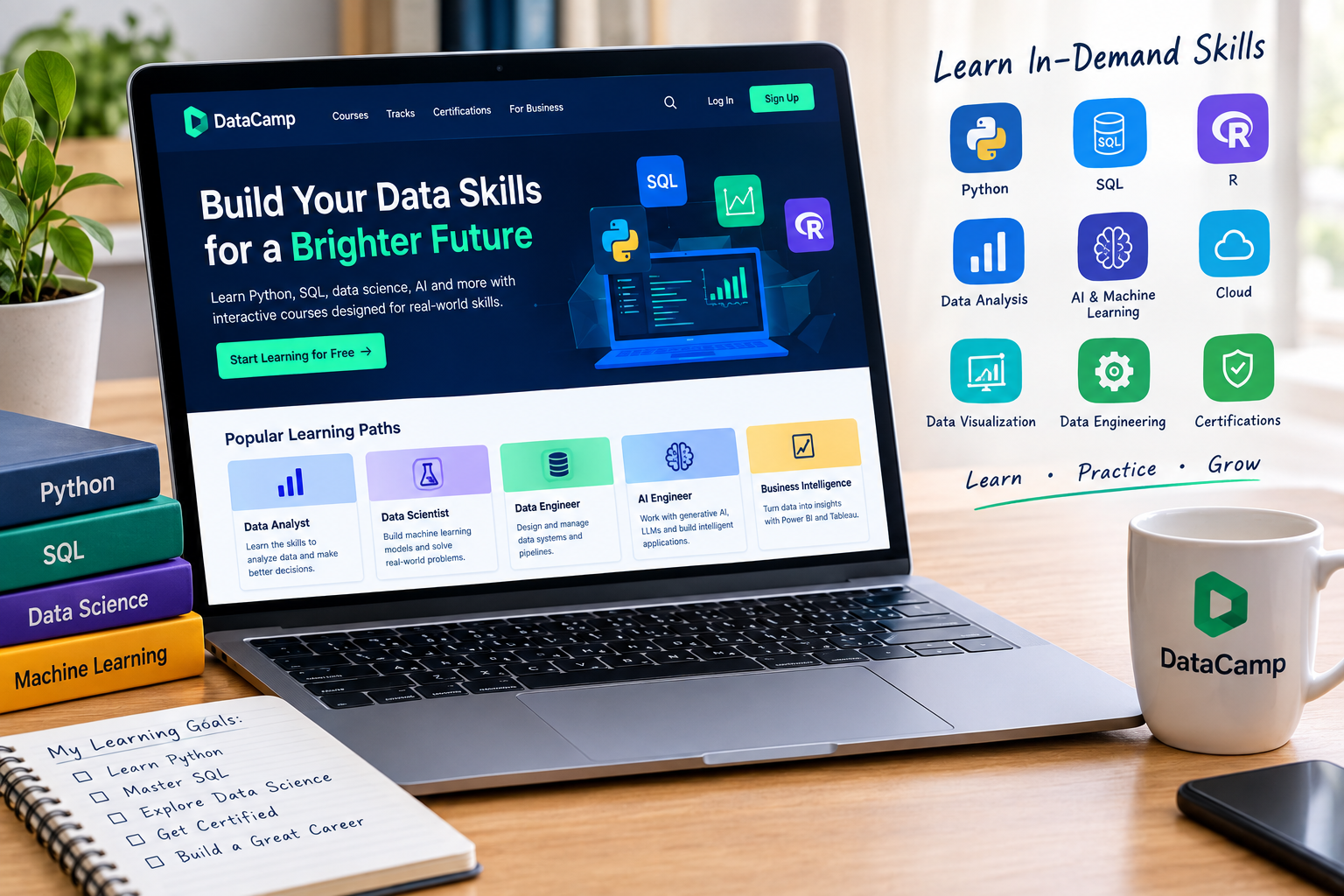
As of 2026, DataCamp lists more than 770 courses across areas such as Python, SQL, AI, cloud, data engineering, business intelligence, R, and software development. Its current catalog also includes career tracks, skill tracks, projects, practice activities, and professional certifications.
Whether you are a complete beginner or already working with data, the platform offers different ways to build your skills. The key is choosing courses that match your current level and career goal.
What Are DataCamp Courses?
DataCamp courses are online, interactive courses designed to teach practical skills in data and technology. Instead of requiring you to install complex software, many exercises can be completed directly in your web browser.
The learning approach is built around a simple process. You learn a concept, practice it in an interactive environment, and then apply it to a practical problem. DataCamp courses describes this approach as learning by doing, with courses that combine instruction, exercises, practice, and real-world applications.
The course catalog covers basic, intermediate, and advanced topics. A beginner can start with Python or data literacy, while an experienced professional can study machine learning, AI engineering, cloud platforms, data engineering, or advanced analytics.
This makes DataCamp useful for people who want structured learning without committing to a traditional university program.
9 Powerful Ways DataCamp Courses Can Help You Build Career Skills
1. Learn Python From the Ground Up
Python is one of the most useful programming languages for data analysis, automation, artificial intelligence, and machine learning.
DataCamp offers beginner-friendly Python courses that introduce basic programming concepts before moving into data analysis and more advanced topics. For example, its current catalog includes Introduction to Python, which is listed as a basic-level course with a four-hour estimated duration.
A beginner might use Python to clean a spreadsheet, analyze customer information, calculate business metrics, or create charts.
For example, imagine an online store has thousands of orders. Instead of manually checking every row in a spreadsheet, a Python script can help organize the data and calculate sales totals.
This is one reason Python skills can be valuable across many careers.
2. Build Strong SQL Skills
SQL is another important skill for anyone interested in data analysis.
Companies store large amounts of information in databases. SQL allows users to retrieve, filter, combine, and analyze that information.
DataCamp offers SQL courses and career paths designed for learners at different levels. Its current Associate Data Analyst career track, for example, focuses on SQL skills and is designed to help learners query databases and analyze results.
A practical example would be a retail company that wants to know which products sold the most during a specific month. Instead of searching through thousands of records manually, an analyst can use SQL to retrieve the relevant information quickly.
If your goal is to become a data analyst, SQL is a skill worth taking seriously.
3. Explore Data Science With Real Practice
Data science combines statistics, programming, data analysis, and machine learning to solve problems using data.
Learning data science can feel difficult when you only study theory. DataCamp attempts to reduce this problem by giving learners interactive exercises and practical tasks.
Its career tracks include paths for data scientists using Python and R. The current catalog includes an Associate Data Scientist track covering areas such as data manipulation and machine learning.
A learner could use these skills to study customer behavior, identify trends, predict outcomes, or build machine learning models.
The important point is that completing a course should not be treated as the final step. You should use the skills to create projects and solve practical problems.
4. Develop Business Intelligence Skills
Not every data career requires advanced programming.
Business intelligence focuses on turning data into useful information that can support business decisions. Tools such as Power BI and Tableau are widely used for dashboards, reporting, and data visualization.
DataCamp provides courses and learning paths covering business intelligence and visualization tools. Its current catalog includes Power BI and Tableau-related learning content, along with career paths for data analysts.
For example, a company might have monthly sales data but struggle to understand what the numbers mean. A Power BI dashboard could transform that information into charts showing sales by region, product, or month.
For someone interested in business analytics rather than pure programming, this can be a practical direction.
5. Learn Artificial Intelligence and Machine Learning
Artificial intelligence has become a major technology skill, but learning AI requires more than knowing how to use a chatbot.
DataCamp now includes AI-focused learning content covering areas such as AI fundamentals, AI engineering, machine learning, and generative AI.
Its current skill-track catalog includes an AI Fundamentals track, while its career tracks include AI Engineer paths for developers and data scientists.
Beginners can start with AI concepts and gradually move toward practical development.
For example, a learner might first understand how machine learning differs from traditional programming. Later, they could study model development, data preparation, APIs, and AI application development.
This gradual approach is often easier than attempting an advanced AI course without understanding the basics.
6. Build Data Engineering Knowledge
Data engineers help organizations collect, process, store, and move data.
Their work can involve databases, data warehouses, pipelines, cloud platforms, and other technologies.
DataCamp currently offers data engineering courses and career tracks. Its Associate Data Engineer career track covers fundamentals such as database design and data warehousing, including technologies such as PostgreSQL and Snowflake.
A simple example can explain the role.
Imagine an e-commerce company collects information from its website, mobile application, payment system, and customer support platform. That information may exist in different systems. Data engineers help create reliable processes that bring the information together so analysts and other teams can use it.
If you enjoy technical problem-solving and working behind the scenes, data engineering may be worth exploring.
7. Learn R for Data Analysis and Statistics
Python receives a lot of attention, but R remains useful for statistics, research, and data analysis.
DataCamp offers R-based courses and career tracks. Its catalog includes paths that cover data manipulation, visualization, and machine learning using R.
For example, a researcher may use R to analyze survey results or explore statistical relationships within a dataset.
If you are studying statistics, research, economics, social sciences, or another field that involves quantitative analysis, R can be a useful addition to your toolkit.
8. Prepare for Professional Certifications
Another reason learners explore DataCamp courses is certification.
DataCamp currently offers certifications covering roles and technologies such as Data Analyst, Data Scientist, Data Engineer, AI Engineer, SQL, Power BI, Tableau, Python, AWS, Azure, and others.
Its certification process is different from simply completing a course. DataCamp courses says its certifications use assessments designed around job-related skills, including timed exams and, for some certifications, practical case-study work.
This distinction matters.
A course certificate mainly shows that you completed a learning experience. A professional certification can provide additional evidence that you were assessed on specific skills.
However, certification should support practical ability rather than replace it. Employers may still want to see projects, experience, communication skills, and problem-solving ability.
9. Learn Through Career and Skill Tracks
One of the most useful features of DataCamp courses is its learning-track system.
A career track is designed around a broader professional role. A skill track focuses on a more specific group of skills.
For example, someone who wants to become a data analyst may follow a career track covering SQL, Python, data visualization, and analysis. Someone who already works as an analyst but wants to improve SQL could choose a more focused skill track.
DataCamp currently lists dozens of career tracks and more than 100 skill tracks.
This structure can prevent a common learning problem: taking random courses without knowing how they connect.
Best DataCamp Courses for Beginners
If you are completely new to data, do not start with the hardest machine learning course you can find.
A better approach is to build a foundation first.
Courses covering Python fundamentals, SQL fundamentals, data literacy, spreadsheets, or introductory data analysis can provide a useful starting point.
For example, a student with no programming experience could begin with an introductory Python course. After learning variables, functions, conditions, and basic data structures, the student could move into Python for data analysis.
Another beginner may prefer SQL because they want to work with databases and become a data analyst.
Someone interested in business may begin with Excel, Power BI, or data visualization.
The right first course depends on the result you want.
Best DataCamp Courses for Data Analysts
Data analysts need more than one tool.
A strong learning plan may combine SQL, spreadsheets, Python or R, statistics, data visualization, and communication.
DataCamp’s current Data Analyst career paths reflect this broader approach. Its Microsoft-linked Data Analyst track focuses on Power BI and preparation for the PL-300 Data Analyst certification, while another Data Analyst path focuses on Python-based analysis.
A practical learning project could involve a fictional retail company.
You could start with a CSV containing customer and sales information. Then you could clean the data, analyze sales trends, calculate important metrics, create visualizations, and present your findings.
That single project can demonstrate several skills at once.
Best DataCamp Courses for Python Learners
If you already know basic Python, you do not need to repeat beginner programming lessons.
Instead, you can move toward Python libraries and practical applications.
Data analysis often involves tools such as pandas and visualization libraries. Data science can then introduce statistics and machine learning.
DataCamp’s catalog includes Python courses at different levels, allowing learners to move from basic programming toward data analysis, software engineering, and data science.
A useful progression is to learn Python basics, practice data manipulation, study visualization, learn statistics, and then explore machine learning.
This creates a stronger foundation than jumping directly into complex machine learning algorithms.
Are DataCamp Courses Worth It?
Whether DataCamp courses is worth the cost depends on your goals, learning style, and how consistently you use the platform.
The platform currently offers a free Basic option that provides access to the first chapter of courses. Its Premium plan provides broader access to the course library, projects, certificates, and other learning resources. The pricing page currently lists more than 790 courses under Premium, although pricing and offers can change over time.
The biggest advantage is the practical format. You can write code and complete exercises in the browser without setting up a complicated local environment.
However, no online course platform can guarantee a job.
If you complete courses without practicing outside the platform, your skills may remain limited. The best results usually come when learners combine courses with personal projects, portfolio work, interview preparation, and real-world practice.
How to Choose the Right DataCamp Course
Start by identifying your goal.
If you want to become a data analyst, focus on SQL, Excel, Python or R, statistics, and visualization.
If you want to become a data scientist, build knowledge in Python or R, statistics, machine learning, data analysis, and model development.
If you want to become a data engineer, explore SQL, databases, data warehouses, cloud technologies, and data pipelines.
If you want to work with AI, start with AI fundamentals and then move toward machine learning, Python, AI development, or AI engineering.
If you work in business and mainly need dashboards and reporting, Power BI, Tableau, Excel, and business intelligence courses may be more relevant.
The goal is not to complete as many courses as possible. The goal is to develop skills that you can actually use.
How to Get Better Results From DataCamp Courses
Consistency matters more than speed.
Instead of trying to complete five courses in one week, spend a small amount of time learning every day.
For example, a student with one hour per day could spend the first 30 minutes learning a lesson and the next 30 minutes completing exercises or reviewing previous concepts.
After finishing several courses, the student should start building projects.
Suppose you have learned SQL. Create a small database and answer questions using queries.
If you have learned Python, analyze a public dataset.
If you have learned Power BI, build a dashboard.
If you have learned machine learning, create a simple predictive model and explain its limitations.
This turns passive learning into evidence of practical ability.
DataCamp Courses vs Traditional Online Learning
DataCamp courses has a strong focus on interactive practice. That makes it different from platforms where most learning happens through long video lectures.
For someone who learns by doing, interactive exercises can make technical topics easier to practice.
The platform also offers short lessons and browser-based exercises, which can make it easier to study during a busy schedule.
Traditional courses can still be valuable, especially when you need deeper theory, academic instruction, or a complete university-level curriculum.
The best choice depends on your goal.
If your main objective is practical data skills, a hands-on platform can be useful. If your goal is an academic qualification, a degree or formal program may be more appropriate.
A Simple DataCamp courses Learning Plan for 2026
A beginner can build a structured learning plan instead of randomly selecting courses.
During the first stage, focus on basic data concepts and one core tool. Python and SQL are common choices.
During the second stage, practice data cleaning, analysis, and visualization.
During the third stage, choose a career direction. This could be data analytics, data science, data engineering, business intelligence, software development, or AI.
During the fourth stage, build projects that demonstrate what you learned.
During the fifth stage, consider certification if it supports your career goals.
This approach gives every course a purpose.
Common Mistakes to Avoid
One common mistake is collecting certificates without building real skills.
Another is changing courses too often. A learner may start Python, switch to SQL, then jump to machine learning, then start Power BI without becoming comfortable with any of them.
Another problem is skipping practice.
Data skills improve through repetition. Reading about SQL is not the same as writing SQL queries. Watching a Python lesson is not the same as solving a Python problem.
Finally, avoid choosing courses only because they sound impressive. An advanced course is not automatically useful for your career.
Choose based on the skills you actually need DataCamp courses.
Frequently Asked Questions About DataCamp Courses
Is DataCamp courses good for beginners?
Yes. DataCamp courses offers courses for different experience levels, including basic-level courses and beginner-oriented learning paths. Its current catalog states that learners can find courses from beginner to advanced levels.
Is DataCamp free?
DataCamp offers a free Basic plan, but access is limited. Its current pricing information says free users can access the first chapter of courses, while Premium provides access to the wider course library and additional resources.
Are DataCamp certificates worth anything?
DataCamp course completion certificates can show that you completed training, while DataCamp’s professional certifications are designed to assess practical, job-related competencies. Their value can vary depending on the employer, role, and other evidence of your skills.
Can I get a job after completing DataCamp courses?
Completing DataCamp courses does not guarantee employment. However, the skills can help you build knowledge for roles such as data analyst, data scientist, data engineer, developer, and other technology positions. Building projects and gaining practical experience can strengthen your job profile.
Does DataCamp courses teach Python?
Yes. DataCamp offers Python courses for different levels, including introductory programming, data analysis, data science, and software engineering. Its current course catalog includes Introduction to Python and other Python-focused learning paths.
Does DataCamp teach SQL?
Yes. SQL is a major part of DataCamp’s learning catalog. The platform offers SQL courses, practice, and career or skill tracks designed to help learners develop database and data-analysis skills.
Can I learn AI with DataCamp courses?
Yes. DataCamp now provides AI-focused courses and tracks covering AI fundamentals, machine learning, generative AI, and AI engineering.
Do DataCamp courses require coding experience?
Not always. DataCamp provides beginner-level courses for people who are new to programming and data. You can start with basic concepts and gradually move toward more technical subjects.
How long does it take to learn data analysis with DataCamp courses?
The time depends on your background and study schedule. DataCamp courses current career tracks range from shorter paths to programs requiring dozens of hours. For example, some listed data analyst tracks take around 36 to 50 hours of course time.
Conclusion
DataCamp courses can provide a practical way to develop modern data and technology skills. With learning options covering Python, SQL, R, Power BI, Tableau, data science, AI, machine learning, cloud, and data engineering, learners can choose a path that matches their goals.
The platform is most useful when you treat it as a starting point rather than the finish line. Complete the lessons, practice regularly, build projects, and learn how to explain your results clearly.
If you are new to data, start with a beginner-friendly course. If you already have experience, choose a focused skill track that fills a gap in your knowledge. If you are preparing for a specific career, use a career track to create a structured learning path.
Most importantly, do not measure your progress only by the number of courses you finish. Measure it by what you can actually build, analyze, explain, and solve.
Start with one DataCamp course that matches your goal, practice consistently, and turn your new knowledge into a real project. That is where online learning can become a valuable career skill.
