
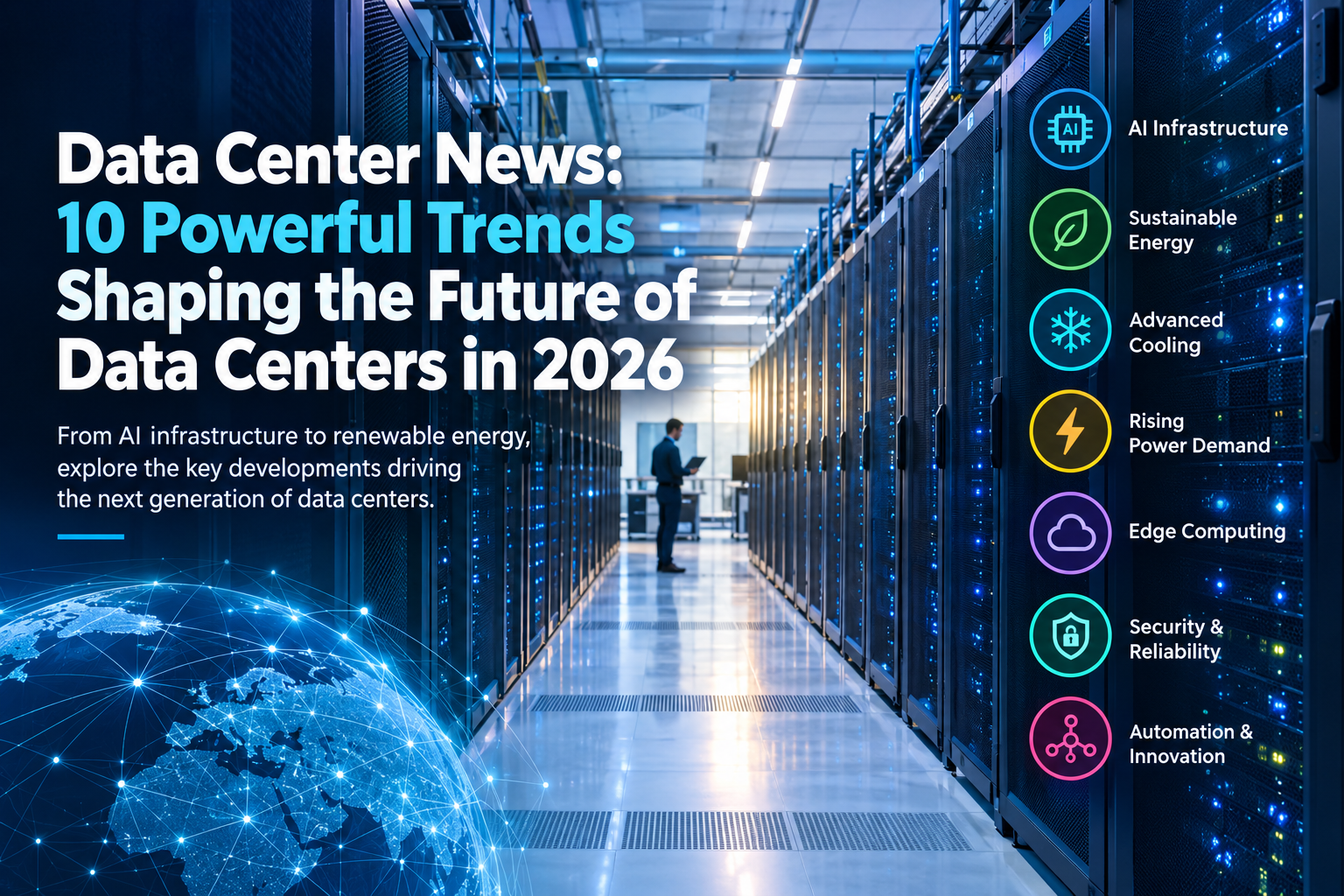
Explore the latest data center news and 10 powerful trends in 2026, including AI infrastructure, energy efficiency, cooling, security, and expansion.
Data centers are no longer just large buildings filled with servers. They are now the backbone of AI, cloud computing, streaming, online banking, e-commerce, and almost every digital service people use each day.
Data centers are becoming increasingly important as businesses depend on cloud computing, artificial intelligence, digital services, and large-scale data processing. The latest data center news highlights major changes in infrastructure, energy use, cooling technology, security, and capacity expansion. In 2026, emerging technologies and growing demand are pushing data center operators to improve efficiency while supporting more powerful computing workloads. Understanding these trends can help businesses and technology professionals prepare for the future of digital infrastructure.
That is why data center news has become increasingly important for businesses, technology professionals, investors, and anyone interested in the future of the internet. A new data center can affect local power demand, create jobs, support cloud services, and help companies run AI workloads faster.
The industry is also changing quickly. Artificial intelligence is increasing demand for high-performance computing. At the same time, operators must deal with rising energy use, limited power availability, water concerns, cooling challenges, and stricter sustainability goals.
In 2026, the data center industry is entering a new phase. AI workloads are changing server design, cooling systems are becoming more advanced, and operators are looking for smarter ways to build capacity without wasting energy.
What Is Data Center News?
Data center news covers important developments related to facilities that store, process, and distribute digital information.
These developments can include new data center construction, cloud infrastructure, artificial intelligence hardware, server technology, networking, power systems, cooling technology, renewable energy projects, mergers, investments, regulations, and major industry announcements.
Data center news also includes changes in regional capacity. For example, a technology company may announce plans to build a large facility in a new market because demand for cloud computing is growing there.
The importance of these stories goes beyond the technology sector. Data centers require land, electricity, cooling, fiber connections, construction workers, engineers, and other resources. As a result, major projects can influence local economies and energy infrastructure.
Why Data Center News Matters in 2026
The growth of artificial intelligence has changed the data center industry.
Traditional cloud workloads already required large amounts of computing power, but AI training and inference can require much more powerful processors. Modern AI systems often use large groups of GPUs or other accelerators that generate substantial heat and require significant electrical capacity.
This has created a new challenge for data center news operators.
Building more server space is not enough. Operators must also secure reliable power, design effective cooling systems, expand network capacity, and manage operating costs.
According to the International Energy Agency, global data center news electricity consumption could more than double by 2030, with AI being one of the major drivers of this growth.
This is why energy, cooling, and infrastructure are now central topics in data center news.
AI Is Driving a New Data Center Boom
Artificial intelligence is one of the biggest forces shaping modern data center news.
Generative AI applications need large amounts of computing power. Training a large model can require thousands of processors working together for long periods. After training, the model still needs computing resources when users send requests.
This second stage is called inference.
As AI becomes part of search engines, office software, customer service, cybersecurity, healthcare, finance, and other industries, demand for AI infrastructure is expected to keep growing.
AI Data Centers Need More Power
AI servers can consume much more power than traditional enterprise servers.
A conventional server rack may have a relatively modest power requirement compared with a high-density AI rack. Modern AI systems can push rack power densities far higher, creating challenges for electrical distribution and cooling.
This is changing how new facilities are designed.
Instead of simply adding more racks to a traditional facility, operators are designing specialized spaces that can handle high-density computing.
AI Is Changing Data Center Architecture
AI workloads are also changing network design.
AI processors need to communicate with each other at very high speeds. Delays between processors can reduce the efficiency of large computing clusters.
As a result, modern AI facilities require high-speed networking, advanced switches, efficient cabling, and carefully designed layouts.
This means the future data center news is not simply a warehouse for servers. It is becoming a highly optimized computing system.
Data Center Cooling Is Becoming a Major Story
Cooling has always been important, but AI has made it even more critical.
Servers produce heat when they operate. Traditional data centers often use air-based cooling systems to remove that heat.
However, very high-density AI hardware can produce more heat than traditional air cooling can efficiently handle.
This has increased interest in liquid cooling.
How Liquid Cooling Works
Liquid cooling uses a fluid to transfer heat away from computing components.
Because liquid can move heat more efficiently than air in many high-density applications, it can help data center news support powerful hardware without relying entirely on massive air-conditioning systems.
There are several approaches to liquid cooling, including direct-to-chip cooling and immersion cooling.
Direct-to-chip systems place cooling plates close to heat-producing components. Immersion systems place certain hardware in a specially designed cooling liquid.
The technology selected depends on the hardware, facility design, operating requirements, and cost.
Why Cooling Matters for Energy Efficiency
Cooling can account for a significant portion of a data center’s electricity use.
A more efficient cooling system can reduce energy consumption and operating costs.
This is why data center operators increasingly track Power Usage Effectiveness, commonly called PUE.
PUE compares the total energy used by a data center news with the energy used by its IT equipment. A lower PUE generally indicates better energy efficiency.
For example, a PUE of 1.2 means that for every unit of energy used by IT equipment, the facility uses another 0.2 units for other infrastructure such as cooling and power distribution.
PUE is useful, but it does not tell the entire sustainability story. Water consumption, carbon emissions, and the source of electricity also matter.
Data Center Power Demand Is Rising
One of the biggest stories in current data center news is access to electricity.
A data center can require a large and continuous supply of power. AI facilities can require even more.
This creates challenges in regions where electrical grids already face high demand.
Some operators are now looking for locations based partly on power availability rather than simply choosing areas close to major cities.
This can change traditional data center markets.
Why Location Matters
A good data center location needs more than cheap land.
Operators need access to reliable electricity, network connectivity, suitable land, cooling resources, transportation, and often tax or economic incentives.
Fiber connectivity is especially important because data centers need fast connections to users, cloud networks, businesses, and other facilities.
Power availability, however, is becoming one of the most important factors.
A site may have plenty of available land but still be unsuitable if the local grid cannot provide enough power.
Renewable Energy Is Changing Data Center News Strategy
Energy use has become an important part of data center planning.
Technology companies and data center operators are investing in renewable energy, power purchase agreements, battery storage, and other approaches to reduce the environmental impact of their facilities.
Solar and wind power can provide low-carbon electricity, although their output varies depending on weather conditions.
This means data centers may need a combination of renewable generation, grid power, energy storage, and other sources to maintain reliable operations.
Data Centers and the Power Grid
The relationship between data center news and electricity providers is becoming closer.
Large facilities can represent major new electricity loads. Utilities therefore need to plan generation, transmission, and distribution capacity.
In some regions, data center development has led to debates about who should pay for new infrastructure and how electricity costs should be distributed.
This is an important issue because data center growth can benefit local economies while also placing pressure on existing infrastructure.
Data Center Construction Is Accelerating
Another major area of data center news is construction.
Cloud providers, colocation companies, telecommunications firms, and technology businesses continue to expand infrastructure to meet growing demand.
But building a data center is not a simple construction project.
A facility requires advanced electrical systems, backup generators, cooling equipment, fire protection, physical security, networking, monitoring, and specialized building systems.
The Shift Toward Large-Scale Campuses
Instead of building one small facility, some operators are developing large data center campuses.
A campus can contain multiple buildings and provide room for future expansion.
This approach can make it easier to share certain infrastructure while allowing capacity to grow over time.
AI is making these campuses even more important because large AI clusters may require substantial amounts of space and power.
Edge Data Centers Are Also Growing
Not every workload needs to run in a massive hyperscale facility.
Some applications need computing resources closer to users.
This is where edge data center news become important.
An edge data center is a smaller facility located closer to the people or devices using the computing service.
Reducing physical distance can help lower latency.
Why Edge Computing Matters
Edge infrastructure can support applications such as industrial automation, connected vehicles, telecommunications, smart cities, gaming, video processing, and Internet of Things systems.
For example, an industrial facility may need to process sensor information almost instantly. Sending every piece of data to a distant data center may introduce unnecessary delay.
An edge facility can process some of that information locally.
This does not mean edge computing will replace large data center news. Instead, both models can work together.
Large facilities can handle heavy centralized workloads while edge locations process time-sensitive tasks closer to users.
Data Center Security Remains Critical
As more business operations depend on data centers, security becomes even more important.
Security has several layers.
Physical security protects buildings and equipment. Cybersecurity protects networks, systems, and applications. Operational security helps keep systems available during failures or attacks.
Data center operators also use monitoring systems to identify unusual activity and potential equipment problems.
Cyberattacks can target infrastructure directly or attempt to compromise customers using the facility.
For this reason, data center news security is becoming increasingly connected with broader cybersecurity strategies.
Data Center Automation Is Growing
Modern data centers contain thousands or even millions of components that need monitoring.
Automation helps operators manage this complexity.
Software can monitor temperature, power consumption, network traffic, hardware performance, and equipment status.
Artificial intelligence can also help identify unusual patterns.
For example, if a cooling system begins using more power than normal, an automated monitoring platform may detect the change before the problem becomes a major failure.
Predictive maintenance can also help operators identify equipment that may need attention.
This can reduce downtime and improve operational efficiency.
Data Center Reliability and Backup Systems
People expect online services to work around the clock.
Banks, hospitals, e-commerce companies, cloud platforms, and communication services cannot easily tolerate long outages.
Data centers therefore use multiple layers of protection.
Backup generators can provide electricity when the main grid fails. Batteries can provide short-term power while backup systems start. Multiple network connections can help maintain connectivity if one connection fails.
Some organizations also distribute workloads across multiple data centers.
If one facility experiences a major problem, traffic can potentially be redirected to another location.
This concept is known as redundancy.
Hyperscale Data Center News Are Reshaping the Industry
The term hyperscale data center refers to very large facilities designed to support massive computing workloads.
Large cloud providers operate hyperscale infrastructure around the world.
Hyperscale facilities are designed for scale, automation, efficiency, and rapid expansion.
AI has increased demand for this type of infrastructure because training and serving advanced models can require huge computing clusters.
However, hyperscale development also creates challenges.
Large facilities need significant amounts of electricity and water or other cooling resources. They can also require major investments in local infrastructure.
This makes planning and community engagement increasingly important.
Data Center Sustainability Goes Beyond Electricity
Sustainability is now a major part of data center news strategy.
It is easy to focus only on electricity consumption, but a complete sustainability plan can include energy, water, construction materials, equipment life cycles, and electronic waste.
Water is especially important in areas where resources are limited.
Some cooling systems use water as part of the heat rejection process. Operators are therefore exploring designs that can reduce water use.
The right solution depends on local climate, facility design, available resources, and operational requirements.
Data Center Waste and Hardware Life Cycles
Servers and networking equipment eventually need to be replaced.
Old equipment can create electronic waste if it is not reused, refurbished, recycled, or disposed of responsibly.
Companies are increasingly paying attention to hardware life cycles.
A server may be reused for another workload, refurbished, or recycled for valuable materials.
This can reduce waste and improve resource efficiency.
As AI hardware evolves rapidly, hardware life-cycle management may become even more important.
Data Center Costs Are Increasing
Building and operating a data center news requires major investment.
Costs include land, construction, electrical infrastructure, cooling systems, servers, networking equipment, security, maintenance, staffing, and energy.
AI can increase these costs because high-performance computing hardware and high-density cooling systems can be expensive.
Power infrastructure can also become a major cost.
As a result, data center operators are looking for ways to improve efficiency while expanding capacity.
What Data Center News Means for Businesses
Businesses should pay attention to data center news trends because infrastructure changes can affect cloud services, software costs, performance, and availability.
A company that relies heavily on cloud applications may benefit from improved infrastructure.
For example, better data center networking can improve application performance. More regional capacity can reduce latency. More efficient facilities can potentially help control operating costs over time.
AI infrastructure can also create new opportunities for businesses.
Companies can use AI services without building their own data center news, but they still depend on the infrastructure provided by cloud and AI companies.
What Consumers Should Know About Data Centers
Most consumers never see the data centers that power their online lives.
When someone watches a video, stores a photo, uses an AI assistant, purchases something online, or sends a message, data center infrastructure is often involved somewhere in the process.
This means data center growth can affect consumers indirectly.
Better infrastructure can support faster and more reliable digital services.
At the same time, growing electricity demand can create challenges for utilities and communities.
The future of data centers therefore affects both technology and everyday life.
The Future of Data Center Technology
The next few years are likely to bring major changes.
AI will continue to influence server architecture, networking, cooling, and facility design.
Liquid cooling will likely become more common for high-density workloads.
Energy efficiency will remain a major priority as electricity demand increases.
Renewable energy and energy storage will play a larger role in data center power strategies.
Edge computing will continue to expand for applications that require low latency.
Automation and AI-based monitoring will help operators manage increasingly complex facilities.
The data center of the future will be more than a building full of computers. It will be an integrated system combining computing, power, cooling, networking, software, and automation.
How to Follow Data Center News Effectively
Because the industry changes quickly, readers should look beyond headlines.
A new data center announcement may sound impressive, but the important questions are often about capacity, location, power availability, technology, timeline, and intended workloads.
It is also useful to distinguish between a proposed project and an operational facility.
Companies often announce plans years before a project becomes fully operational.
For businesses and investors, reliable data matters more than hype.
Looking at energy use, capacity, construction progress, technology adoption, and market demand provides a clearer picture of where the industry is heading.
Frequently Asked Questions About Data Center News
What is the latest trend in data centers?
Artificial intelligence is one of the strongest trends in the data center news industry. AI workloads are increasing demand for high-density computing, advanced networking, powerful processors, and new cooling technologies.
Why are data centers growing so fast?
The growth of cloud computing, AI, streaming, online services, enterprise software, and digital applications is increasing demand for computing and storage capacity.
How much electricity do data centers use?
Data center electricity consumption varies widely depending on facility size, workload, cooling technology, and location. Globally, data centers already represent a significant electricity load, and the International Energy Agency expects their electricity consumption to grow sharply this decade.
What is a hyperscale data center?
A hyperscale data center is a very large facility designed to provide computing and storage capacity at massive scale. Large cloud and technology companies commonly operate hyperscale infrastructure.
Why is liquid cooling important for AI data centers?
AI processors can generate substantial heat. Liquid cooling can transfer heat more efficiently than traditional air-based methods in many high-density computing environments, allowing facilities to support powerful hardware.
Are data centers bad for the environment?
Data centers can have environmental impacts because they consume electricity and may use water for cooling. However, operators are working on energy efficiency, renewable energy, water reduction, hardware reuse, and other sustainability measures.
What is edge data center technology?
An edge data center places computing resources closer to users or connected devices. It can reduce latency and support applications that need fast local processing.
Why are data centers important for AI?
AI systems require significant computing resources for training and inference. Data centers provide the processors, networking, storage, power, and cooling needed to run these workloads.
Will AI increase data center demand?
Yes. The rapid adoption of AI is a major driver of new computing infrastructure. As organizations use more AI applications, demand for specialized computing capacity is expected to increase.
What is PUE in a data center?
PUE stands for Power Usage Effectiveness. It is a common measure of data center energy efficiency that compares total facility energy use with the energy consumed by IT equipment.
Conclusion
The world of data center news is changing faster than ever. Artificial intelligence is creating new demand for computing power, while rising energy needs are forcing operators to rethink how facilities are built and powered.
Cooling is becoming more important as server density increases. Renewable energy and energy storage are gaining attention. Edge computing is expanding into applications that require low latency. Automation is helping operators manage complex infrastructure, while security and reliability remain essential.
For businesses, these changes can influence cloud performance, costs, digital services, and future technology decisions. For consumers, they shape the infrastructure behind many of the online services used every day.
The data center industry will continue to evolve as AI, cloud computing, networking, and digital services grow. Keep following reliable data center news to understand where the technology is going and how these changes may affect your business, career, or digital strategy.
