

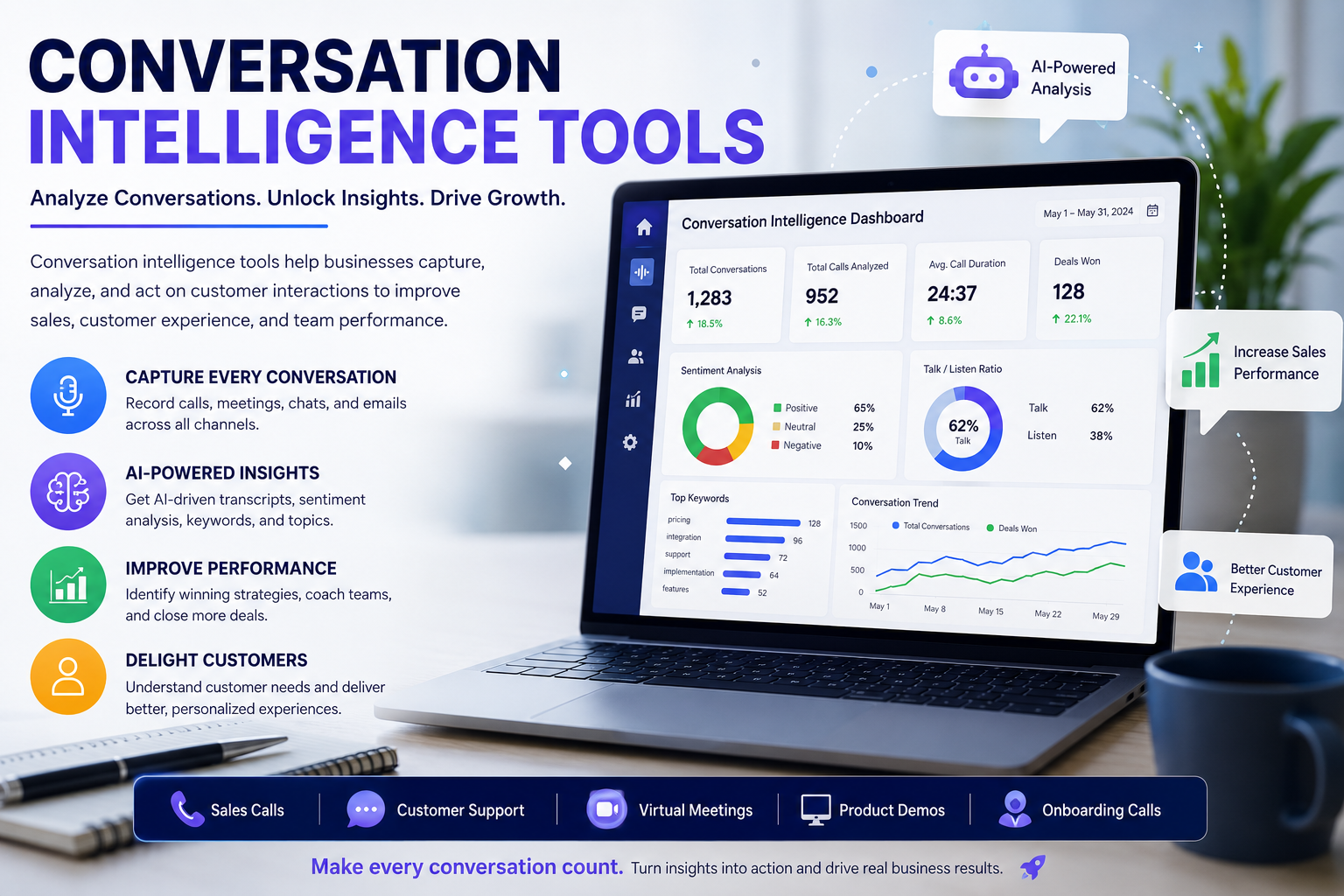
Explore 15 conversation intelligence tools in 2026 to boost sales, analyze customer interactions, and gain actionable insights for business growth.
Introduction
Sales teams have more customer conversations than ever, but turning those conversations into useful insights can be difficult. Conversation intelligence tools use AI to analyze calls, meetings, and customer interactions, helping businesses understand what customers really need. These platforms can highlight important topics, identify sales opportunities, track conversation trends, and help teams improve their communication. In 2026, businesses can use these tools to make smarter decisions, strengthen customer relationships, and improve sales performance.
Every customer conversation holds valuable insights. Whether it is a sales call, support chat, or demo meeting, there is always hidden data that can improve your business. The challenge is that most companies do not capture or analyze these conversations effectively.
In 2026, conversation intelligence tools have become essential for businesses looking to improve sales performance and understand customer behavior more effectively. These tools use AI to analyze calls, chats, and meetings, providing valuable insights into customer needs, sales strategies, and team performance. By capturing and analyzing real-time conversations, businesses can optimize communication, increase conversions, and enhance customer experience. In this guide, we’ll explore 15 powerful conversation intelligence tools that help transform sales processes and deliver actionable insights.
This is where conversation intelligence tools come in. These tools use advanced technology to record, analyze, and extract meaningful insights from customer interactions. They help businesses understand what customers want, improve communication, and increase conversions.
If you want to grow faster, improve your sales performance, and build stronger relationships with your customers, this guide will show you exactly how conversation intelligence tools can help.
What Are Conversation Intelligence Tools?
Conversation intelligence tools are software platforms that analyze voice and text interactions between businesses and customers. They use artificial intelligence to track keywords, sentiment, tone, and behavior patterns.
These tools can record calls, transcribe conversations, and provide insights that help teams make better decisions. They are widely used in sales, marketing, and customer support.
Instead of guessing what works, businesses can rely on real data to improve their strategies.
Why Conversation Intelligence Matters in 2026
Customer expectations are higher than ever. People want fast responses, personalized communication, and meaningful interactions. Businesses that fail to meet these expectations lose customers quickly.
Conversation intelligence tools help bridge this gap. They allow companies to understand customer needs in real time and respond more effectively.
Many growing companies even collaborate with the best account based marketing marketing agency to combine conversation insights with targeted campaigns. This approach leads to better engagement and higher conversion rates.
How Conversation Intelligence Tools Work
These tools use AI and machine learning to analyze conversations. They capture data from calls, emails, chats, and video meetings.
The system then processes this data to identify patterns. It highlights important moments such as objections, questions, and buying signals.
Managers and teams can review these insights to improve performance and optimize strategies.
Key Benefits of Conversation Intelligence Tools
Improved Sales Performance
Sales teams can learn what works and what does not. By analyzing successful calls, they can replicate winning strategies.
For example, if a specific phrase increases conversions, teams can use it more often. This leads to better results over time.
Better Customer Understanding
These tools reveal what customers are really thinking. They show common concerns, preferences, and pain points.
This helps businesses create better products and services.
Enhanced Team Training
Managers can use real conversations to train employees. Instead of theory, teams learn from real scenarios.
This makes training more effective and practical.
Data-Driven Decision Making
With accurate insights, businesses can make smarter decisions. They no longer rely on assumptions.
Data helps improve marketing, sales, and customer support strategies.
Top Conversation Intelligence Tools in the Market
Several tools are leading the market with advanced features and strong performance.
Gong is one of the most popular platforms. It focuses on sales conversations and provides deep insights into customer behavior.
Chorus is another powerful tool that helps teams analyze calls and improve communication strategies.
ExecVision focuses on coaching and performance improvement, making it ideal for training teams.
Avoma combines meeting management with conversation intelligence, offering a complete solution for businesses.
Each tool has its own strengths, and the right choice depends on your business needs.
Real-Life Example of Success
A SaaS company was struggling with low conversion rates. Their sales team was making calls, but results were inconsistent.
They started using a conversation intelligence tool to analyze their calls. The tool revealed that top-performing sales reps were asking better questions and handling objections more effectively.
By training the entire team using these insights, the company increased its conversion rate by 35 percent within three months.
This example shows how powerful these tools can be when used correctly.
How to Choose the Right Tool
Choosing the right conversation intelligence tool depends on your goals. If your focus is sales, look for tools with strong call analysis features.
If you want to improve customer support, choose tools that analyze chat and email interactions.
Integration is also important. The tool should work seamlessly with your existing systems.
Ease of use matters as well. A complex tool can slow down your team instead of helping them.
Common Mistakes to Avoid
Many businesses make the mistake of collecting data but not using it. Insights are only valuable if you act on them.
Another mistake is focusing only on technology and ignoring human interaction. Tools should support your team, not replace genuine communication.
Some companies also fail to train their teams properly, which reduces the effectiveness of these tools.
Avoid these mistakes to get the best results.
The Future of Conversation Intelligence
The future of conversation intelligence is very promising. As AI technology improves, these tools will become even more accurate and powerful.
Real-time insights will become more advanced. Businesses will be able to adjust their strategies instantly during conversations.
Voice recognition and sentiment analysis will also improve, making it easier to understand customer emotions.
Companies that adopt these tools early will have a strong competitive advantage.
How Conversation Intelligence Boosts Business Growth
Conversation intelligence tools do more than analyze data. They help businesses grow.
By improving communication, they increase customer satisfaction. Happy customers are more likely to return and recommend your business.
Better insights also lead to more effective marketing campaigns. When you understand your audience, you can target them more accurately.
This combination of improved sales, marketing, and customer experience drives long-term growth.
Practical Tips for Getting Started
Start by identifying your goals. Decide what you want to improve, whether it is sales performance, customer support, or marketing.
Choose a tool that fits your needs and budget. Begin with a small team and test the results.
Train your team to use the tool effectively. Encourage them to learn from insights and apply them in real situations.
Monitor your progress and make adjustments as needed.
Consistency is key to success.
Conclusion
Conversation intelligence tools are changing the way businesses understand and interact with customers. They provide valuable insights that can improve sales, enhance customer experience, and drive growth.
If you want to stay competitive in today’s market, investing in these tools is a smart decision. Combine them with expert strategies or work with the best account based marketing marketing agency to maximize your results.
Start using conversation intelligence today and unlock the full potential of your customer interactions.
FAQs
What are conversation intelligence tools used for?
They are used to analyze customer interactions, improve communication, and provide insights that help businesses make better decisions.
Are conversation intelligence tools expensive?
Costs vary depending on the features and scale. Many tools offer flexible pricing plans for different business sizes.
Can small businesses use these tools?
Yes, many tools are designed for small businesses and startups. They can help improve performance and growth.
Do these tools replace human interaction?
No, they support human interaction by providing insights. The human element is still very important.
How quickly can I see results?
Some improvements can be seen within weeks, especially in sales performance and customer engagement.
Are these tools difficult to use?
Most modern tools are user-friendly and easy to integrate with existing systems.
