

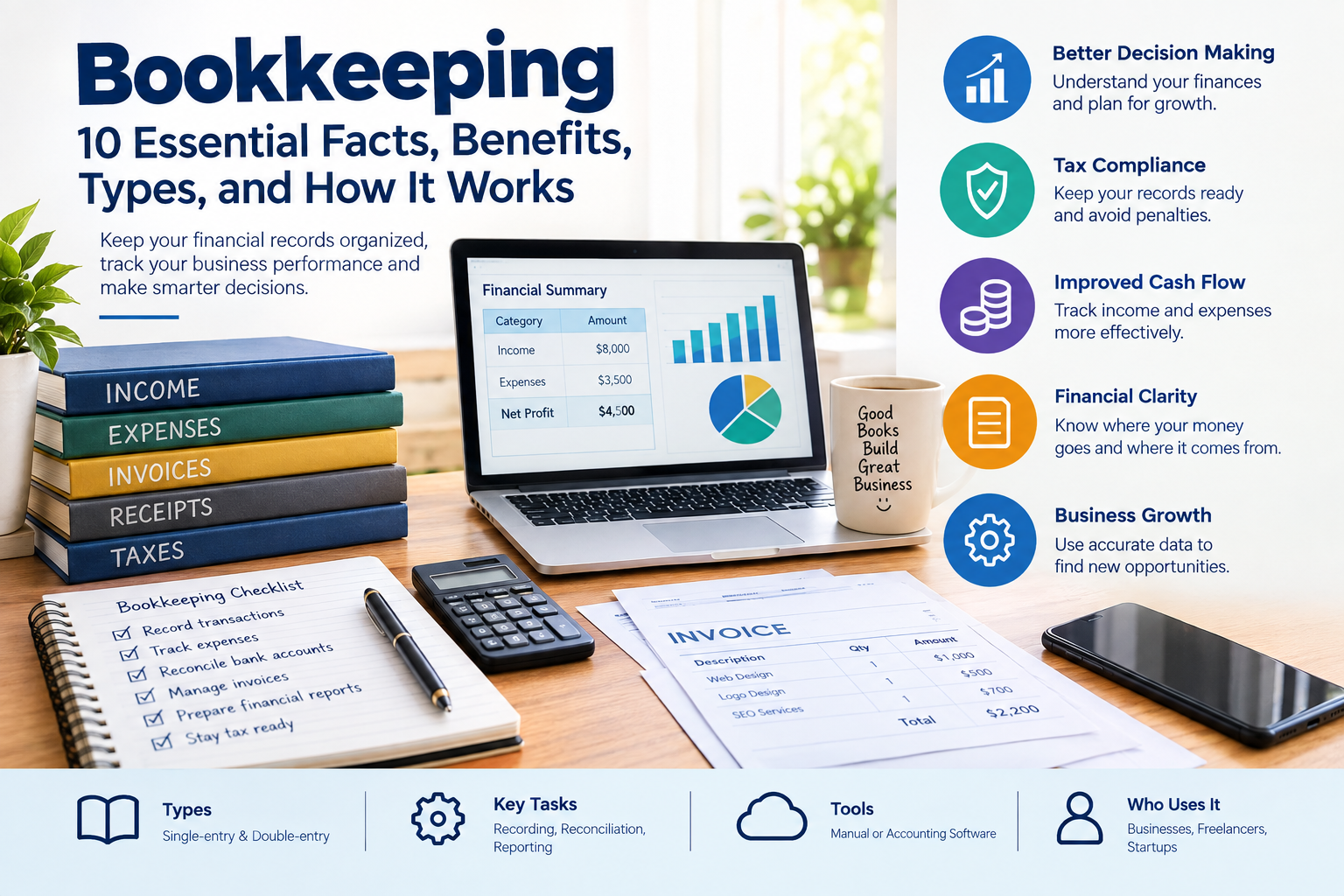
Learn 10 essential facts about bookkeeping, including its benefits, types, key processes, and how accurate financial records support business success.
Bookkeping is an essential part of managing a business because it keeps financial transactions organized and records accurate. It involves tracking income, expenses, sales, purchases, and other financial activities so businesses can understand their financial position. Whether a company handles bookkeeping manually or uses accounting software, accurate records can support better financial decisions and smoother business operations. This guide explains the key facts, benefits, types, and basic processes of bookkeeping in simple terms.
Running a business means dealing with sales, expenses, invoices, payments, payroll, taxes, and many other financial tasks. When these records are not organized, it becomes hard to know whether a business is actually making money.
This is where bookkeeping comes in.
Bookkeeping is the process of recording and organizing a business’s financial transactions. It helps business owners understand where money comes from, where it goes, and how the company is performing over time.
A small business may start with only a few transactions each week. As it grows, however, the number of invoices, purchases, bank transactions, employee payments, and customer payments can increase quickly. Without a proper bookkeeping system, small mistakes can turn into bigger financial problems.
The good news is that bookkeeping does not have to be complicated. With the right process and tools, businesses can keep accurate records and use them to make smarter decisions.
What Is Bookeeping?
Bookkeeping is the process of recording, organizing, and maintaining a business’s financial transactions.
These transactions can include sales, purchases, expenses, payments received, payments made, loans, and other financial activities.
For example, imagine a small online store sells a product for $500. The business needs to record the sale, the money received, and any costs related to that transaction.
If the business spends $200 on inventory and $50 on shipping, those expenses also need to be recorded.
Over time, these records help create a clear picture of the company’s financial position.
Bookkeeping is therefore one of the basic financial functions of almost every business.
Why Is Bookkeeping Important?
Accurate bookkeeping gives business owners reliable financial information.
Without proper records, an owner may look at the money in a bank account and assume the business is profitable. But the bank balance alone does not show unpaid bills, outstanding invoices, taxes, loans, inventory costs, or other financial obligations.
Good bookkeeping helps separate these details.
It also makes it easier to prepare financial statements and tax information. When records are complete and organized, an accountant or tax professional can work more efficiently.
Bookkeping can also help identify problems early.
For example, a business might discover that sales are increasing but profit is falling. By reviewing its records, the owner may find that supplier costs or operating expenses have increased.
Without accurate records, this problem could remain hidden.
Bookkeeping vs. Accounting
Bookkeping and accounting are closely related, but they are not exactly the same.
Bookkeeping mainly focuses on recording and organizing financial transactions.
Accounting goes further by analyzing financial information and using it to prepare reports, evaluate performance, and support financial decisions.
Think of bookkeping as building the financial record.
Accounting uses that record to understand what the numbers mean.
For example, a bookkeeper may record thousands of transactions during a year. An accountant may then use those records to prepare financial statements, calculate financial ratios, or help the business plan for taxes.
Both functions are important, but they serve different purposes.
How Does Bookkeeping Work?
The bookkeping process starts when a financial transaction occurs.
A business receives money from a customer, pays a supplier, buys equipment, pays rent, or incurs another business expense. The transaction is recorded in the accounting system.
The transaction is then assigned to an appropriate account.
For example, money received from a customer may be recorded as sales revenue. Office rent may be recorded as a rent expense.
Bank and credit card records can then be compared with the company’s bookkeeping records. This process is called reconciliation.
Regular reconciliation helps identify missing transactions, duplicate entries, bank fees, and other differences.
At the end of a reporting period, the financial records can be used to prepare reports.
The Main Types of Bookkeping
There are several ways to organize bookkeeping. The two main methods are single-entry and double-entry bookkeeping.
Single-Entry Bookkeping
Single-entry bookkeeping records transactions in a relatively simple way.
A small business owner may maintain a record of income and expenses. This method can be easier to understand and may work for some very small businesses with straightforward financial activity.
However, it provides less detailed information than double-entry bookkeeping.
As a business becomes more complex, it may need a more complete accounting system.
Double-Entry Bookkeping
Double-entry bookkeeping records every financial transaction in at least two accounts.
One side of the transaction is recorded as a debit and the other as a credit.
The basic principle is that the accounting records remain balanced.
For example, when a business buys equipment with cash, the equipment account increases while the cash account decreases.
This system provides a more complete view of financial activity and is widely used by businesses.
What Are the Main Bookkeping Tasks?
Bookkeeping can involve many routine financial tasks.
Recording income is one of the most basic tasks. Every sale should be recorded accurately so the business knows how much revenue it generated.
Recording expenses is equally important. Expenses can include rent, utilities, software, supplies, advertising, transportation, professional services, and other business costs.
Invoice tracking is another important part of bookkeeping. Businesses need to know which customers have paid and which invoices remain outstanding.
Bank reconciliation is also essential. It compares internal financial records with bank statements to identify differences.
Depending on the business, bookkeeping may also involve payroll records, sales tax records, accounts payable, accounts receivable, inventory records, and financial reporting.
What Is a Bookkeeper?
A bookkeeper is a person who maintains financial records for a business or organization.
A bookkeeper may record transactions, organize invoices, reconcile bank accounts, track payments, and maintain accounting records.
The exact responsibilities depend on the business.
A small business may hire one bookkeeper to handle most routine financial tasks. A larger company may have several people working on different parts of the accounting process.
Bookkeepers can work as employees, freelancers, or external service providers.
What Does a Bookkeeper Do Every Day?
The daily work of a bookkeeper depends on the size and type of business.
A bookkeeper may enter sales transactions, record expenses, review bank activity, match payments with invoices, and organize receipts.
They may also communicate with business owners about missing documents or unusual transactions.
For example, suppose a company receives a payment from a customer but cannot immediately identify which invoice it relates to. The bookkeeper may review the records and match the payment to the correct customer account.
This kind of work helps keep financial records accurate and up to date.
Bookkeping for Small Businesses
Bookkeping is especially important for small businesses.
Many small business owners manage sales, marketing, customer service, operations, and finances at the same time. Financial recordkeeping can easily become something they postpone.
That can create problems later.
Imagine a small marketing agency with 20 clients. Each month, it sends invoices, receives payments, pays software subscriptions, pays freelancers, and covers other operating costs.
If the owner only checks the bank account occasionally, it may be difficult to determine which clients have unpaid invoices or how much the business spends on software and contractors.
A regular bookkeeping process gives the owner a much clearer picture.
Bookkeeping for Freelancers
Freelancers also benefit from organized bookkeping.
A freelancer may receive payments from several clients and have expenses such as software subscriptions, internet services, equipment, advertising, and professional fees.
Keeping these transactions organized can make tax preparation easier and help the freelancer understand actual profit.
For example, a freelancer may receive $4,000 in payments during one month. If business expenses total $1,200, looking only at the $4,000 income can create a misleading picture.
The records show that the business generated $2,800 before other applicable costs and taxes.
This is why income and expenses should be tracked separately.
Bookkeeping for Startups
Startups often grow quickly, which can make financial recordkeping challenging.
A startup may have investor funding, payroll, software costs, office expenses, marketing costs, contractor payments, and other transactions.
Good bookkeeping helps founders understand their cash position.
Cash flow is especially important for a growing company. A business can have strong sales and still face financial pressure if customers pay slowly while expenses must be paid immediately.
Accurate records help founders monitor these issues.
Cash Flow and Bookkeeping
Cash flow refers to money moving into and out of a business.
Bookkeping helps track this movement.
Suppose a company sends a $10,000 invoice to a customer. The company may record the sale even if the customer has not paid yet, depending on its accounting method.
If the customer does not pay for 60 days, the business may still need money to cover salaries, rent, software, and other expenses.
Bookkeeping helps the business track both the sale and the outstanding payment.
This distinction between revenue and available cash is important for business planning.
Accounts Receivable and Accounts Payable
Two important areas of bookkeeping are accounts receivable and accounts payable.
Accounts receivable refers to money customers owe the business.
For example, if a company sends an invoice for $2,000 and has not received payment, that amount may appear as an account receivable.
Accounts payable refers to money the business owes to suppliers or other parties.
For example, if a company receives a $1,500 invoice from a software provider and has not paid it yet, that amount may be recorded as an account payable.
Tracking both helps a business understand its short-term financial obligations and expected incoming payments.
What Are Financial Statements?
Bookkeeping records provide the foundation for financial statements.
One major report is the income statement.
An income statement shows revenue, expenses, and profit or loss over a specific period.
Another important report is the balance sheet.
A balance sheet shows assets, liabilities, and owner’s equity at a particular point in time.
The cash flow statement focuses on cash movement through operating, investing, and financing activities.
These reports help owners, managers, investors, lenders, and other authorized users understand the financial health of a business.
Bookkeeping and Taxes
Good bookkeping can make tax preparation much easier.
Businesses usually need accurate records to determine income and eligible expenses according to the tax rules that apply to them.
If records are incomplete, the business may spend more time searching for receipts, invoices, and payment records.
A clean bookkeeping system keeps financial information organized throughout the year rather than forcing the owner to reconstruct everything at tax time.
Tax rules differ by country, state, province, and business structure. For tax-specific decisions, businesses should work with a qualified tax professional who understands the applicable rules.
Manual Bookkeeping vs. Software
Businesses can maintain bookkeping records manually, but accounting software has made the process much easier.
Modern bookkeeping software can automate many routine tasks.
For example, software can import bank transactions, create invoices, categorize expenses, generate reports, and help track unpaid invoices.
Automation can reduce repetitive work and lower the chance of simple data-entry mistakes.
However, software does not remove the need for human review.
A transaction can still be categorized incorrectly. A bank connection can fail. A duplicate entry can appear.
Good bookkeeping combines technology with regular human checks.
Cloud Bookkeeping
Cloud-based bookkeping allows financial information to be accessed through the internet.
Instead of keeping accounting records only on one computer, businesses can use online systems that store information securely on remote servers.
This can be useful for businesses with remote teams or external accountants.
For example, a business owner can provide an accountant with controlled access to financial records without sending large files back and forth.
Cloud systems can also support automatic backups and real-time collaboration, depending on the service.
Businesses should still pay attention to account security, access controls, passwords, and data protection.
How Automation Is Changing Bookkeeping
Automation is changing many routine bookkeping tasks.
Software can automatically import bank transactions and suggest categories. Invoicing platforms can send payment reminders. Receipt systems can capture information from uploaded documents.
Artificial intelligence is also being introduced into some financial software.
AI-powered tools can help identify transaction patterns, detect unusual activity, extract information from documents, and reduce repetitive data entry.
These tools can improve efficiency, but they should not replace professional judgment in situations that require careful financial or tax interpretation.
Common Bookkeeping Mistakes
One common mistake is mixing personal and business expenses.
For example, a business owner may use one bank card for both groceries and business software. This makes financial records harder to organize.
Another mistake is failing to reconcile bank accounts regularly.
Some business owners also wait until the end of the year to organize their books. This can create unnecessary stress and make it harder to identify problems early.
Missing receipts and invoices can also create issues.
A simple routine can prevent many of these problems.
Recording transactions regularly, keeping business and personal finances separate, reviewing accounts each month, and storing financial documents properly can make bookkeeping much easier.
How Often Should Bookkeeping Be Done?
There is no single schedule that works for every business.
A business with only a few monthly transactions may need less frequent bookkeeping.
A busy retail company with hundreds of transactions each day may need records updated much more often.
Many businesses benefit from weekly or monthly bookkeping.
Regular updates make it easier to track cash flow, identify unpaid invoices, monitor expenses, and prepare financial reports.
The key is consistency.
Bookkeeping that is done regularly is usually much easier to manage than bookkeeping that is left untouched for months.
How Much Does Bookkeeping Cost?
Bookkeping costs vary widely.
A freelancer with a small number of transactions may spend very little by using accounting software and handling basic records independently.
A larger business with payroll, inventory, multiple bank accounts, international transactions, or hundreds of monthly transactions may need professional bookkeeping services.
Pricing may be based on the number of transactions, hours worked, monthly service packages, business complexity, or other factors.
The cheapest option is not always the best option.
The real value of bookkeeping is not just entering numbers. Accurate records can help prevent costly mistakes and give business owners information they need to make decisions.
DIY Bookkeeping or Professional Bookkeeper?
Some business owners prefer to handle bookkeping themselves.
This can work when the business is small and transactions are simple.
DIY bookkeeping can also help owners understand their finances more closely.
However, professional help can become valuable as a business grows.
A professional bookkeeper can save time, organize records, reconcile accounts, and identify issues that an inexperienced business owner might overlook.
The right choice depends on transaction volume, financial complexity, available time, and the owner’s comfort with accounting systems.
How to Choose a Bookkeeping Service
When choosing a bookkeping service, businesses should consider experience, software knowledge, communication, pricing, and the type of businesses the provider serves.
It is also important to understand exactly what is included.
For example, one service may only record transactions, while another may include bank reconciliation, accounts receivable, accounts payable, payroll support, and financial reports.
Businesses should also ask how financial information is protected and who will have access to it.
Clear communication is important because bookkeping involves sensitive financial information.
A Simple Bookkeeping Example
Consider a small web design company.
During one month, the company receives $8,000 from clients.
It spends $1,500 on freelance designers, $500 on software, $800 on advertising, and $700 on other business expenses.
Bookkeeping records each transaction separately.
The business can then see that its revenue was $8,000 and its listed expenses were $3,500.
That leaves $4,500 before considering other applicable costs, taxes, and accounting adjustments.
This simple example shows why bookkeeping matters. Instead of looking only at money entering the bank account, the owner can see the relationship between revenue and expenses.
Bookkeeping Best Practices
A strong bookkeeping system should be simple enough to maintain consistently.
Business owners should keep business and personal transactions separate whenever possible.
They should also keep invoices, receipts, bank statements, and other supporting documents organized.
Bank accounts should be reconciled regularly.
Unpaid customer invoices should be reviewed so the business knows what money it is waiting to receive.
Expenses should be categorized consistently.
Financial reports should also be reviewed regularly rather than only at tax time.
These habits can turn bookkeeping from a stressful task into a useful management tool.
The Future of Bookkeeping
Bookkeeping will continue to become more digital and automated.
Cloud software, artificial intelligence, bank integrations, electronic invoices, automated payment systems, and digital receipts are reducing the amount of manual data entry required.
However, the basic purpose of bookkeeping will remain the same.
Businesses still need accurate financial records.
Technology can make the process faster, but businesses still need people who understand financial information, review unusual transactions, protect sensitive data, and make informed decisions.
The future of bookkeeping is therefore likely to combine automation with human oversight.
Frequently Asked Questions About Bookkeeping
What is bookkeeping in simple words?
Bookkeeping is the process of recording and organizing a business’s financial transactions, such as income, expenses, payments, and purchases.
What is the main purpose of bookkeeping?
The main purpose is to keep accurate financial records. These records help businesses track money, monitor performance, prepare financial reports, and support tax and financial planning.
What is the difference between bookkeeping and accounting?
Bookkeeping focuses mainly on recording and organizing financial transactions. Accounting involves analyzing those records, preparing financial statements, and using financial information to support decisions.
Is bookkeeping difficult to learn?
Basic bookkeeping can be learned with practice. Understanding transactions, accounts, debits, credits, reconciliation, and financial statements takes time, but many modern accounting tools make routine tasks easier.
Can I do my own bookkeeping?
Yes. Some small businesses and freelancers handle their own bookkeeping, especially when they have simple financial activity. As the business becomes more complex, professional support may become useful.
Is bookkeeping necessary for a small business?
Keeping accurate financial records is important even for a small business. Good records help owners understand income, expenses, cash flow, unpaid invoices, and other financial information.
How often should a small business do bookkeeping?
The ideal schedule depends on transaction volume and business complexity. Many businesses benefit from updating and reviewing their records weekly or monthly rather than waiting until the end of the year.
What software is used for bookkeeping?
Businesses use many types of accounting and bookkeeping software. The right choice depends on the company’s size, industry, number of transactions, payroll needs, invoicing requirements, and reporting needs.
What is double-entry bookkeeping?
Double-entry bookkeeping records each financial transaction in at least two accounts using debits and credits. The system helps keep accounting records balanced and provides a more complete financial picture.
What is bank reconciliation in bookkeeping?
Bank reconciliation is the process of comparing a business’s bookkeeping records with its bank statement. It helps identify missing transactions, errors, duplicate entries, and other differences.
Does bookkeeping help with taxes?
Yes. Organized bookkeeping can make it easier to determine business income and expenses and provide records needed for tax preparation. Specific tax requirements depend on the applicable laws and the business’s location and structure.
Can AI replace bookkeepers?
AI and automation can handle many repetitive bookkeeping tasks, but they do not eliminate the need for human review and judgment. Bookkeepers and accounting professionals can still play an important role in checking records and handling complex situations.
Conclusion
Bookkeeping is much more than entering numbers into a spreadsheet. It gives a business a clear record of its financial activity and helps owners understand what is happening with their money.
Accurate bookkeeping can make it easier to track income, control expenses, monitor cash flow, follow up on unpaid invoices, prepare financial reports, and organize information for tax purposes.
Whether you run a small shop, work as a freelancer, manage an online business, or operate a growing company, a consistent bookkeeping process can make financial management much easier.
Start by keeping business and personal transactions separate, recording income and expenses regularly, saving important financial documents, and reconciling your accounts on a consistent schedule. If your finances become more complex, consider working with a qualified bookkeeper or accounting professional.
Good financial records give you something every business owner needs: a clearer view of where the business stands today and where it can go next.
