
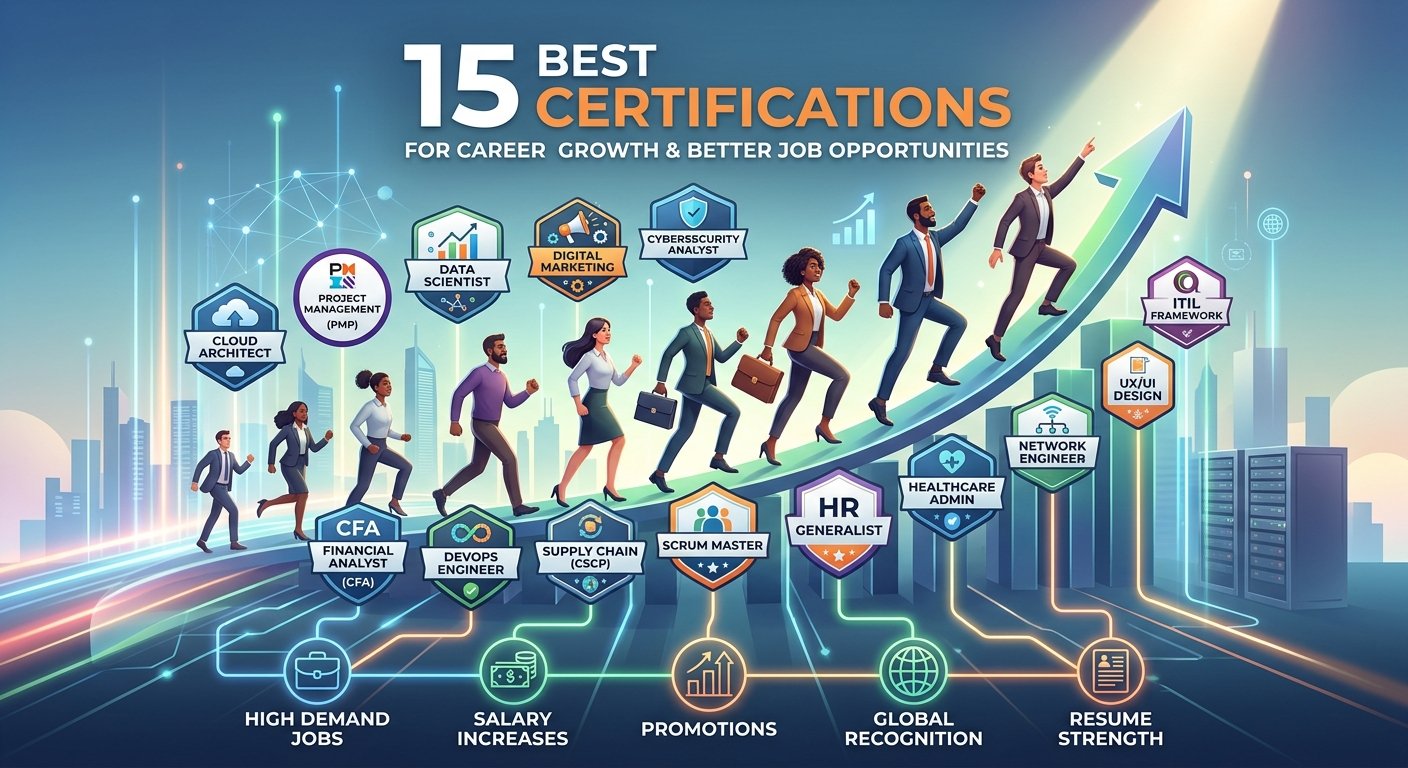
Explore 15 best certifications to get for career growth, higher earning potential, stronger skills, and better job opportunities across industries.
Professional certifications can help job seekers demonstrate specialized knowledge, strengthen their resumes, and stand out in competitive job markets. The best certifications to get depend on your career goals, industry, experience, and the skills employers are looking for. In 2026, certifications in areas such as technology, project management, cybersecurity, data, cloud computing, and business can provide valuable opportunities for professional development. This guide explores 15 certifications worth considering for career growth and better job prospects.
A strong degree can help you start a career, but it may not be enough to keep moving forward. Employers often look for people who can show practical skills, current knowledge, and a willingness to learn. This is where professional certifications can make a real difference.
The best certifications to get for career growth depend on your field, experience, career goals, and the type of job you want. A certification can help you learn a new skill, strengthen your resume, qualify for a new role, or move toward a higher-level position.
For example, someone interested in project management may benefit from a project management certification. A person moving into technology may choose a cloud, cybersecurity, or data certification. Marketing professionals may focus on digital marketing, analytics, or sales-related credentials.
The important thing is not to collect certificates simply to make your resume longer. The best certification is one that teaches a useful skill and supports the career path you actually want.
In this guide, we will explore some of the best certifications to get for career growth, who they are suitable for, what they can teach you, and how to choose the right one.
What Is a Professional Certification?
A professional certification is a credential that shows you have completed a specific learning or assessment process related to a particular skill or profession.
Certifications are usually offered by professional organizations, technology companies, universities, and recognized training providers.
They can cover many areas, including information technology, business, project management, cybersecurity, cloud computing, data analytics, marketing, finance, and human resources.
A certification is different from a college degree. A degree usually provides broad education over several years, while a certification often focuses on a specific skill or professional area.
For someone already working, a certification can be a practical way to build specialized knowledge without returning to school for another full degree.
Why Certifications Matter for Career Growth
The job market changes quickly. New technologies, tools, and work methods appear every year. Employers need people who can keep their skills current.
A good certification can show that you have taken the time to develop knowledge in a specific area.
Certifications can also help career changers. Suppose someone works in administration but wants to move into project management. Learning project planning, risk management, scheduling, and stakeholder communication can make the transition easier.
Google Career Certificates can help learners build job-ready skills in areas such as data analytics, digital marketing, IT support, and project management.
Certifications may also help experienced professionals move into higher-level roles. A person with several years of IT experience, for example, may use a cloud or security best certifications to get for career growth to demonstrate expertise in a growing specialization.
However, certification alone does not guarantee a job or promotion. Employers usually consider experience, communication, education, technical skills, and results along with credentials.
How to Choose the best certifications to get for career growth
The best certification is not necessarily the most famous or expensive one.
Start by identifying the job you want. Look at several job descriptions and see which skills employers commonly request.
For example, if your target roles frequently mention SQL, data visualization, and business analytics, a data-focused certification may be more useful than a general business certificate.
You should also consider your current skill level.
Beginners may benefit from foundational best certifications to get for career growth, while experienced professionals may need advanced credentials that match their existing knowledge.
Cost and preparation time also matter. A certification that takes months of study may not be practical if you need a quick skill upgrade.
Most importantly, check whether the certification is recognized in the industry you want to enter.
1. Project Management Professional Certification
Project management is useful in almost every industry. Companies need people who can plan work, manage deadlines, control budgets, communicate with teams, and deliver projects.
The Project Management Professional, commonly known as PMP, is one of the best-known professional credentials in project management.
It is designed for people with project management experience and covers areas such as planning, execution, risk, stakeholders, and project delivery.
For an experienced professional, this certification can strengthen a resume when applying for project manager, program manager, and related positions.
It may not be the best first certification for someone with no project experience. Beginners can start with a foundational project management credential and build experience before moving to an advanced certification.
2. CompTIA A+ Certification
For people starting an IT career, CompTIA A+ can provide a useful foundation.
It covers fundamental technology skills such as hardware, operating systems, troubleshooting, networking basics, and security concepts.
This certification can be relevant for entry-level technical support and IT support roles.
For example, someone who wants to become a help desk technician can use A+ preparation to understand how computers work and how common technical problems are solved.
It is especially useful for beginners who want a structured introduction to IT.
3. CompTIA Security+ Certification
Cybersecurity continues to be an important area of technology.
CompTIA Security+ is designed around foundational cybersecurity knowledge. It covers topics related to threats, vulnerabilities, security operations, access control, and risk management.
This certification can be useful for people beginning a cybersecurity career or IT professionals who want to build security knowledge.
A beginner should understand basic networking and computer concepts before starting serious Security+ preparation. Strong fundamentals can make the learning process much easier.
4. AWS Certifications
Cloud computing has become an important part of modern technology infrastructure.
Amazon Web Services offers certifications for different levels of cloud knowledge and different technical roles.
For beginners, a foundational cloud certification can help explain basic cloud concepts. More advanced certifications can focus on areas such as cloud architecture, development, security, and operations.
AWS certifications can be especially valuable for IT professionals who want to move toward cloud-related careers.
For example, a systems administrator who already understands servers and networking may use cloud training to move toward a cloud engineering role.
5. Microsoft Azure Certifications
Microsoft Azure is another major cloud platform.
Azure certifications cover several professional paths, including cloud administration, development, data, security, and AI.
The right certification depends on your career goal.
A beginner can start with foundational cloud concepts. Someone with technical experience may choose a certification related to administration, development, security, or architecture.
Azure skills can also complement existing Microsoft technology knowledge.
6. Google Cloud Certifications
Google Cloud offers professional credentials for people working with cloud technology, data, security, machine learning, and related areas.
Google best certifications to get for career growth can be useful for technology professionals who want to develop cloud expertise in the Google Cloud ecosystem.
A data professional, for example, may focus on data engineering or analytics-related learning, while an IT professional may choose a cloud infrastructure path.
7. Certified Information Systems Security Professional
The Certified Information Systems Security Professional, or CISSP, is an advanced cybersecurity credential.
It is aimed at experienced cybersecurity professionals rather than complete beginners.
The certification covers broad areas of information security and is often associated with security leadership and advanced professional responsibilities.
Someone considering CISSP should first build substantial cybersecurity experience and understand the certification’s eligibility requirements.
For an experienced security professional, it can be a strong addition to a long-term career development plan.
8. Certified ScrumMaster
Agile methods are widely used by software and product teams.
The Certified ScrumMaster credential focuses on Scrum principles, team collaboration, facilitation, and the Scrum Master’s role.
It can be useful for professionals interested in Agile project environments.
For example, someone working as a project coordinator may want to understand Agile practices before moving into a Scrum Master or Agile delivery role.
The value of this type of certification is strongest when combined with practical experience working with teams.
9. Google Data Analytics Certification
Data skills are useful across many industries.
Google’s Data Analytics Professional Certificate provides an entry-level learning path for people who want to understand data analysis.
It introduces concepts such as data cleaning, analysis, visualization, and communicating findings.
It can be suitable for beginners who want to explore data analytics before committing to a more advanced technical path.
A learner can strengthen the certification by creating practical projects using spreadsheets, SQL, and data visualization tools.
10. Salesforce Certifications
Salesforce is widely used for customer relationship management and business operations.
Salesforce offers certifications for different roles and skills within its ecosystem.
These credentials can be useful for people interested in CRM administration, development, consulting, and related careers.
For someone working in sales operations or customer management, learning Salesforce can provide a practical technology skill that connects business knowledge with software expertise.
11. HubSpot Certifications
Digital marketing professionals can benefit from certifications focused on marketing, sales, content, and customer relationship management.
HubSpot provides educational certifications covering areas such as inbound marketing, email marketing, content marketing, social media, and sales.
These certifications can be useful for beginners because they introduce practical marketing concepts.
A person building a digital marketing career can combine best certifications to get for career growth learning with real projects, such as creating content strategies, email campaigns, landing pages, and analytics reports.
12. Google Ads Certifications
Paid advertising is an important digital marketing skill.
Google Ads certifications can help marketers understand how advertising campaigns work across Google’s advertising ecosystem.
They can cover areas such as search advertising, display advertising, video advertising, shopping, and measurement.
Certification is only one part of becoming a good paid advertising professional. Real campaign experience, budget management, testing, conversion tracking, and performance analysis are also important.
Still, structured learning can help beginners understand the basics before they work with larger advertising budgets.
13. Meta Marketing Certifications
Social media advertising has become an important skill for digital marketers.
Meta offers professional certification paths related to its advertising ecosystem.
These credentials can help learners understand advertising concepts, campaign planning, measurement, and related marketing practices.
For someone who wants to work in social media marketing or paid advertising, this type of credential can complement practical campaign experience.
14. Certified Public Accountant
Accounting and finance professionals may benefit from specialized professional credentials.
The Certified Public Accountant, or CPA, is a major accounting credential in the United States and has specific education, examination, and licensing requirements.
It is not a general career certificate that anyone can complete quickly. Eligibility varies by jurisdiction.
For someone committed to an accounting career, however, professional accounting credentials can have significant long-term value.
People outside the United States should check the professional accounting requirements in their own country before choosing a credential.
15. SHRM Certifications
Human resources professionals can develop their careers through recognized HR certifications.
The Society for Human Resource Management offers professional credentials for HR practitioners.
These credentials can cover areas related to HR knowledge, workplace practices, employee relations, talent management, and organizational responsibilities.
An HR professional can use best certifications to get for career growth to demonstrate continued professional development while also building practical experience in recruitment, employee development, and HR operations.
Best Certifications for Career Changers
Career changers should avoid choosing a certification simply because it appears popular online.
Instead, identify the target career first.
Suppose you have a background in English or communication and want to move into digital marketing. Marketing analytics, content marketing, SEO, email marketing, or advertising certifications may provide a logical starting point.
If you want to move into IT, a foundational technology certification can help you learn basic technical concepts.
For project management, an entry-level credential and practical project experience may provide a better starting point than immediately attempting an advanced certification.
The goal is to build a bridge between your existing skills and your desired career.
Best Certifications for Beginners
Beginners should focus on best certifications to get for career growth that match their current knowledge.
A difficult advanced credential can become frustrating if you do not understand the basics.
For technology, foundational IT and cloud certifications can provide a starting point.
For marketing, introductory digital marketing and analytics certifications can help build core knowledge.
For project management, foundational training can teach concepts such as project planning, timelines, stakeholders, and risk.
A good beginner certification should make you more capable, not simply give you another line on your resume.
Best Certifications for High-Paying Careers
Some certifications can support careers that have strong earning potential, particularly when they are combined with experience.
Cloud computing, cybersecurity, data analytics, project management, finance, and specialized technology roles can offer strong career opportunities.
However, salary depends on many factors, including location, experience, industry, company size, specialization, and job responsibilities.
A certification should therefore be viewed as part of a career strategy rather than a guarantee of a high salary.
For example, an entry-level cloud certificate may help you understand the field, but real-world cloud projects and professional experience are usually needed to move into advanced roles.
Certifications vs Degrees
A degree and a certification serve different purposes.
A degree provides broad academic education and may be required for certain professions. Certifications usually focus on a particular skill or professional area.
Someone starting a career may benefit from a degree combined with relevant certifications.
Someone already working may use certifications to update skills without completing another degree.
The right choice depends on the career.
For regulated professions, formal education and licensing may be essential. For technology and digital careers, skills, projects, experience, and certifications may all contribute to employability.
How to Make a Certification More Valuable
A certificate becomes much more useful when you can demonstrate the skill behind it.
After completing a certification, try to apply what you learned.
A data analytics learner could analyze a public dataset and create a dashboard.
A digital marketer could build a sample campaign plan.
A project management learner could create a complete project schedule and risk plan.
An IT learner could build a small lab environment and document troubleshooting exercises.
These projects give employers something concrete to evaluate.
They also help you remember what you studied.
Should You Get Multiple Certifications?
You do not need dozens of certifications.
In many cases, one relevant certification combined with strong practical skills is more valuable than ten unrelated certificates.
Choose credentials that build toward a clear career direction.
For example, an IT professional might build from foundational IT knowledge into networking, cloud, or security. A marketing professional might combine digital marketing knowledge with analytics and advertising skills.
A focused learning path is easier to explain during an interview.
How Long Does It Take to Get Certified?
The time required varies widely.
Some beginner certificates can be completed within weeks or a few months. Advanced professional certifications may require months of preparation and significant professional experience.
Your study schedule also matters.
Someone studying one hour each day will progress differently from someone studying several hours daily.
The best approach is to create a realistic study plan and practice consistently rather than trying to finish as quickly as possible.
Are Online Certifications Worth It?
Online certifications can be valuable when they are relevant, credible, and connected to real skills.
Before paying for a course, research the organization that issues the credential and check whether employers in your target field recognize it.
Do not assume that every certificate advertised online has equal value.
A credential from a recognized professional organization or major technology company may carry more weight than an unknown certificate provider.
The most important question is simple: Will this certification help me become better qualified for the job I want?
Final Thoughts
The best certifications to get for career growth depend on where you are now and where you want to go.
There is no single certificate that is perfect for everyone. A technology professional may benefit from cloud or cybersecurity credentials, while a marketer may gain more from advertising, analytics, or marketing certifications. Project managers, finance professionals, HR specialists, and data professionals also have specialized options.
Before choosing a best certifications to get for career growth, study your target job market, check the skills employers request, understand the requirements, and consider the total cost and preparation time.
Most importantly, do not stop at the certificate. Use what you learn in real projects, build a portfolio when possible, and develop communication and problem-solving skills alongside technical knowledge.
If you are planning your next career move, choose one certification that matches your goal, create a study plan, and start building the skills that can move you closer to the job you want.
Frequently Asked Questions About Career Certifications
What are the best certifications to get for career growth?
The best certification depends on your career. Popular options include project management, cloud computing, cybersecurity, data analytics, digital marketing, accounting, HR, and IT certifications.
Which certification is best for getting a job quickly?
There is no best certifications to get for career growth that guarantees quick employment. Entry-level IT, data analytics, digital marketing, and cloud certifications can provide useful starting points, but practical skills and job-search strategy are also important.
Are best certifications to get for career growth?
Yes, a relevant certification can be worthwhile when it teaches a skill employers value. Its impact is usually stronger when combined with practical experience and measurable work results.
Which certification is best for beginners?
Beginners should choose a foundational best certifications to get for career growth that matches their target career. IT beginners may explore entry-level technology credentials, while aspiring marketers can start with digital marketing or analytics training.
Can certifications replace a degree?
Usually, no. Certifications and degrees serve different purposes. Some professions require formal degrees and licenses, while many technology and digital roles place significant value on practical skills and professional credentials.
Do certifications increase salary?
A certification can support career advancement and may help qualify someone for new roles, but it does not automatically increase salary. Experience, job role, location, skills, and employer demand also affect earnings.
How many certifications should I have?
Quality is more important than quantity. A few relevant best certifications to get for career growth that support a clear career path are generally more useful than collecting many unrelated certificates.
What certification is best for changing careers?
The best option depends on the career you want to enter. Start by reviewing job descriptions in your target field and identify the skills and credentials employers commonly request.
Are free certifications useful?
Some free best certifications to get for career growth can provide useful knowledge and demonstrate initiative. However, their value depends on who provides them and whether employers recognize the credential.
Should I get a certification before applying for jobs?
Not always. If you already have enough skills for an entry-level role, you can apply while studying. In many fields, practical experience and projects can be developed alongside best certifications to get for career growth preparation.
What makes a certification valuable?
A valuable certification usually comes from a credible organization, teaches relevant skills, has clear assessment standards, and is recognized by employers in the industry.
Is an online certificate enough to get a job?
An online certificate alone may not be enough. Employers often want evidence that you can use the skills in real situations. Projects, portfolios, internships, work experience, and strong communication can make your best certifications to get for career growth more useful.
