
Discover the 7 best fitness trackers in 2026 for tracking workouts, daily activity, sleep, heart rate, and other fitness goals.
A best fitness trackers can make it easier to understand daily activity and stay consistent with personal fitness goals. Modern trackers can monitor steps, workouts, heart rate, sleep, and other useful activity metrics, depending on the device. With so many options available in 2026, choosing the best fitness tracker depends on your goals, budget, preferred features, and smartphone compatibility. This guide explores seven smart options for different types of users, from everyday activity tracking to more advanced fitness needs.
Choosing the best fitness tracker can make it easier to understand your daily activity and stay consistent with your fitness goals. A good tracker can count your steps, monitor heart rate, record workouts, track sleep, and show useful trends over time.
But not every best fitness tracker is made for the same person. A runner may need accurate GPS and training tools. Someone focused on sleep may care more about comfort and battery life. A beginner may want a simple fitness band that tracks the basics without adding too many features.
In 2026, fitness trackers range from simple activity bands to advanced smartwatches. Some focus on long battery life, while others offer detailed workout data and health insights. The right choice depends on what you actually need.
This guide explains what to look for and explores some of the strongest options for different types of users.
What Is a Fitness Tracker?
A best fitness trackers is a wearable device designed to monitor physical activity and selected health and wellness information. Most models use sensors to measure movement, heart rate, and other signals.
Depending on the model, a best fitness tracker may count steps, estimate calories burned, monitor sleep, measure blood oxygen, track workouts, record heart rate, and provide reminders to move.
Some devices are small bands with a simple screen. Others look more like traditional watches and include GPS, apps, notifications, music controls, and advanced training features.
The important thing is not to choose the device with the longest feature list. Instead, choose one that matches your lifestyle.
What Makes the Best Fitness Tracker?
The best fitness tracker should be comfortable enough to wear regularly, simple enough to use, and accurate enough to make its information useful.
Battery life is another major factor. A tracker that needs charging every day can become annoying, especially if you want to monitor sleep. A device that lasts several days can be much easier to live with.
The mobile app also matters. A tracker collects data, but the app helps you understand it. A good app should show trends in a clear way instead of giving you a confusing wall of numbers.
Compatibility is important too. Some fitness trackers work with both Android and iPhone, while others offer their best experience when paired with a specific phone brand.
Best Fitness Tracker Overall
For many users, the best fitness tracker is not necessarily the most expensive model. It is the device that provides the right balance of tracking, comfort, battery life, and ease of use.
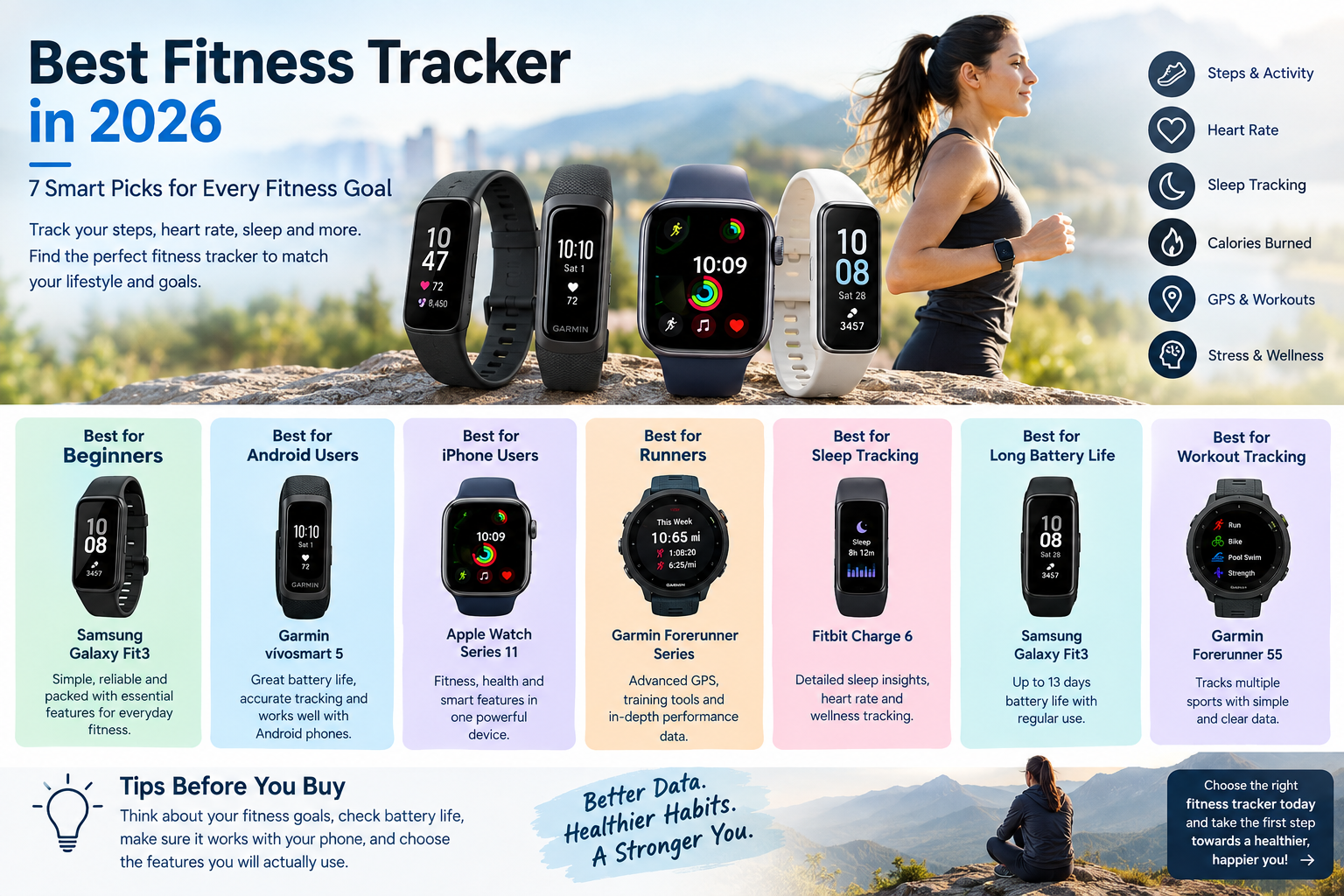
The Fitbit Charge 6 remains an appealing choice for people who want a dedicated fitness-focused wearable with a slim design. It is aimed at users who care about everyday activity, heart rate, workouts, sleep, and related health trends.
The Garmin vívosmart 5 is another good option for people who prefer a simple fitness band rather than a full smartwatch. Garmin says the vívosmart 5 offers up to seven days of battery life and tracks activity, heart rate, sleep, stress, Pulse Ox, and Body Battery information.
For iPhone users who want a wider smartwatch experience, the Apple Watch Series 11 offers fitness tracking alongside notifications, apps, safety features, and health tools. Apple lists up to 24 hours of battery life for the Series 11.
The best option therefore depends on how you plan to use the device.
Best Fitness Tracker for Beginners
Beginners often do not need advanced training statistics.
If you are starting a walking routine, trying to become more active, or simply want to understand your daily movement, a simple fitness band can be a better choice than an expensive sports watch.
The Samsung Galaxy Fit3 is designed as a lightweight best fitness tracker band and tracks more than 100 exercises. Samsung says it can provide up to 13 days of battery life under its specified conditions, although actual battery life varies with settings and usage.
It also tracks steps, activity, heart rate, stress, blood oxygen, and sleep. Samsung states that the Galaxy Fit3 is compatible with Android phones and does not support iPhone pairing.
For a beginner who already uses an Android phone, this can make the Galaxy Fit3 an interesting choice.
Best Fitness Tracker for Android Users
Android users have a wide range of choices.
The Samsung Galaxy Fit3 is especially useful for people who want a slim band and already use a Galaxy phone. Its 1.6-inch AMOLED display makes activity information easy to see, while its lightweight body is designed for everyday wear. Samsung lists the device at 18.5 grams without the band.
The Garmin vívosmart 5 is another option. Garmin designed it as a simple alternative to a smartwatch. It works with compatible Android and Apple phones and provides notifications, activity tracking, sleep information, heart rate monitoring, and other wellness features.
Android users should also look at full smartwatches if they want apps, GPS, music controls, and more advanced workout functions.
Best Fitness Tracker for iPhone Users
For iPhone owners, the Apple Watch ecosystem is one of the strongest choices.
The Apple Watch is more than a fitness band. It combines activity tracking with communication, safety, apps, notifications, and health features.
Apple introduced training load and the Vitals app in watchOS 11, giving users more ways to understand workout effort and daily health trends.
The Apple Watch Series 11 adds sleep score and hypertension notifications, along with a battery rating of up to 24 hours.
The main drawback is battery life compared with simpler best fitness tracker bands. If you strongly prefer a tracker that can run for a week or more between charges, a dedicated fitness band may suit you better.
Best Fitness Tracker for Runners
Runners often need more than step counting.
GPS accuracy, pace, distance, heart rate, recovery information, training plans, and workout analysis can become important when running regularly.
This is where Garmin’s sports watches have a strong advantage. Garmin offers dedicated running watches with detailed training features, while the vívosmart 5 is better suited to basic activity tracking.
The vívosmart 5 can connect to compatible GPS through a smartphone to track outdoor activities, while Garmin’s dedicated running watches can provide more advanced GPS and training tools.
If running is your main sport, a running watch may therefore be a better investment than a basic fitness tracker.
Best Fitness Tracker for Sleep Tracking
Sleep tracking has become one of the most popular features in wearable technology.
A good sleep tracker can show estimated sleep duration and provide information about sleep stages and other nighttime measurements. But these measurements should be treated as wellness information rather than a medical diagnosis.
Comfort is especially important for sleep tracking. A large or heavy smartwatch may feel uncomfortable when worn overnight.
The Samsung Galaxy Fit3 is designed to be slim and lightweight. Samsung says it tracks sleep patterns and provides information related to sleep stages and blood oxygen.
Garmin’s vívosmart 5 also includes sleep score and sleep insights. Garmin says its sleep analysis considers factors such as sleep stages, movement, and stress.
The best sleep tracker is therefore often the one you can comfortably wear every night.
Best Fitness Tracker for Long Battery Life
Battery life can completely change the daily experience of a wearable.
If you need to charge your device every night, you may miss sleep tracking. If you forget to charge it before a workout, you may also lose useful data.
Fitness bands generally have an advantage over full smartwatches in this area.
Samsung lists up to 13 days of battery life for the Galaxy Fit3 with its specified usage conditions. Its always-on display can reduce battery life significantly.
Garmin lists up to seven days for the vívosmart 5.
Apple lists up to 24 hours for the Apple Watch Series 11.
These figures show why battery life should be one of the first things you check before buying a fitness tracker.
Best Fitness Tracker for Workout Tracking
Workout tracking is useful for people who want to understand how often they exercise and how their activity changes over time.
A good tracker should make starting a workout easy. Automatic workout detection can also help when you forget to manually start a session.
Samsung says the Galaxy Fit3 can automatically recognize several popular activities and supports more than 100 exercises.
Garmin offers a broader range of sports-focused features across its product line. The vívosmart 5 includes sports apps for activities such as walking, swimming, cycling, yoga, and cardio.
For casual workouts, a fitness band may be enough. For structured training, a dedicated sports watch can provide much deeper information.
Fitness Tracker vs Smartwatch
A fitness tracker and a smartwatch can look similar, but they serve different purposes.
A fitness tracker usually focuses on health, activity, and workout monitoring. It is often smaller, lighter, and has better battery life.
A smartwatch usually offers more general smartphone functions. You may receive notifications, use apps, control music, answer calls, access navigation, and perform other tasks directly from your wrist.
For someone who only wants step counting, sleep tracking, and workouts, a fitness band can be a smart choice.
For someone who wants a miniature smartphone on their wrist, a smartwatch makes more sense.
There is no universal winner. The best fitness tracker is the one that fits your daily routine.
How Accurate Are Fitness Trackers?
Fitness trackers can be useful, but their measurements are estimates.
Step counting can be affected by movement and how the device is worn. Heart rate readings can change based on wrist position, movement, fit, skin contact, and exercise intensity.
Calories burned are also estimates rather than exact measurements.
This does not mean fitness trackers are useless. Their biggest value often comes from trends.
For example, you may notice that you normally walk 4,000 steps per day and gradually increase that number to 6,000 or 7,000. The exact number may not be perfect, but the trend can still help you stay aware of your activity.
The same idea applies to sleep and heart rate data.
What Features Should You Look For?
Start with your main goal.
If your goal is walking, focus on steps, comfort, battery life, and basic heart rate tracking.
If your goal is running, prioritize GPS, pace, distance, workout analysis, and training tools.
If your goal is better sleep habits, choose a lightweight device with strong battery life and comfortable overnight wear.
If you want a device that replaces some phone functions, look for a smartwatch with notifications, apps, calls, and other smart features.
Do not pay for features you will never use.
Do You Need Built-In GPS?
Built-in GPS can be useful if you run, cycle, hike, or walk outdoors and want to record your route without carrying your phone.
Some simpler trackers use connected GPS, which means they rely on your smartphone for location information.
A dedicated sports watch with built-in GPS is more useful for people who regularly train outdoors.
For someone who mostly walks around the neighborhood with a phone in their pocket, connected GPS may be perfectly adequate.
Are Fitness Trackers Worth the Money?
A fitness tracker can be worth the money if it helps you become more consistent.
The device itself does not make you fit. Your habits do.
A tracker can simply make those habits easier to see.
For example, someone may notice that they rarely move during long workdays. Seeing daily activity numbers could encourage them to take short walks during breaks.
Another person may use a tracker to maintain a regular running schedule.
The value comes from how you use the information.
How to Choose the Right Fitness Tracker
Start by deciding how much tracking you actually need.
If you want a simple device for everyday activity, choose a lightweight band with strong battery life.
If you want detailed sports analysis, consider a dedicated running or multisport watch.
If you use an iPhone and want smart features as well as fitness tracking, an Apple Watch may be more suitable.
If you use Android and want a lightweight band, the Galaxy Fit3 is worth considering, particularly for users already inside the Samsung ecosystem.
For users who want Garmin’s health and activity platform in a slim band, the vívosmart 5 remains an option.
Real-Life Example: Choosing a Tracker for a Busy Worker
Imagine a person who spends most of the day at a desk.
They do not run marathons. They simply want to walk more, sleep better, and become more active.
A large premium sports watch may be unnecessary.
A lightweight band with long battery life may be better because it can be worn throughout the day and night without much effort.
The person can set a daily movement goal, monitor steps, review sleep trends, and use reminders to stay active.
The device does not need to be complicated. It needs to be useful.
Real-Life Example: Choosing a Tracker for a Runner
Now consider a recreational runner who trains four times each week.
This person may care about pace, distance, GPS, heart rate, recovery, and training load.
A simple activity band may not provide enough information.
A dedicated running watch can be a better choice because it is designed around structured training.
This example shows why there is no single device that can honestly be called the best for everyone.
Fitness Tracker Health Features and Their Limits
Modern trackers can provide useful information about heart rate, sleep, stress, blood oxygen, and activity.
However, these features should not replace professional medical care.
For example, Samsung clearly states that health measurements on the Galaxy Fit3 are intended for general wellness and fitness purposes and are not designed to diagnose or treat medical conditions.
If a tracker shows an unusual reading or you have health concerns, speak with a qualified healthcare professional rather than relying on the wearable alone.
Frequently Asked Questions
What is the best fitness tracker right now?
The best fitness tracker depends on your needs. Fitbit and Garmin offer strong fitness-focused options, Samsung has affordable Android-friendly bands, and Apple Watch is a strong choice for iPhone users who want both fitness and smartwatch features.
Which fitness tracker is best for beginners?
A simple fitness band is usually a good starting point. The Samsung Galaxy Fit3 is one option for Android users because it tracks daily activity, sleep, heart rate, stress, and many workouts without the complexity of a premium sports watch.
Which fitness tracker has the best battery life?
Battery life depends on settings and usage, but fitness bands generally last longer than full smartwatches. Samsung lists up to 13 days for Galaxy Fit3 under its stated conditions, while Garmin lists up to seven days for the vívosmart 5.
Is Fitbit better than Garmin?
Neither brand is automatically better. Fitbit can appeal to people who want a simple health and fitness experience, while Garmin offers a wide range of devices for runners, cyclists, outdoor users, and serious athletes.
Is Apple Watch a good fitness tracker?
Yes. Apple Watch provides extensive fitness and health features, but it is also a full smartwatch. It can be a strong choice for iPhone users who want fitness tracking alongside apps, notifications, safety features, and communication tools.
Can fitness trackers measure heart rate accurately?
Fitness trackers can provide useful heart rate estimates, especially during everyday activity, but readings can be affected by movement, fit, skin contact, and exercise type. They should not be treated as medical-grade measurements.
Can a fitness tracker monitor sleep?
Many modern best fitness trackers trackers can monitor sleep and provide estimated sleep duration and stages. The quality of the experience depends on the device, sensors, software, and how comfortably you can wear it overnight.
Do fitness trackers work without a phone?
Some can perform basic best fitness trackers without your phone nearby and sync the information later. However, features such as GPS, notifications, app syncing, and some advanced functions may require a connected smartphone.
Do best fitness trackers count calories?
Most fitness trackers estimate calories burned using information such as movement, heart rate, body measurements, and activity type. These numbers are estimates and should not be considered exact calorie measurements.
Should I buy a best fitness trackers or smartwatch?
Buy a best fitness trackers if you mainly want activity, sleep, and workout tracking with long battery life. Choose a smartwatch if you also want apps, notifications, calls, navigation, music controls, and other smart features.
Conclusion
Finding the best fitness tracker is less about choosing the device with the most features and more about choosing one that fits your lifestyle.
For simple daily tracking, a lightweight fitness band can be enough. For Android users, the Samsung Galaxy Fit3 offers a strong mix of activity, sleep, heart rate, and battery features. Garmin’s vívosmart 5 is another option for people who want a simple wearable with useful health and activity information. For iPhone users who want a broader smartwatch experience, Apple Watch Series 11 combines fitness tracking with a large set of health and smart features.
Before buying, think about your main goal. Do you want to walk more, improve your sleep routine, train for a race, monitor workouts, or simply become more active?
Once you know that, choosing becomes much easier.
The best fitness tracker is not the one with the biggest price tag. It is the one you will actually wear, understand, and use to build better habits. Choose the features that matter to you, compare battery life and compatibility, and invest in a tracker that supports your real fitness goals.
