

Discover what Gen AI is, how it works, its real-world uses, benefits, risks, and future impact on business, work, and everyday life.
Introduction
Artificial intelligence has moved from science fiction into everyday life. One of the biggest changes is Gen AI, short for generative artificial intelligence. Unlike traditional AI systems that mainly analyze information, generative AI can create new content from a simple instruction.
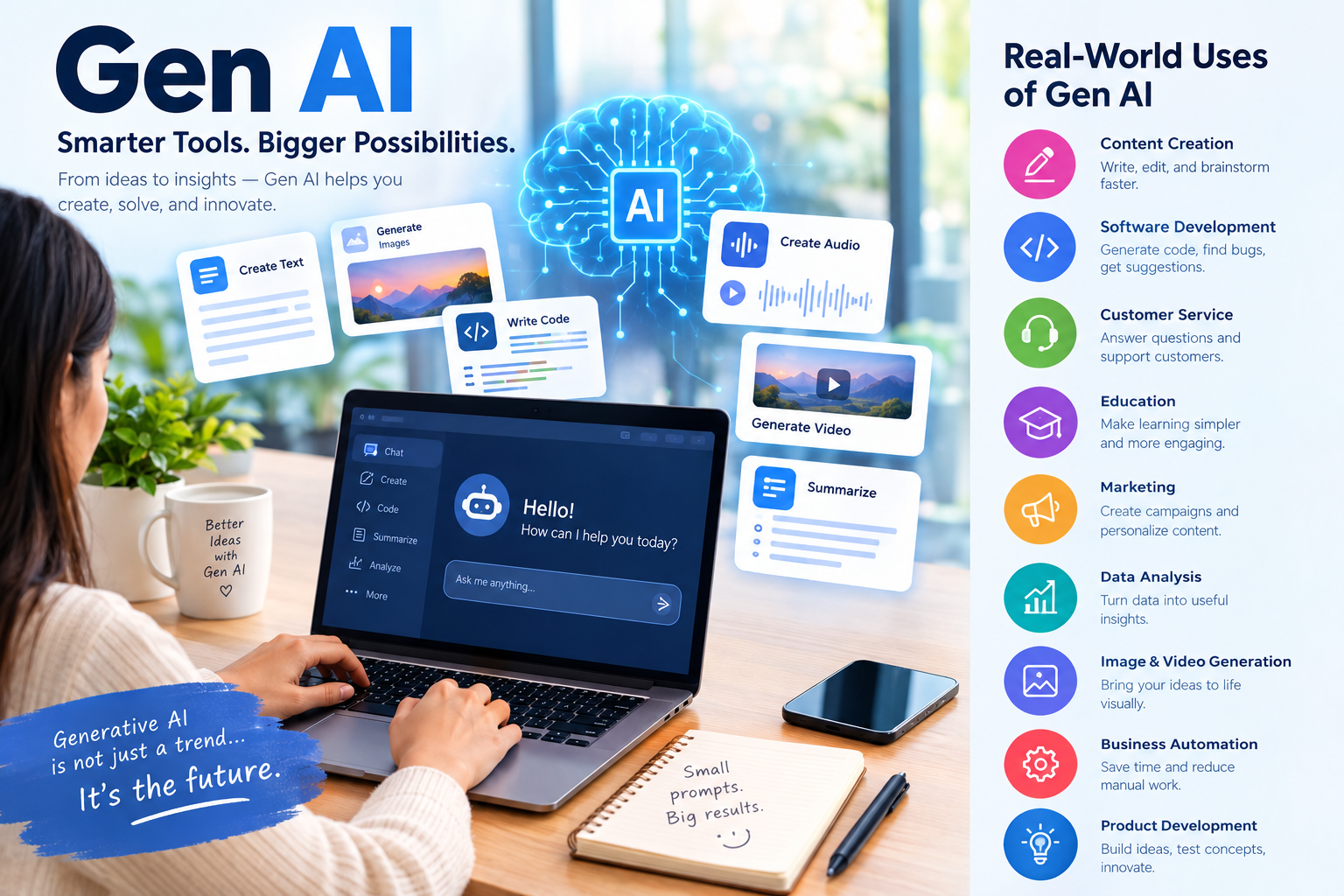
It can write text, create images, generate computer code, produce audio, summarize documents, answer questions, and support many other tasks. This has made Gen AI useful for students, developers, marketers, designers, researchers, businesses, and everyday users.
The technology is also growing at a remarkable speed. Stanford’s 2026 AI Index reports that generative AI reached 53% population-level adoption within three years, faster than the personal computer or the internet. The same report says generative AI was used in at least one business function by 70% of surveyed organizations in 2025.
But what exactly is Gen AI? How does it work, and what can businesses and individuals actually do with it? Understanding these questions can help you use this technology more effectively while avoiding common mistakes.
What Is Gen AI?
Gen AI, or generative AI, is a type of artificial intelligence that creates new content based on instructions or prompts.
The content can include written text, images, video, audio, software code, and other forms of digital information. IBM describes generative AI as AI that can create original content in response to a user’s prompt or request.
Traditional AI is often designed to identify patterns, classify information, make predictions, or recommend an action. Generative AI goes a step further by using learned patterns to produce a new output.
For example, a traditional AI system might identify whether an email is spam. A generative AI system can help write an email from a short instruction such as, “Write a polite reply to this customer.”
This difference has opened the door to a wide range of applications.
How Does Generative AI Work?
Gen AI works through advanced machine learning models that learn patterns from large amounts of data.
A model may be trained using huge collections of text, images, audio, code, or other information. During training, the model learns relationships and patterns within that data.
When a user enters a prompt, the model processes the request and generates an output based on what it has learned.
Large language models, often called LLMs, are one important type of generative AI. They are designed mainly for language-related tasks, including writing, summarization, translation, question answering, and code generation.
Other generative models are designed for images, video, music, speech, or combinations of different types of information.
Modern generative AI systems commonly involve training a foundation model, adapting or tuning it for specific tasks, and then generating and evaluating outputs.
Why Is Gen AI Growing So Quickly?
The growth of Gen AI is driven by improvements in computing power, machine learning techniques, data, model architecture, and access to cloud-based AI services.
Another major factor is ease of use.
People no longer need advanced programming skills to interact with many AI systems. A user can write a natural-language prompt and receive a response within seconds.
Investment has also increased significantly. Stanford’s 2025 AI Index reported that private investment in generative AI reached $33.9 billion in 2024, which was more than eight times the 2022 level.
The technology is also becoming less expensive to use. Stanford reported that the cost of querying an AI model at a GPT-3.5-level benchmark fell from $20 per million tokens in November 2022 to $0.07 per million tokens by October 2024 for one model, showing how rapidly AI inference costs can decline.
Lower costs and easier access make it possible for more companies to experiment with AI.
11 Powerful Uses of Gen AI
Content Creation
One of the most common uses of generative AI is content creation.
Marketing teams can use it to brainstorm topics, create first drafts, rewrite text, develop social media ideas, and summarize research.
A writer might provide a topic, target audience, tone, and word count and ask an AI tool to create a starting draft.
However, businesses should not publish AI-generated content without review. Human editing is important for accuracy, originality, brand voice, and useful information.
The best approach is often to use Gen AI as a productivity tool rather than treating it as a complete replacement for human expertise.
Software Development
Gen AI is also changing software development.
Developers can use AI tools to explain code, suggest functions, identify potential bugs, create documentation, write tests, and help convert code between programming languages.
For example, a developer working on a web application could ask an AI assistant to explain why a particular function is returning an error.
The developer can then review the suggestion, test it, and make the final decision.
This can reduce time spent on routine development work while allowing developers to focus more on architecture, security, and complex problems.
Customer Service
Businesses can use Gen AI to support customer service teams.
AI-powered assistants can answer common questions, summarize conversations, suggest responses, and help agents find information quickly.
For example, an online retailer could use an AI assistant to answer questions about delivery times, returns, product details, and order status.
More complex questions can then be transferred to a human representative.
This creates a combination of automation and human support instead of relying entirely on either approach.
Education and Learning
Gen AI can also act as a learning assistant.
Students can use it to explain difficult concepts in simpler language, create practice questions, summarize complex material, or provide examples.
A student studying programming might ask an AI system to explain a difficult concept using a simple real-world example.
Teachers can also use generative AI to brainstorm lesson plans, create classroom activities, and develop practice materials.
The important point is that students should use AI to understand a subject rather than simply copying its answers.
Marketing and Advertising
Marketing teams can use Gen AI throughout the customer journey.
It can help develop campaign ideas, create variations of marketing copy, analyze customer feedback, summarize research, and personalize communication.
For example, a company could create several versions of an email campaign for different customer groups.
Human marketers can then review the outputs and select the versions that best match the company’s brand and goals.
Gen AI can therefore speed up repetitive creative work while keeping strategic decisions with people.
Image Generation
Generative AI is not limited to text.
Image generation models can create visual content from natural-language descriptions.
A user might describe a futuristic office, product concept, website illustration, or advertising scene and receive a generated image.
This can be useful for brainstorming and early-stage design.
However, businesses should pay attention to licensing, copyright, trademarks, brand requirements, and the terms of the AI service they use.
Data Analysis
Gen AI can make complex data easier to understand when it is connected to reliable data systems.
For example, an employee could ask for a summary of sales trends instead of manually reading hundreds of rows of information.
AI can help explain patterns, create summaries, generate formulas, and support business reporting.
But the quality of the result depends heavily on the underlying data and the way the AI system is connected to it.
Important business decisions should not rely on an unchecked AI response.
Research and Summarization
Professionals often need to process large amounts of information.
Gen AI can summarize documents, compare information, extract key themes, and turn long material into easier-to-read notes.
A researcher could provide a group of reports and ask the system to identify recurring topics.
This can save time during the early stages of research.
Still, important facts should be checked against the original sources because generative AI can produce incorrect information or misunderstand context.
Healthcare Support
Healthcare is another area where generative AI is being explored.
Possible applications include clinical documentation, patient communication, research assistance, medical education, and administrative work.
For example, AI may help summarize information from a long clinical document so a professional can review it more quickly.
Because healthcare involves sensitive personal information and high-stakes decisions, AI systems in this field require strong privacy, security, testing, and human oversight.
Business Automation
Gen AI can work with automation tools to reduce repetitive tasks.
A company could connect an AI system with its customer relationship management platform, email system, documents, or internal knowledge base.
For example, when a customer submits a support request, an automated workflow could classify the request, summarize the issue, create a draft response, and send it to a human employee for approval.
This can reduce manual work while keeping people involved in important decisions.
Product Development
Companies can also use Gen AI to support product development.
Teams can ask AI systems to help brainstorm product ideas, analyze customer feedback, create prototypes, or generate early concepts.
Suppose a software company receives thousands of customer comments. An AI system could help group similar requests and summarize common complaints.
Product managers could then use those insights when deciding what to improve.
Gen AI vs Traditional AI
Generative AI and traditional AI are related, but they are not the same.
Traditional AI often focuses on tasks such as classification, prediction, recommendation, detection, or optimization.
For example, a fraud detection system may analyze a transaction and estimate whether it appears suspicious.
Generative AI focuses on creating new content.
An AI writing assistant, image generator, coding assistant, or conversational model is a common example.
The two technologies can also work together.
A business might use traditional machine learning to detect unusual transactions and generative AI to explain the results in simple language for a human analyst.
Understanding this difference helps businesses choose the right technology for each problem.
Benefits of Gen AI for Businesses
The biggest benefit of Gen AI is its ability to help people complete certain tasks faster.
It can support writing, research, coding, communication, customer service, analysis, and creative work.
Another benefit is scalability. An AI system can help generate many variations of content or handle large amounts of routine information without requiring a human to perform every step manually.
Gen AI can also improve accessibility. People who struggle with complex technical language can ask an AI system to explain information in simpler terms.
Businesses can use these capabilities to improve productivity and customer experiences.
However, the value depends on implementation. Simply purchasing an AI tool does not guarantee better results.
Companies need clear goals, reliable data, appropriate security controls, employee training, and a process for checking AI-generated results.
Risks and Challenges of Gen AI
Generative AI has major benefits, but it also has important limitations.
AI Hallucinations
One of the most discussed problems is AI hallucination.
A generative AI system may produce information that sounds convincing but is incorrect.
This can happen because the model generates likely outputs rather than functioning like a traditional database that retrieves verified facts.
For this reason, important information should be checked against reliable sources.
Privacy Concerns
Users should be careful when entering confidential information into AI tools.
Businesses need clear rules about what data employees can share with AI systems.
Sensitive customer records, passwords, private financial information, and confidential business documents should be handled according to the organization’s security and privacy policies.
Bias
AI models learn from data, and data can contain bias.
As a result, AI outputs can sometimes reflect unfair or inaccurate patterns.
Businesses should test AI systems for problematic outputs, especially when the technology affects hiring, lending, healthcare, education, or other sensitive areas.
Copyright and Ownership
Generative AI can create content that raises questions about copyright, ownership, and licensing.
The rules vary by country and situation.
Companies should review the terms of the AI service they use and obtain appropriate legal advice when copyright or intellectual property issues are important.
Overreliance on AI
Another risk is allowing AI to make decisions that should involve human judgment.
AI can support people, but it should not automatically replace expertise in high-stakes situations.
Human review remains important when accuracy, safety, privacy, or legal responsibility is involved.
How to Use Gen AI Effectively
Good results often start with a good prompt.
Instead of writing something vague such as “write about marketing,” provide useful context.
Explain the task, audience, desired format, tone, constraints, and important background information.
For example, a business owner could ask an AI tool to create a short email for existing customers, using a friendly tone and explaining a new product feature in simple language.
The more useful context the system receives, the easier it becomes to produce a relevant response.
It is also helpful to review AI output rather than accepting the first response.
Ask the system to improve unclear sections, compare alternative approaches, or explain its assumptions. Then verify important facts independently.
Gen AI in the Workplace
Gen AI is changing how many employees approach routine knowledge work.
Instead of spending an hour creating a first draft, a worker may use AI to create a starting point in a few minutes.
The employee can then spend more time reviewing, improving, and applying professional judgment.
Stanford’s 2025 AI Index found that 71% of surveyed organizations reported using generative AI in at least one business function in 2024, up from 33% in 2023.
This does not mean every organization is using AI effectively.
Some companies are still experimenting, while others have integrated AI into everyday workflows.
The difference often comes down to training, leadership, data quality, security, and whether the organization has chosen practical use cases.
The Future of Gen AI
The future of generative AI is likely to involve more than simple chatbots.
AI systems are increasingly being connected to business software, databases, productivity tools, and automated workflows.
This could allow AI assistants to move from answering questions to helping complete multi-step tasks.
Multimodal AI is also expanding. Instead of working with text alone, modern systems can process combinations of text, images, audio, video, and other information.
At the same time, AI models are becoming more accessible and efficient. Stanford’s 2026 AI Index reports that organizational AI adoption reached 88% in its 2025 survey, while generative AI was used in at least one business function by 70% of organizations surveyed.
These numbers show that Gen AI is becoming part of mainstream technology use.
The next stage will likely focus less on simply asking what AI can generate and more on how organizations can use it safely, accurately, and effectively.
Frequently Asked Questions
What does Gen AI stand for?
Gen AI stands for generative artificial intelligence. It refers to AI systems that can create new content such as text, images, audio, video, software code, and other outputs from prompts or other inputs.
What is Gen AI used for?
Gen AI is used for content creation, coding, customer support, education, research, marketing, data analysis, image generation, business automation, and many other tasks.
Is Gen AI the same as AI?
Gen AI is a type of artificial intelligence, but the terms are not identical. AI is the broader field, while generative AI focuses on creating new content from learned patterns.
How does Gen AI create content?
Generative AI models learn patterns and relationships from large datasets during training. When a user provides an instruction, the model uses what it learned to generate a new response.
What are examples of Gen AI?
Examples include AI writing assistants, image generators, coding assistants, conversational AI systems, text-to-speech tools, video generation systems, and AI-powered business applications.
Can Gen AI replace human workers?
Gen AI can automate or speed up some tasks, but its impact varies by occupation and task. In many workplaces, it is used as an assistant that helps people work faster rather than as a complete replacement for human employees.
Is Gen AI safe to use?
Gen AI can be useful when used responsibly, but it has risks such as inaccurate information, privacy concerns, bias, security problems, and copyright issues. Human review and appropriate safeguards are important.
How can businesses start using Gen AI?
Businesses can begin by identifying repetitive or time-consuming tasks where AI could provide measurable value. They should then test a small use case, establish data and security rules, train employees, measure results, and expand successful applications.
Conclusion
Gen AI is changing the way people create, communicate, learn, analyze information, and work with technology. Its ability to generate text, images, code, audio, video, and other content makes it one of the most important developments in modern artificial intelligence.
The technology is already being used across business functions, while investment and adoption continue to grow. At the same time, Gen AI has limitations. It can produce inaccurate information, raise privacy and copyright concerns, and create risks when people rely on it without proper review.
The smartest approach is not to use AI simply because it is popular. Start with a real problem. Choose a useful application. Protect sensitive information. Check important results. Keep humans involved where judgment matters.
Whether you are a business owner, student, marketer, developer, or technology enthusiast, learning how to use Gen AI effectively can help you work more efficiently and prepare for a technology-driven future. Start with one practical use case today, measure the results, and build your AI skills step by step.
