

Learn what DevSecOps is, how it works, its benefits, tools, practices, challenges, and how it helps teams build secure software faster.
Introduction
Modern software moves fast. New features, cloud services, APIs, mobile apps, and AI tools can go from an idea to production in a short time. But speed also creates security risks. A small coding mistake, weak dependency, exposed secret, or poorly configured cloud service can become a serious problem.
This is where DevSecOps comes in.
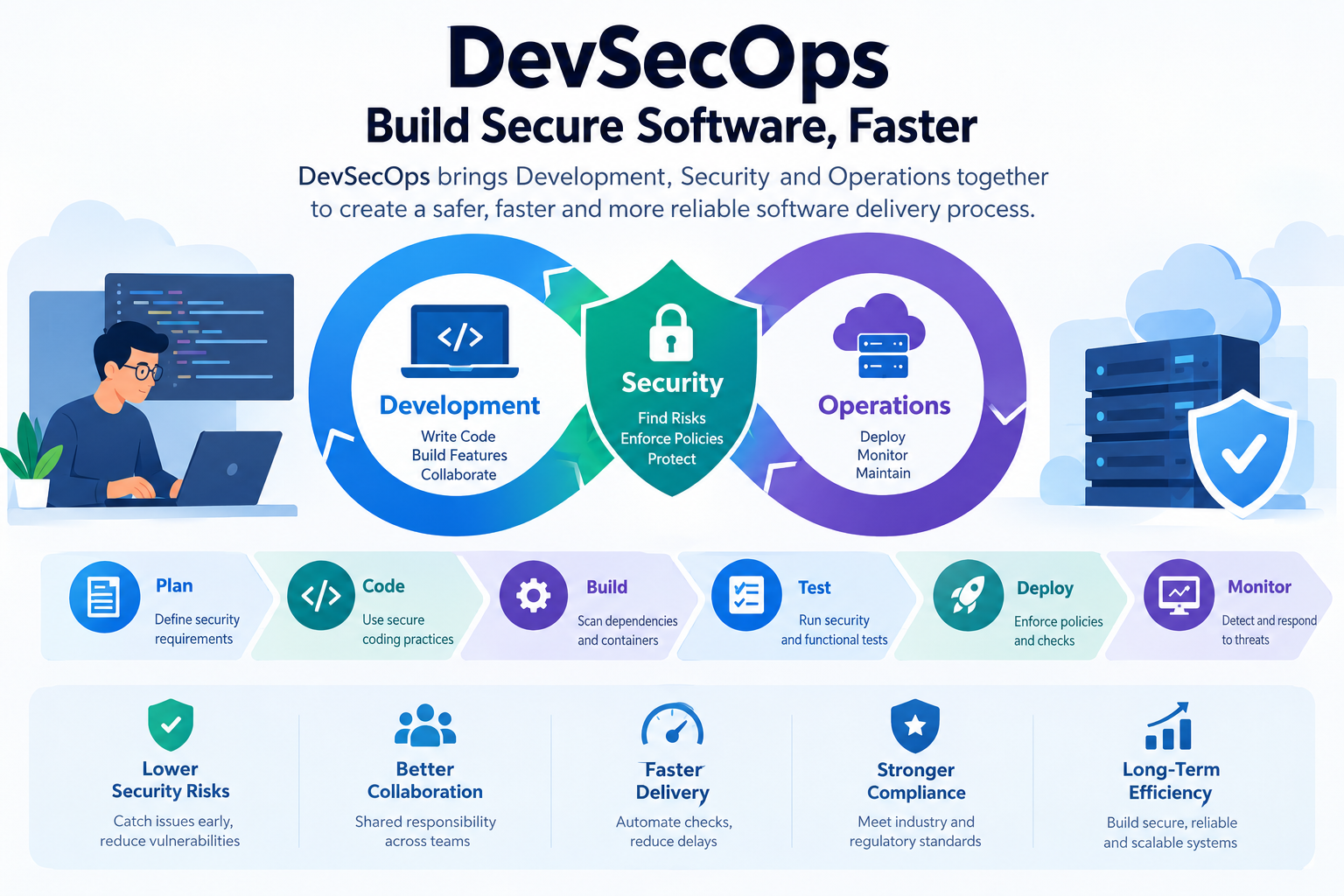
DevSecOps stands for Development, Security, and Operations. It extends the DevOps approach by making security part of the software development process from the beginning rather than treating it as a final inspection. NIST describes DevSecOps as an approach that integrates security into DevOps and supports secure development across the software lifecycle.
Instead of waiting until an application is ready to launch, development and security teams work together throughout planning, coding, building, testing, deployment, and operation.
The result is a development process where security becomes a shared responsibility. Teams can find problems earlier, fix them faster, and reduce the chance of releasing vulnerable software.
What Is DevSecOps?
DevSecOps is a software development approach that combines development, security, and operations into one continuous process. It builds security checks and security thinking into the DevOps workflow.
Traditional software development often placed security near the end of the development lifecycle. Developers created the application, operations prepared it for deployment, and security teams checked it later. This model could create delays because serious vulnerabilities might be discovered only after much of the software had already been built.
DevSecOps changes that process.
Security starts during planning and continues through coding, testing, deployment, and monitoring. Automated security tools can check source code, dependencies, containers, infrastructure, and application behavior as part of the development pipeline.
NIST’s current DevSecOps project demonstrates how its Secure Software Development Framework, or SSDF, can be applied to modern DevSecOps environments. The project covers the software development lifecycle from initial planning through deployment and ongoing use.
The central idea is simple: find security problems early instead of waiting for them to become expensive problems later.
DevSecOps vs DevOps
DevOps focuses on bringing development and operations teams closer together. Its goals include faster delivery, better collaboration, automation, and continuous feedback.
DevSecOps keeps these goals but adds security as a core part of the process.
For example, a DevOps pipeline may automatically build and test an application whenever developers submit new code. A DevSecOps pipeline can add security checks to that same process. It may scan the code for common vulnerabilities, check third-party packages, detect exposed credentials, test application behavior, and evaluate infrastructure configurations.
This does not mean that developers suddenly become full-time security specialists. Instead, security knowledge, automated checks, clear policies, and security specialists become part of the normal development workflow.
That shared responsibility is one of the most important ideas behind DevSecOps.
Why Is DevSecOps Important?
Software is now connected to almost every part of modern business. Organizations use applications for payments, customer data, communication, healthcare, education, logistics, marketing, and internal operations.
A security weakness can therefore affect much more than the application itself.
NIST explains that secure software development practices can help reduce vulnerabilities in released software, reduce the potential impact of exploited vulnerabilities, and address the root causes that allow similar issues to happen again.
DevSecOps is important because it makes security continuous.
When security is checked only before release, developers may have to stop current work and return to old code. This can create delays and increase the effort needed to understand and fix a problem.
When security checks happen throughout development, problems can be found closer to the moment they are introduced.
For example, imagine a developer adds a third-party library to an e-commerce application. A dependency scanner detects that the selected version has a known security vulnerability. The team can replace or update the package before the application reaches production.
That is much easier than discovering the same problem after the application is already serving customers.
How Does DevSecOps Work?
DevSecOps follows the same general software lifecycle as modern DevOps, but security is included throughout each stage.
Planning
Security should begin before code is written.
During planning, teams identify the data the application will handle, the users who will access it, the systems it will connect to, and the risks that could affect it.
Teams can also define security requirements at this stage. For example, an application handling payment information may need stronger authentication, encryption, access controls, logging, and monitoring.
NIST’s SSDF places organizational preparation and security requirements among the foundational practices for secure software development.
Development
During development, security becomes part of everyday coding.
Developers can use secure coding practices and automated tools to identify common problems. Static application security testing can inspect source code for weaknesses without executing the application.
Developers can also avoid placing passwords, API keys, or other secrets directly inside source code.
Code review is another important part of secure development. A second developer or automated system can identify mistakes that the original developer may have missed.
The goal is not to slow developers down. The goal is to make security checks a normal part of writing software.
Build
The build stage turns source code into software that can be tested or deployed.
A DevSecOps pipeline can verify dependencies, scan containers, check build configurations, and look for vulnerable components.
This matters because modern applications rarely contain only code written by one development team. Applications often depend on open-source libraries, frameworks, packages, container images, APIs, and cloud services.
NIST’s current DevSecOps guidance highlights the complexity created by applications that combine internally developed and externally sourced components.
Testing
Security testing can happen alongside functional and performance testing.
Dynamic application security testing can examine a running application for certain weaknesses. Dependency scanning can identify vulnerable third-party components. Infrastructure-as-code scanning can detect unsafe cloud or infrastructure settings.
The exact combination depends on the application’s risk, technology stack, and business requirements.
Security testing should also produce useful results rather than overwhelming developers with thousands of alerts. Teams need a process for prioritizing findings based on severity, exploitability, business impact, and exposure.
Deployment
Before software reaches production, DevSecOps practices can check whether security requirements have been met.
For example, a deployment pipeline may prevent a release when it detects a critical vulnerability or a leaked production credential.
Deployment policies can also verify configuration settings, access controls, container security, and other requirements.
The aim is not to block every release for every minor issue. Instead, organizations should establish sensible risk-based rules.
Operations and Monitoring
Security does not end when software reaches production.
Applications need ongoing monitoring because new vulnerabilities can appear after release. A dependency that was considered safe six months ago may later receive a security advisory.
Teams can monitor application logs, infrastructure activity, authentication events, network behavior, and security alerts.
When a vulnerability is discovered, the team should have a clear process for investigating, patching, testing, and deploying a fix.
This creates a continuous feedback loop between development, security, and operations.
Key DevSecOps Practices
DevSecOps is not one tool or one product. It is a combination of people, processes, technology, and security practices.
Shift Security Left
“Shift left” means moving security activities earlier in the software lifecycle.
Instead of discovering a vulnerability shortly before launch, teams try to identify it during design, coding, and early testing.
OWASP’s DevSecOps guidance emphasizes detecting security issues as early as possible and integrating security into software development and testing.
Early detection can make remediation easier because developers still have the relevant code and design decisions fresh in their minds.
Automate Security Testing
Automation is one of the strongest features of DevSecOps.
A development pipeline can automatically perform security checks whenever code changes. This allows teams to perform repetitive checks without relying entirely on manual reviews.
Common automated activities include source-code scanning, dependency analysis, secret detection, container scanning, infrastructure scanning, and application security testing.
Automation does not replace human security expertise. Instead, it handles repeatable checks so specialists can focus on complex risks.
Manage Dependencies
Modern applications often depend on hundreds or thousands of external components.
A vulnerable package can introduce risk even when the organization’s own code is well written.
Software composition analysis can help teams identify third-party components and check them against vulnerability information.
Organizations should also maintain a clear process for updating dependencies and responding to security advisories.
Protect Secrets
Passwords, API keys, access tokens, certificates, and other sensitive credentials should not be casually stored in source code.
A leaked credential can provide an attacker with access to development systems, cloud environments, databases, or production applications.
DevSecOps teams commonly use dedicated secret-management systems and automated secret scanning to reduce this risk.
Developers should also understand that removing a secret from the latest version of a file does not necessarily remove it from the entire history of a source repository.
Secure Infrastructure as Code
Cloud infrastructure is increasingly managed through code.
Infrastructure-as-code tools allow teams to define servers, networks, permissions, databases, and other resources in configuration files.
This creates an opportunity for security checks before infrastructure is deployed.
For example, an automated scan might identify an overly permissive storage policy or an unnecessary public network exposure.
Finding these issues before deployment is much safer than discovering them after a cloud resource is exposed.
Use Security Policies as Code
Security rules can also be expressed in machine-readable policies.
Instead of relying only on documentation that says a certain configuration is required, organizations can create automated rules that check whether systems follow the requirement.
This makes security more consistent across environments.
Monitor Continuously
Threats change over time. DevSecOps therefore requires continuous monitoring.
Security teams can use logs, alerts, vulnerability information, and operational data to identify unusual activity and emerging risks.
Monitoring also provides valuable feedback to developers. If a recurring security problem appears in production, teams can investigate why it happened and improve the development process.
DevSecOps Tools
There is no single DevSecOps tool that solves every security problem. Most organizations use a collection of tools connected to their development pipeline.
Source-control platforms manage code and collaboration. CI/CD platforms automate builds, tests, and deployments. Static analysis tools inspect source code. Software composition analysis tools check dependencies. Dynamic security testing tools evaluate running applications.
Container security tools inspect images and container configurations. Infrastructure-as-code scanners evaluate cloud configurations. Secret-scanning tools search for exposed credentials.
Security information and event management platforms can help teams collect and analyze security events during operations.
The right technology stack depends on the organization’s programming languages, cloud environment, application architecture, compliance requirements, team skills, and risk profile.
OWASP provides DevSecOps guidance and a DevSecOps Maturity Model designed to help organizations assess and improve their security practices over time.
Benefits of DevSecOps
The biggest benefit of DevSecOps is better integration between security and software delivery.
When security is part of the development process, teams can identify vulnerabilities earlier. Earlier detection can reduce rework and make fixes easier to manage.
DevSecOps can also improve collaboration. Developers, security professionals, and operations engineers share more responsibility for application security rather than treating security as the responsibility of one separate department.
Automation can improve consistency as well. A security check that runs automatically for every code change is less likely to be forgotten than a manual process that depends on someone remembering to perform it.
DevSecOps can also support faster software delivery. This may sound surprising, because security checks appear to add work. In practice, automated security checks can reduce the need for large security reviews late in the release process.
The objective is not simply to make development faster. It is to make software delivery faster while maintaining an appropriate level of security.
A Real-World DevSecOps Example
Consider an online shopping company that develops a web application for customers.
A developer adds a new payment feature. The code is submitted to the company’s source-control system.
Organizations can follow the NIST DevSecOps Practices to understand how secure software development practices can be integrated into modern DevSecOps environments.
The CI/CD pipeline starts automatically. First, the application is built and tested. Static analysis checks the new code for security weaknesses. A dependency scanner checks whether the payment feature introduced a vulnerable package. A secret scanner looks for accidentally exposed credentials.
The application is then deployed to a test environment. Dynamic security testing checks the running application. Infrastructure checks verify that cloud resources follow the company’s security policies.
Suppose the dependency scanner finds a critical vulnerability in a newly added library.
Instead of allowing the application to continue toward production, the pipeline reports the problem. The developer replaces the vulnerable version, runs the tests again, and submits the corrected change.
Security has been addressed during development instead of becoming a production incident.
This is the practical value of DevSecOps.
DevSecOps and the Software Supply Chain
Software supply chain security has become increasingly important because applications rely on many external components.
A business may use open-source libraries, commercial packages, cloud services, container images, development tools, and third-party APIs. Each component can introduce additional risk.
DevSecOps helps organizations manage this risk by identifying components, monitoring vulnerabilities, protecting build environments, and applying controls throughout the software lifecycle.
NIST’s SSDF is designed to provide a common set of secure software development practices and includes practices for preparing the organization, protecting software, producing well-secured software, and responding to vulnerabilities.
This framework can help organizations create a more consistent approach to software supply chain security.
DevSecOps and Artificial Intelligence
AI is changing software development rapidly.
Developers now use AI tools to generate code, explain errors, write tests, and automate parts of development. This can improve productivity, but it also introduces new security questions.
AI-generated code still needs human review and automated security testing. Developers should not assume that code generated by an AI system is automatically secure.
NIST’s current DevSecOps work specifically discusses the role of AI in software development, including the use of AI for coding, security analysis, vulnerability detection, and remediation.
Organizations should therefore apply the same security principles to AI-assisted development as they do to traditionally written code.
AI can help developers work faster, but security validation remains essential.
Common DevSecOps Challenges
Implementing DevSecOps is not always easy.
One common challenge is culture. If developers believe that security belongs only to the security department, DevSecOps will struggle.
Another challenge is alert overload. Security tools can produce many findings. If developers receive too many low-value alerts, they may begin ignoring them.
Poorly integrated tools can create another problem. A pipeline containing many disconnected security products may become difficult to manage.
Skills are also important. Developers need practical security knowledge, while security professionals need to understand modern development workflows and cloud environments.
Organizations should therefore introduce DevSecOps gradually. Start with important risks, automate useful checks, measure results, and improve the process over time.
How to Implement DevSecOps Successfully
A successful DevSecOps program starts with clear security requirements.
Organizations should understand what they are protecting and which risks matter most. They should then select security controls that match those risks.
The next step is to integrate security into existing development workflows. Instead of creating a completely separate security process, teams can add appropriate checks to the existing CI/CD pipeline.
Training is equally important. Developers should understand common vulnerabilities, secure coding techniques, dependency risks, secrets management, and the security tools used by their organization.
Teams should also define what happens when a security check fails. A critical vulnerability may require the release to stop, while a low-risk issue may simply create a ticket for later remediation.
Measurement is another important part of improvement. Organizations can track indicators such as the time required to fix vulnerabilities, the number of recurring findings, security test coverage, and the percentage of applications using automated security checks.
OWASP’s DevSecOps Maturity Model supports this idea by providing a structured way for organizations to assess their current capabilities and improve them incrementally.
DevSecOps Best Practices for Small Teams
Small development teams do not need a huge security department to start using DevSecOps.
A small team can begin by protecting source repositories, using multi-factor authentication, scanning dependencies, checking for exposed secrets, and adding basic security tests to its CI/CD pipeline.
Developers can also use secure coding guidelines and review important changes before deployment.
The key is consistency.
A simple security process that runs on every project can be more useful than a complex security program that teams rarely follow.
As the organization grows, additional controls can be introduced based on risk.
What Is the Future of DevSecOps?
DevSecOps will continue to evolve as cloud computing, automation, artificial intelligence, containers, and software supply chains become more complex.
Security is also moving closer to the actual development workflow. Developers increasingly receive security feedback directly inside tools they already use.
AI may automate more security analysis and help identify vulnerabilities, but it will also create new risks that teams must manage.
NIST’s 2026 DevSecOps project reflects this changing environment. Its current work demonstrates DevSecOps practices aligned with the NIST SSDF and includes modern cloud-based implementations, AI considerations, and continuous security improvement.
The future of DevSecOps is therefore not simply about adding more security tools. It is about creating software development systems where security is continuous, measurable, automated where appropriate, and shared across teams.
Conclusion
DevSecOps brings development, security, and operations together to create a safer and more efficient software delivery process. Instead of waiting until the final stage to search for vulnerabilities, teams build security into planning, coding, testing, deployment, and ongoing monitoring.
This approach can help organizations find problems earlier, improve collaboration, reduce security risks, and respond faster when new vulnerabilities appear.
NIST’s Secure Software Development Framework provides a strong foundation for organizations that want to improve secure software development, while OWASP offers practical guidance and maturity resources for DevSecOps teams.
Whether you manage a large enterprise or a small development team, you do not need to transform everything overnight. Start with the highest-risk areas, automate useful security checks, train your developers, and continuously improve the process.
Ready to make security part of your development workflow? Start by reviewing your current software pipeline, identify where security checks are missing, and introduce DevSecOps practices step by step.
Frequently Asked Questions About DevSecOps
What does DevSecOps stand for?
DevSecOps stands for Development, Security, and Operations. It is an approach that integrates security into the DevOps software development and delivery process.
What is the main goal of DevSecOps?
The main goal of DevSecOps is to build security into the software lifecycle so that security problems can be identified and addressed as early as possible.
Is DevSecOps better than DevOps?
DevSecOps builds on DevOps by adding security throughout the development and operations process. DevOps focuses strongly on collaboration, automation, and delivery, while DevSecOps includes those principles with security as a continuous responsibility.
What are common DevSecOps tools?
Common DevSecOps technologies include static application security testing, dynamic application security testing, software composition analysis, secret scanning, container scanning, infrastructure-as-code scanning, vulnerability management, CI/CD automation, and security monitoring tools.
What is shift-left security?
Shift-left security means moving security activities earlier in the software development lifecycle. Instead of waiting until the application is ready for release, teams identify and fix security issues during planning, coding, and testing.
Is DevSecOps only for large companies?
No. Small teams can also use DevSecOps. They can start with basic practices such as secure source-code management, dependency scanning, secret detection, code review, and automated security testing.
How does DevSecOps improve software security?
DevSecOps improves security by integrating security controls throughout development and operations. This allows teams to detect vulnerabilities earlier and establish a repeatable process for fixing and monitoring security issues.
Is DevSecOps part of cybersecurity?
Yes. DevSecOps is closely connected to application security, secure software development, cloud security, vulnerability management, and software supply chain security. It brings these security concerns into the software delivery process.
