

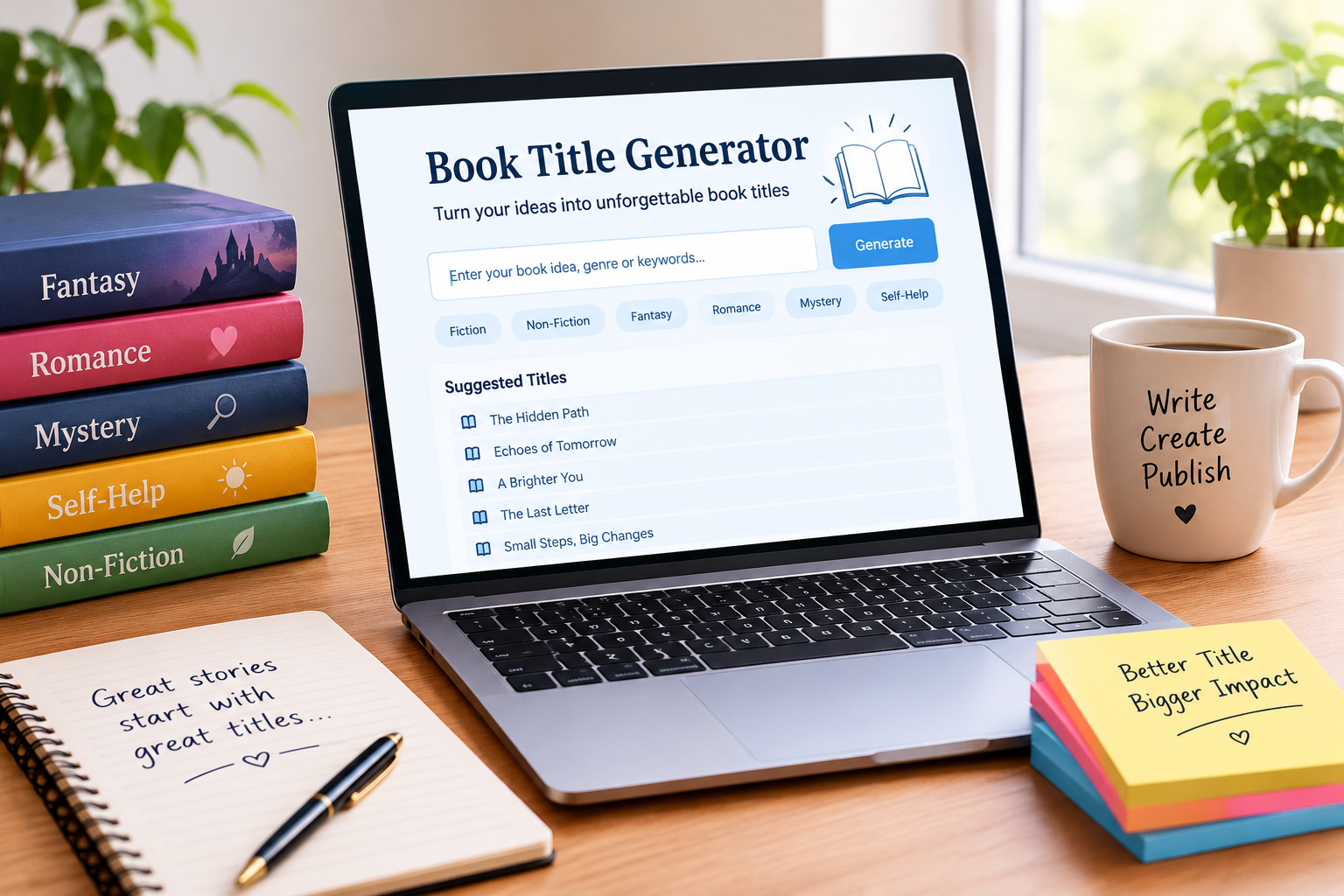
Use a book title generator to create catchy, creative, and memorable titles for your next novel, ebook, short story, or nonfiction book.
A great book starts with a great idea, but finding the right title can be hard. You may have a complete story in mind, yet the perfect words remain out of reach. Your title needs to catch attention, spark interest, and give readers a reason to open your book. This is where a book title generator can help.
A book title generator is an online tool that creates title ideas based on your topic, genre, keywords, or preferred style. It can help writers explore fresh ideas, overcome writer’s block, and find names that fit their work. Whether you are writing a fantasy novel, a romance story, a business guide, or an ebook, the right tool can make the process easier.
However, a good book title generator needs more than a few clever words. It should reflect your book’s message, match your audience, and feel natural. In this guide, you will learn how book title generators work, how to use them, and how to choose a title that helps your book stand out.
What Is a Book Title Generator?
A book title generator is a digital tool that suggests names for books. It may use keywords, writing prompts, genre details, or artificial intelligence to produce different title ideas.
For example, a writer working on a mystery novel might enter the words “old house,” “missing letter,” and “family secret.” The tool could suggest titles such as The Secret Behind the Old House or Letters from the Forgotten Room.
These suggestions give the writer a starting point. The writer can then change the wording, combine ideas, or create a better title that matches the story.
Some generators focus on specific genres, such as romance, fantasy, science fiction, or horror. Others work across many categories, including nonfiction, education, personal development, business, and children’s books.
A book title generator does not replace a writer’s creativity. Instead, it offers new directions when ideas run low. It can also help writers compare several title styles before making a final choice.
Why Does a Book Title Matter?
A book title generator is often the first thing a potential reader sees. It can shape the reader’s first impression before they read the description, view the cover, or open the first page.
A strong title can suggest the book’s subject, create curiosity, or communicate a clear benefit. A weak title may leave readers unsure about what the book offers.
Consider a writer who creates a guide to managing money. The title Money Management Guide explains the subject, but it feels broad and plain. A title such as Smart Money Habits for a Better Future gives readers a clearer sense of the book’s purpose.
The best choice depends on the audience, content, and publishing goals. A simple title may work well for an academic book, while a mysterious title may suit a thriller.
A title also affects how easily readers can remember and discuss a book. Short, clear titles are often easier to recall than long phrases filled with complex words.
For authors who sell books online, the book title generator may also influence search visibility. Readers often search for books by topic, genre, or specific keywords. A relevant title can help communicate what a book covers, although no title alone can guarantee higher rankings or more sales.
How Does a Book Title Generator Work?
Different tools use different methods to create title suggestions. Understanding these methods can help you choose the right tool for your needs.
Keyword-Based Title Generation
A keyword-based generator uses words supplied by the user. You enter a subject, character name, theme, or topic, and the tool creates title combinations.
For example, entering “healthy cooking” might produce titles such as Healthy Cooking Made Simple or Fresh Meals for Everyday Life.
This method works well when you already know what your book is about. It is especially useful for practical guides, cookbooks, educational books, and business ebooks.
AI-Powered Title Generation
An AI book title generator can use artificial intelligence to produce more varied suggestions. Depending on the tool, you may be able to describe your story, explain your target audience, and select a preferred tone.
Suppose you are writing a fantasy novel about a young girl who discovers a hidden kingdom. You could ask an AI tool to suggest mysterious, memorable titles for a young adult audience.
The results might include The Kingdom Beyond the Moon or The Girl Who Found the Hidden Realm.
AI tools can also revise titles, shorten long phrases, and suggest alternatives. However, their suggestions may be repetitive, inaccurate, or too similar to existing titles. You should review every result before using it.
Genre-Based Title Generation
Some generators focus on the conventions of specific book genres.
A romance title may use words associated with love, longing, or second chances. A horror title may suggest fear, darkness, or danger. A science fiction title may refer to distant worlds, future technology, or space exploration.
Genre-based tools can help writers follow reader expectations without copying another author’s style or title.
Template-Based Title Generation
Template-based generators use common title structures. These may include a subject followed by a benefit, a character followed by a mystery, or a short phrase followed by a subtitle.
For example, a personal finance book might use the structure The Beginner’s Guide to [Topic].
Templates can be useful for nonfiction because they make the subject clear. Fiction writers may prefer more imaginative structures that create emotion or curiosity.
Benefits of Using a Book Title Generator
A book title generator can help at several stages of the writing and publishing process.
Overcome Writer’s Block
Many writers find it difficult to name a book, even after finishing the manuscript. They may have too many ideas or feel that every title sounds ordinary.
A generator provides a fresh starting point. Instead of trying to create one perfect title, you can review several options and identify words or themes that fit your book.
For example, a writer creating a historical novel may receive suggestions involving forgotten letters, lost kingdoms, family secrets, or distant memories. One of these themes may inspire a stronger title.
The goal is not to accept the first suggestion. It is to use the suggestions to develop your own ideas.
Save Time During Brainstorming
Creating dozens of title ideas by hand can take time. A book title generator can produce an initial list in seconds, allowing you to focus on the options that best match your book.
This can be helpful for authors working on several projects, self-publishers preparing ebooks, and content creators developing educational materials.
Still, speed should not replace careful judgment. Reviewing and improving the results remains an important part of the process.
Explore Different Creative Directions
A title can present the same book in several ways.
For example, a book about building better habits could use a direct title such as Build Better Habits Every Day. A more emotional option might be Small Changes, Lasting Results.
Both titles may fit the same subject, but they appeal to readers in different ways.
A generator allows you to explore direct, emotional, mysterious, humorous, and descriptive approaches before choosing one.
Find Ideas for Different Genres
Writers often work across different genres, and each genre has its own expectations.
A fantasy writer may want a title that suggests magic and adventure. A business author may prefer a title that promises a clear lesson. A children’s writer may need simple words that are easy to read and remember.
A book title generator can help you explore these different styles without starting from scratch each time.
Support Self-Publishing Projects
Self-published authors often manage several parts of a book launch, including editing, cover design, formatting, descriptions, and marketing.
A book title generator can make the naming stage more efficient. Once an author has a shortlist, they can test the strongest options against the book’s content and intended audience.
However, a generator cannot determine whether a title is legally available or whether readers will buy the book. Those questions require separate research and testing.
How to Use a Book Title Generator Effectively
Getting useful results depends on the information you provide and the way you review the suggestions.
Step 1: Define Your Book’s Main Idea
Before using a generator, write one or two sentences that explain your book.
For fiction, describe the main character, central conflict, and key theme. For nonfiction, identify the subject and the main benefit readers will gain.
For example, you might write, “This book teaches new freelancers how to find clients, set fair prices, and manage their first projects.”
This short description gives you a clear direction.
Step 2: Choose Your Genre
Select the genre that best matches your manuscript.
If you are writing a romantic comedy, a dark fantasy title may not suit the book. If you are creating a professional guide, an overly mysterious title may hide the value of the content.
Choose the closest category and consider whether your readers expect a serious, playful, emotional, or practical tone.
Step 3: Enter Relevant Keywords
Choose words that represent your book’s topic, setting, characters, or main promise.
For a book about freelancing, useful words might include clients, skills, income, freedom, and business.
For a fantasy story, you might use kingdom, magic, prophecy, shadow, and journey.
You do not need to include every keyword in the final title. The purpose is to help the generator explore relevant ideas.
Step 4: Generate Several Suggestions
Create a range of options instead of selecting the first result.
Review the suggestions and identify the ones that communicate your book’s central idea. Save titles that feel memorable, relevant, and easy to understand.
You can also ask an AI tool to produce different versions of the same title, such as shorter options, more emotional alternatives, or titles for a particular audience.
Step 5: Refine the Best Ideas
The first suggestion may contain a useful idea but need better wording.
For example, a generator might suggest The Complete Guide to Starting Your Own Small Online Business Successfully.
You could shorten it to How to Start a Successful Online Business.
The revised title is easier to understand and gives readers a clear idea of the content.
Step 6: Check the Final Title
Before publishing, search the exact title online and on major book platforms.
Check whether another book already uses the same or a very similar title. Common titles are not always legally prohibited, but confusion with an existing book or brand can create practical problems.
If the title is part of a series or a commercial brand, consider a trademark search and seek legal advice when necessary.
You should also confirm that the title accurately reflects your manuscript. A catchy phrase will not help if it promises something the book does not deliver.
Best Book Title Generator Ideas for Different Genres
The most effective title style depends on the type of book you are writing. Here are examples of how a generator can support different genres.
Fiction Book Title Generator
Fiction titles often create curiosity, introduce a central theme, or hint at a conflict.
A mystery novel might use The Last Note in the Library. A contemporary drama might use The Things We Never Said. A historical novel might use Beneath the Forgotten Crown.
These are illustrative ideas, not claims about available book titles. Before publishing, check whether another work already uses your chosen name.
When generating fiction titles, consider the setting, main character, central problem, and emotional tone. You do not need to explain the whole story in the title. A small hint can be enough to make readers curious.
Fantasy Book Title Generator
Fantasy titles often draw on magic, mythical places, unusual characters, ancient objects, and powerful conflicts.
For example, a story about a hidden magical city might inspire The City Behind the Stars. A tale about a lost royal family might inspire The Heirs of the Silver Throne.
These examples suggest a setting or mystery without explaining every plot detail.
Fantasy writers should also check that their titles fit the world they have created. A dark fantasy story may need a different tone from a lighthearted magical adventure.
Mystery and Thriller Book Title Generator
Mystery and thriller titles often create tension by suggesting danger, secrets, or unanswered questions.
Examples include The Door That Never Opened, A Witness in the Dark, and The Secret at Number Seven.
A strong title in this genre may encourage readers to ask what happened, who is responsible, or what the characters are hiding.
Avoid titles that reveal the central twist. The goal is to create interest while preserving the mystery.
Children’s Book Title Generator
Children’s book titles should match the reading level and interests of the intended age group.
A picture book about a nervous little rabbit might use The Rabbit Who Tried Again. A story about a child’s first day at school might use Mia’s Big First Day.
Simple words, memorable characters, and clear themes can make children’s titles easier to understand.
For books aimed at older children, you may have more room for adventure, mystery, humor, or imaginative language.
Nonfiction Book Title Generator
Nonfiction titles should usually explain the subject or benefit clearly.
For example, a book about productivity might use Make Time for What Matters. A beginner’s guide to gardening might use Grow Your First Home Garden.
A clear title helps readers decide whether the book matches their needs.
If the book covers a specific skill, audience, or outcome, consider including that information in the main title or subtitle.
Business and Self-Help Book Title Generator
Business and self-help books often promise practical guidance or personal improvement.
A guide for new entrepreneurs might use Your First Business, Step by Step. A book about confidence could use Build Confidence Through Small Daily Actions.
The title should reflect what the book actually teaches. Avoid promises of guaranteed income, instant success, or dramatic results unless they can be justified, and even then, explain the limits clearly.
Book Title Generator vs. Manual Brainstorming
Both automatic generation and manual brainstorming have advantages.
A book title generator can quickly create many possibilities. It is useful when you have a clear topic but cannot find the right wording. It can also introduce combinations that you may not have considered.
Manual brainstorming gives you more control over tone, meaning, and personal experience. Authors who know their characters or subject deeply may find that their own ideas better reflect the manuscript.
For many writers, the best approach combines both methods.
Start by writing a few titles yourself. Use a generator to explore alternatives. Then compare the results and revise the strongest ideas.
For example, you might begin with A Guide to Freelancing. A generator may suggest The Independent Worker’s Handbook or Build Your Freelance Future. You could then create a final title that combines clarity with a distinctive style.
The best title is not necessarily the most unusual one. It is the one that suits the book and appeals to the intended reader.
How to Create SEO-Friendly Book Titles
Search engine optimization can matter when readers discover books through websites, blogs, online stores, and search engines.
However, an SEO-friendly title is not simply a title filled with keywords. It should remain clear, natural, and relevant.
Use Relevant Search Terms
If your book teaches beginners how to bake bread, a title that mentions bread baking may be more useful than an abstract title that gives no clue about the subject.
Relevant wording can help readers understand the content and may support discoverability on platforms that index book titles.
Choose terms that match how your target audience describes the subject. Avoid adding unrelated popular keywords just to attract attention.
Keep the Title Clear
Readers should not need to solve a puzzle to understand a practical guide.
For example, Beginner’s Guide to Personal Budgeting immediately communicates its subject. A vague title such as The Hidden Numbers may sound intriguing but gives less information.
The best approach depends on the genre. Fiction can use mystery, while instructional books often benefit from direct wording.
Use a Subtitle When Needed
A subtitle can explain the audience, purpose, or scope of a book without making the main title too long.
For example, The Freelance Path could use the subtitle A Practical Guide to Finding Clients and Building a Sustainable Business.
The main title provides a memorable phrase, while the subtitle explains the book’s value.
Avoid Keyword Stuffing
A title such as Best Budgeting Money Saving Personal Finance Guide for Beginners sounds unnatural.
A clearer alternative is Personal Finance for Beginners: A Simple Guide to Saving and Budgeting.
The second title communicates the topic without repeating too many similar phrases.
Remember that search visibility depends on many factors, including the publishing platform, book description, competition, reader interest, and overall quality. No title can guarantee search rankings or sales.
Common Mistakes to Avoid When Using a Book Title Generator
A generator can save time, but it can also produce titles that need careful editing.
One common mistake is choosing a title simply because it sounds impressive. Complex words and dramatic phrases may attract attention, but they can also make a title hard to understand. Choose language that fits the audience.
Another mistake is ignoring the manuscript. A title may sound exciting but fail to represent the actual story or subject. Always compare your shortlist with the book’s main themes and purpose.
Writers should also avoid copying the title style of a famous author too closely. You can learn from genre conventions without imitating another writer’s distinctive branding.
It is also important to check existing titles. A generator may suggest a phrase that is already used by another author. Search the phrase online and review relevant book listings before making a final decision.
Finally, do not assume that the first title is the best. Generate several options, compare them, and ask a few suitable readers for feedback. A short review process can reveal whether the title is clear, memorable, and relevant.
How to Test a Book Title Before Publishing
Once you have a shortlist, test the options against a few practical questions.
First, ask whether the title accurately represents the book. Someone who reads the title should gain a reasonable idea of its subject, genre, or mood.
Next, consider memorability. Can someone read the title once and remember it later? Short and distinctive wording can help, although a longer title may be appropriate when clarity matters more.
You can also ask potential readers to compare two or three options. Instead of asking which one sounds nicest, ask what they expect each book to contain. Their answers may reveal whether your title sends the right message.
For a book sold online, review similar titles in the same category. This can help you understand common conventions and identify opportunities to make your title more distinctive.
If you already have an audience, you might test a few options through a poll or newsletter. Treat the responses as useful feedback rather than a guarantee of future sales.
The final decision should remain connected to the quality and purpose of the book.
Who Should Use a Book Title Generator?
A book title generator can help almost anyone who needs a name for a written project.
First-time authors may use it to overcome uncertainty and explore different directions. Experienced writers may use it to speed up brainstorming or compare alternative titles.
Self-publishers can use a generator when preparing ebooks, guides, workbooks, and short digital publications. Bloggers may also find it useful when naming collections of articles or downloadable resources.
Students writing stories, teachers developing educational materials, and business professionals creating ebooks can benefit from the same process.
Even so, a generator is not equally useful for every project. If you already have a clear, memorable title that accurately represents your work, you may not need one.
The tool is most valuable when it helps you make a better decision, not when it creates more work without improving the result.
Frequently Asked Questions
What Is the Best Book Title Generator?
The best book title generator depends on your needs. A simple generator may be enough for basic ideas, while an AI-powered tool can offer more customized suggestions based on genre, audience, theme, and tone. Choose a tool that produces relevant results and allows you to refine them.
Are Book Title Generators Free?
Many book title generators offer free features, although some AI-powered tools may limit usage or require payment for advanced options. Check the tool’s current pricing, usage limits, and terms before relying on it for a large project.
Can AI Generate a Good Book Title?
Yes, AI can suggest useful book titles based on a description, genre, or set of keywords. However, the results may be generic or unsuitable for your manuscript. Review and refine the suggestions to ensure the final title reflects your book.
How Do I Choose a Catchy Book Title?
Start with the book’s main idea and target audience. Choose clear, memorable words that create interest and match the genre. Generate several options, remove weak choices, and test the strongest titles with potential readers.
Can I Use a Generated Book Title for Commercial Publishing?
You may be able to use a generated title commercially, but you should review the tool’s terms and check whether the title creates legal or branding concerns. Copyright, trademark, and title rules vary by jurisdiction and situation. Seek qualified legal advice if you have concerns about a particular title.
Should My Book Title Include Keywords?
Keywords can help readers understand a book’s subject, especially for nonfiction and instructional books. However, the title should sound natural and reflect the content. Avoid keyword stuffing, as it can make the title confusing and less appealing.
How Long Should a Book Title Be?
There is no universal ideal length. Short titles can be easy to remember, while longer titles and subtitles can explain a book’s subject in greater detail. Choose a length that suits your genre, audience, cover design, and publishing platform.
Can a Book Title Generator Help With Writer’s Block?
Yes. It can provide fresh ideas when you feel stuck or cannot find the right words. You can use the suggestions as prompts, combine useful phrases, and develop a title that feels original to your project.
How Can I Check Whether a book title generator Already Exists?
Search the exact title on search engines, major book marketplaces, and library catalogs. Check similar titles in your genre and consider trademark research if you plan to build a brand or series around the name.
Do book title generator Affect Sales?
A title can influence a reader’s first impression and help communicate a book’s value. However, sales also depend on the writing, cover design, description, price, reviews, marketing, and audience demand. A good title supports a strong book but cannot guarantee commercial success.
Conclusion
Finding the right title is an important step in creating a book that connects with readers. A book title generator can make the process easier by offering fresh ideas, exploring different genres, and helping you move past writer’s block.
The key is to use the tool as a creative assistant rather than a replacement for your judgment. Start with a clear idea, choose relevant keywords, explore several suggestions, and refine the strongest options. Then check the final book title generator for clarity, originality, and suitability before publishing.
Whether you are writing a novel, a children’s story, a business guide, or an ebook, a thoughtful title can help communicate your message and make your work more memorable.
Ready to find the right name for your next book? Try a book title generator, explore different ideas, and turn your favorite suggestion into a title that reflects your creativity and speaks to your readers.
