
Discover 10 email marketing campaigns strategies to increase customer engagement, improve open rates, build stronger relationships, and drive more sales.
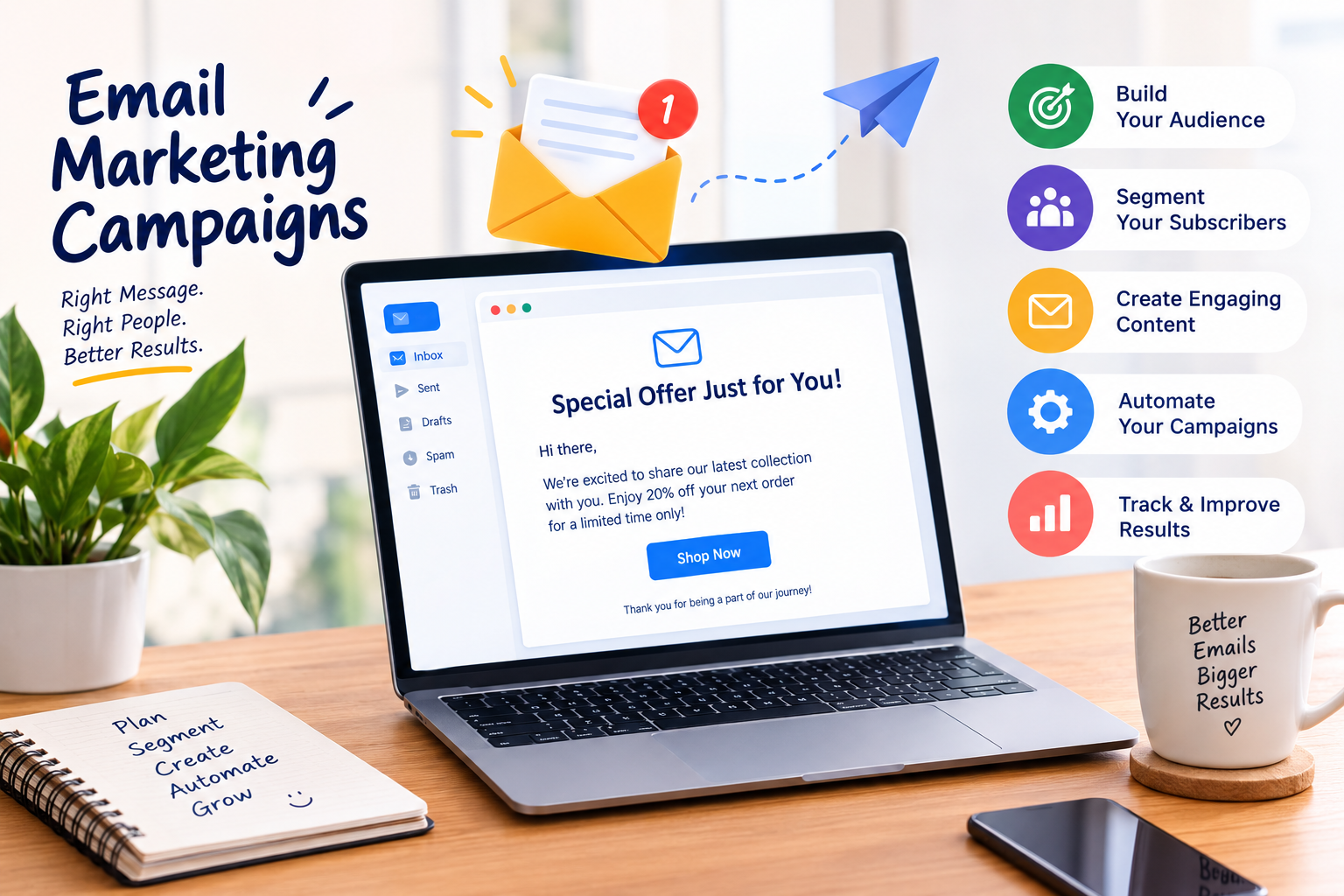
Email marketing campaigns help businesses connect with their audiences, promote products or services, and build lasting customer relationships. When planned effectively, they can encourage subscribers to open emails, click links, and take meaningful actions. However, successful campaigns require more than sending regular messages. Businesses need relevant content, clear calls to action, audience segmentation, and thoughtful timing to reach the right people. From personalized emails and welcome sequences to promotional offers and performance tracking, the right strategies can improve engagement and support business growth in email marketing campaigns. In this guide, we explore 10 proven email marketing campaign strategies to help you connect with customers and increase sales.
Email marketing campaigns remain one of the most useful ways for businesses to reach customers directly. While social media platforms and paid ads can help brands gain attention, email gives businesses a direct line to people who have already shown interest.
A well-planned email marketing campaigns can do more than promote a product. It can welcome new subscribers, build trust, share useful information, recover abandoned carts, announce new products, and turn existing customers into repeat buyers. The key is to send the right message to the right person at the right time.
Whether you run a small online store, SaaS company, agency, blog, or growing startup, email marketing can become an important part of your email marketing campaign. This guide explains how email marketing campaigns work, how to create them, what types to use, how to measure results, and how to improve performance over time.
What Are Email Marketing Campaigns?
An email marketing campaign is a planned set of emails sent to a specific audience for a clear business purpose. The goal may be to generate sales, increase website visits, educate subscribers, promote an event, or build long-term customer relationships.
A campaign can contain one email or several emails delivered over a period of days or weeks. For example, an online clothing store may send an email announcing a new collection, followed by an email showing popular products and another offering a limited-time discount.
Email campaigns are different from random promotional emails because they have a defined objective and audience. A successful campaign starts with a reason for sending the message and ends with a measurable action.
Why Email Marketing Campaigns Still Matter
Email marketing has remained relevant because it combines direct communication with measurable results. Businesses can see how many people opened an email, clicked a link, purchased a product, or unsubscribed.
Another major advantage is that email marketing campaigns allows businesses to communicate with people who have already opted into their audience. This can make communication more relevant than trying to reach completely new users through broad advertising.
Email is also useful across the customer journey. A person may first receive a welcome email, later get educational content, then receive a product recommendation based on their interests.
For example, imagine someone visits a software website and signs up for a free trial. Instead of sending the same promotional email to everyone, the company can send a welcome message, explain the main features, provide a useful tutorial, and later offer help with upgrading.
This approach makes email feel more like a helpful conversation than a sales pitch.
How to Create an Effective Email Marketing Campaign
Creating a strong campaign does not start with writing an email. It starts with understanding the audience and defining the purpose.
Define Your Campaign Goal
Every campaign should have one main goal.
You may want subscribers to purchase a product, register for a webinar, download a guide, start a free trial, read a new article, or return to an abandoned shopping cart.
A clear goal makes the rest of the campaign easier to plan.
For example, an ecommerce brand launching a new product might set a goal of increasing sales during the first week. A SaaS company may instead focus on increasing free-trial conversions.
Avoid trying to achieve five different goals in one email. Too many messages can confuse readers and weaken the main call to action.
Understand Your Audience
Knowing your audience is one of the most important parts of email marketing campaigns.
Consider what subscribers want, what problems they face, what products they viewed, and where they are in the buying journey.
A new subscriber should not always receive the same email as a loyal customer. Someone who has purchased a product may be more interested in setup instructions or related products than a first-time visitor.
Audience data can help you create more relevant campaigns without making every email completely different.
Build a Quality Email List
A strong email list is more valuable than a large list filled with inactive or uninterested contacts.
Businesses should collect email addresses through legitimate methods such as website signup forms, product purchases, free resources, newsletters, webinars, and account registrations.
Subscribers should understand what they are signing up for. Clear permission helps create trust and supports responsible email marketing.
Buying random email lists may produce a large number of contacts, but those people may not know your brand or want your messages. That can lead to poor engagement, spam complaints, and damage to your sender reputation.
Segment Your Subscribers
Email segmentation means dividing an audience into smaller groups based on useful characteristics or behavior.
You might segment subscribers by location, purchase history, interests, engagement level, subscription type, or stage in the customer journey.
Suppose an online bookstore has 20,000 subscribers. Sending a mystery-fiction promotion to every person may not be effective. Instead, the company could identify customers who have previously purchased mystery novels and send them a targeted recommendation.
The message becomes more relevant because it reflects the subscriber’s interests.
Important Types of Email Marketing Campaigns
Different situations require different types of campaigns. Using the right format can improve both customer experience and business results.
Welcome Email Campaigns
A welcome campaign introduces new subscribers to your brand.
The first email can thank them for joining and explain what they can expect. A second email might introduce useful resources, while another can highlight popular products or services.
For example, a marketing software company could welcome a new user, explain how to create their first email marketing campaigns, and then provide a short guide to improving results.
Welcome emails are especially useful because the subscriber has recently shown interest in the brand.
Promotional Email Campaigns
Promotional campaigns are designed to encourage a specific action, often a purchase.
They may announce discounts, seasonal sales, product launches, special offers, or limited-time deals.
A strong promotional email should make the offer easy to understand. The subject line should create interest without making misleading claims.
For example, instead of writing a vague subject line such as “Something Special Is Here,” an ecommerce company could say, “Save 20% on Your Next Order This Weekend.”
Newsletter Campaigns
Email newsletters help businesses maintain regular contact with their audience.
A newsletter can include educational content, industry updates, useful tips, company news, product information, or curated resources.
A technology website, for example, could send a weekly newsletter covering important AI developments, software updates, and practical technology tips.
The best newsletters give subscribers a reason to keep opening them.
Abandoned Cart Emails
Abandoned cart campaigns target customers who added products to their shopping cart but did not complete the purchase.
A simple reminder can sometimes bring the customer back to the website.
For example, an online store might send a reminder a few hours after abandonment and another message the next day. The email can show the product, provide a direct checkout link, and answer common questions about delivery or returns.
The message should remain helpful rather than overly aggressive.
Re-Engagement Campaigns
Some subscribers stop opening emails over time. A re-engagement campaign attempts to bring inactive subscribers back.
The message could ask whether the person still wants to receive emails or offer useful new content.
For example, a fitness company might send an inactive subscriber a message featuring new workout plans and ask them to update their preferences.
If a subscriber remains inactive for a long period, businesses should consider removing or suppressing the address rather than repeatedly sending unwanted messages.
Product Recommendation Campaigns
Product recommendation emails use customer behavior or purchase history to suggest relevant products.
An online electronics store could recommend laptop accessories to someone who recently purchased a laptop.
The more relevant the recommendation, the more useful the email can feel.
Event and Webinar Campaigns
Email is also effective for promoting webinars, workshops, conferences, product demonstrations, and online events.
A campaign can begin with an announcement, followed by a reminder and a final message before the event.
Afterward, businesses can send a recording, summary, or related resource.
How to Write Better Email Subject Lines
The subject line is often the first thing a subscriber sees.
A good subject line should be clear, relevant, and interesting. It should tell the reader enough to understand why opening the email may be worthwhile.
Personalization can help when used naturally. However, adding someone’s first name does not automatically make an email valuable.
Compare these examples:
“New SEO Guide for Small Businesses”
and
“Your New SEO Guide Is Ready”
The better choice depends on the audience and email marketing campaigns. Testing different approaches is more reliable than assuming one formula works for every business.
Avoid misleading subject lines. If the subject promises something that the email does not deliver, subscribers may lose trust.
How to Create Email Content That People Read
People receive many emails every day, so clarity matters.
Keep the opening focused on the reader. Explain the problem, benefit, update, or offer quickly.
Instead of writing a long introduction about how great your company is, show the subscriber why the message matters to them.
For example, a productivity app could start with a simple message explaining how users can reduce repetitive tasks. It could then introduce a feature that helps automate those tasks.
The language should be natural and easy to understand. Short paragraphs, simple words, descriptive headings, and one clear call to action can make the email easier to scan.
Use One Strong Call to Action
A call to action tells the reader what to do next.
It could be “Shop Now,” “Start Your Free Trial,” “Read the Guide,” “Register Today,” or “Book a Demo.”
The CTA should match the campaign goal.
If the purpose is to drive webinar registrations, the main CTA should lead directly to the registration page rather than asking readers to browse the entire website.
Email Personalization and Automation
Modern email marketing campaigns platforms allow businesses to personalize messages and automate many tasks.
Personalization can include a subscriber’s name, location, interests, purchase history, or previous interactions.
Automation allows emails to be triggered by specific actions.
For example, when someone signs up for a newsletter, they can automatically receive a welcome email. If they start a free trial, they can receive a series of educational messages. If they abandon a shopping cart, they can receive a reminder.
Automation saves time and allows businesses to communicate consistently.
However, automation should not replace human thinking. A poorly planned automated campaign can repeatedly send irrelevant messages and create a poor customer experience.
Mobile-Friendly Email Design
A large portion of email reading happens on mobile devices, so responsive design is essential.
An email should be easy to read on a small screen. Text should be large enough, links should be easy to tap, and important information should not depend entirely on large images.
Before launching a email marketing campaigns, preview the email on different screen sizes.
A beautiful desktop design is not enough if mobile users have to zoom in or struggle to click the CTA.
Email Marketing Metrics You Should Track
Email performance should be measured using several metrics rather than one number.
Open Rate
Open rate measures how many delivered emails were opened.
It can provide useful directional information about subject lines and engagement, although modern email privacy features can make open rates less precise than they once were.
Click-Through Rate
Click-through rate measures the percentage of delivered emails that resulted in clicks.
This can help you understand whether the content and call to action motivated subscribers to visit the destination page.
Conversion Rate
Conversion rate focuses on the action that matters to the campaign.
Depending on the business, that could mean purchases, registrations, downloads, bookings, or free-trial signups.
For a sales campaign, conversion rate is often more meaningful than simply knowing how many people opened the email.
Unsubscribe Rate
The unsubscribe rate shows how many recipients chose to stop receiving emails.
A sudden increase may suggest that the email marketing campaigns was too frequent, poorly targeted, or not aligned with subscriber expectations.
Bounce Rate
Email bounce rate measures messages that could not be delivered.
A high bounce rate may indicate outdated addresses, poor list quality, or technical issues.
Maintaining a clean email list helps protect deliverability.
A/B Testing Email Campaigns
A/B testing involves comparing two versions of an email element to see which performs better.
You might test two subject lines, CTA phrases, layouts, images, or offers.
For example, an online course company could compare “Start Learning Today” with “Build Your Digital Skills.” If one produces more clicks under a properly controlled test, that result can inform future campaigns.
Test one major variable at a time when possible. If you change the subject line, CTA, design, and offer simultaneously, it becomes harder to understand what caused the difference.
Testing should be ongoing because audiences and markets change.
Email Deliverability: How to Reach the Inbox
A successful email campaign is useless if messages do not reach subscribers.
Email deliverability depends on several factors, including sender reputation, list quality, authentication, engagement, and sending practices.
Businesses should use proper email authentication such as SPF, DKIM, and DMARC where applicable. They should also avoid sending to old or purchased lists.
Sending a huge number of messages suddenly can also create problems, especially for a new sending domain.
Consistent sending practices, permission-based lists, relevant content, and good technical setup can support healthier deliverability.
Email Marketing Campaigns for Small Businesses
Small businesses do not need a huge marketing department to benefit from email.
A local service provider could send appointment reminders, seasonal offers, helpful advice, and follow-up messages.
A small ecommerce company could create a welcome series, product announcements, abandoned-cart reminders, and post-purchase emails.
For example, a local skincare business might welcome new subscribers with a skincare guide, introduce its best-selling products, and later recommend products based on skin concerns selected during signup.
The strategy can remain simple while still being useful.
Email Marketing Campaigns for SaaS Companies
SaaS businesses can use email throughout the customer lifecycle.
A new user may receive onboarding emails that explain important features. Users who stop using the product may receive helpful tips. Existing customers may receive information about new features, training sessions, or relevant upgrades.
For SaaS companies, the goal is not always immediate sales. Education and product adoption can also be important because customers who understand the product may get more value from it.
A good SaaS email campaign should focus on solving user problems rather than constantly pushing upgrades.
Common Email Marketing Campaigns Mistakes
One common mistake is sending too many emails without considering subscriber expectations.
Another is sending the same message to every person on the list. Segmentation can make communication more relevant.
Poor subject lines can also reduce engagement, while unclear CTAs can make it difficult for readers to know what to do.
Some businesses also focus too heavily on design. A visually impressive email cannot compensate for an irrelevant offer.
Finally, ignoring inactive subscribers can reduce list quality over time. Regular list maintenance is an important part of long-term email marketing campaigns.
Real-Life Example of an Email Marketing Campaigns
Consider a fictional online project management company called TaskFlow.
TaskFlow wants to increase free-trial conversions.
First, the company sends a welcome email immediately after signup. The email explains how to create the first project.
The next email arrives two days later and demonstrates how to assign tasks to team members.
A few days later, users who have created a project but have not invited teammates receive an email explaining team collaboration.
Users who have not logged in for several days receive a helpful reminder rather than a generic sales message.
Finally, users who have reached the end of the free trial receive an email explaining the available plans and showing what they can continue doing with the paid version.
This email marketing campaigns is effective in principle because each message is connected to a stage of the user’s journey.
How Often Should You Send Email Marketing Campaigns?
There is no universal number that works for every business.
The right frequency depends on the audience, industry, email marketing campaigns type, and expectations set during signup.
A daily newsletter may work for a news publisher, while a monthly update may be more suitable for a professional consulting firm.
The most important factor is value.
If subscribers consistently find your emails useful, they may be comfortable hearing from you more often. If every email feels like a sales pitch, even a low frequency can become irritating.
Best Practices for Better Email Marketing Campaigns
Effective email marketing campaigns combines strategy, relevance, testing, and consistency.
Start with a clear goal. Know who you are sending to. Use segmentation when it improves relevance. Write clear subject lines and keep the main message focused.
Make every email easy to read on mobile devices. Use a clear call to action and test important elements before scaling a campaign.
Effective email marketing campaigns combines strategy, relevance, testing, and consistency. Start with a clear goal. Know who you are sending to. Use segmentation when it improves relevance. Write clear subject lines and keep the main message focused. For more guidance, explore these Email Marketing Best Practices.
Track clicks, conversions, unsubscribes, bounces, and other meaningful metrics. Use those results to improve future email marketing campaigns.
Most importantly, respect your subscribers. Give them useful reasons to remain on your list and make it easy for them to manage their preferences or unsubscribe.
The Future of Email Marketing Campaigns
Email marketing campaigns continues to change as technology develops.
Artificial intelligence can help marketers analyze customer behavior, generate draft content, personalize recommendations, and identify patterns in campaign performance.
Automation is also becoming more advanced. Instead of creating one email marketing campaigns for an entire audience, marketers can build journeys that respond to customer actions.
However, technology does not remove the need for good strategy. A perfectly automated campaign can still fail if it sends the wrong message to the wrong audience.
The future of email marketing is likely to focus increasingly on relevance, personalization, privacy, automation, and useful customer experiences.
FAQs About Email Marketing Campaigns
What is an email marketing campaign?
An email marketing campaign is a planned email or series of emails designed to achieve a specific goal, such as increasing sales, generating leads, educating customers, or promoting an event.
What are the main types of email marketing campaigns?
Common types include welcome campaigns, newsletters, promotional emails, abandoned-cart emails, re-engagement campaigns, product recommendations, event emails, and automated customer journeys.
Is email marketing campaigns effective for small businesses?
Yes. Small businesses can use email to build customer relationships, promote products, generate repeat purchases, share useful information, and stay connected with existing customers.
What makes a good email marketing campaigns?
A good marketing email is relevant, clear, useful, easy to read on mobile devices, and focused on a specific goal. It should also have a clear call to action.
How can I improve email open rates?
Improve the relevance and clarity of your subject lines, segment your audience, maintain a clean email list, and test different approaches. Open-rate data should be interpreted carefully because privacy features can affect measurement.
What is email automation?
Email automation uses software to send messages automatically when specific conditions or customer actions occur. Examples include welcome emails, abandoned-cart reminders, onboarding messages, and follow-ups.
What is email segmentation?
Email segmentation means dividing subscribers into groups based on characteristics or behavior. This allows businesses to send more relevant content to different parts of their audience.
Can AI help with email marketing campaigns?
AI can assist with tasks such as content drafting, personalization, audience analysis, subject-line ideas, and campaign optimization. Human review is still important to ensure accuracy, relevance, and brand consistency.
Conclusion
Email marketing campaigns give businesses a direct and measurable way to build relationships with customers. From welcome emails and newsletters to automated journeys and abandoned-cart reminders, there are many ways to use email throughout the customer journey.
The strongest campaigns are not simply about sending more emails. They focus on sending useful messages to the right audience at the right moment. Clear goals, quality content, segmentation, automation, mobile-friendly design, testing, and careful measurement can all improve campaign performance.
If you are building an email strategy for your business, start small. Choose one clear goal, understand your audience, create a focused campaign, measure the results, and use what you learn to improve the next campaign. With consistent testing and a customer-first approach, email can become a valuable part of your long-term digital marketing strategy.
