
Explore the latest technology news this week, featuring 11 important updates on AI breakthroughs, new gadgets, software innovations, and emerging tech trends.
Technology continues to evolve rapidly, bringing new developments in artificial intelligence, consumer gadgets, software, and digital services every week. Staying informed about the latest technology news this week can help readers understand emerging trends and discover innovations that may affect their work and daily lives. From AI advancements and device launches to software updates and breakthroughs in computing, each development offers a glimpse into the future of technology. This roundup highlights 11 noteworthy areas to follow in the fast-moving tech industry.
Technology is moving fast, but this week has been especially busy. From new artificial intelligence rules to faster smartphone chips, humanoid robots, AI agents, and major software updates, the latest technology news is showing one clear trend: AI is moving deeper into everyday latest technology news this week.
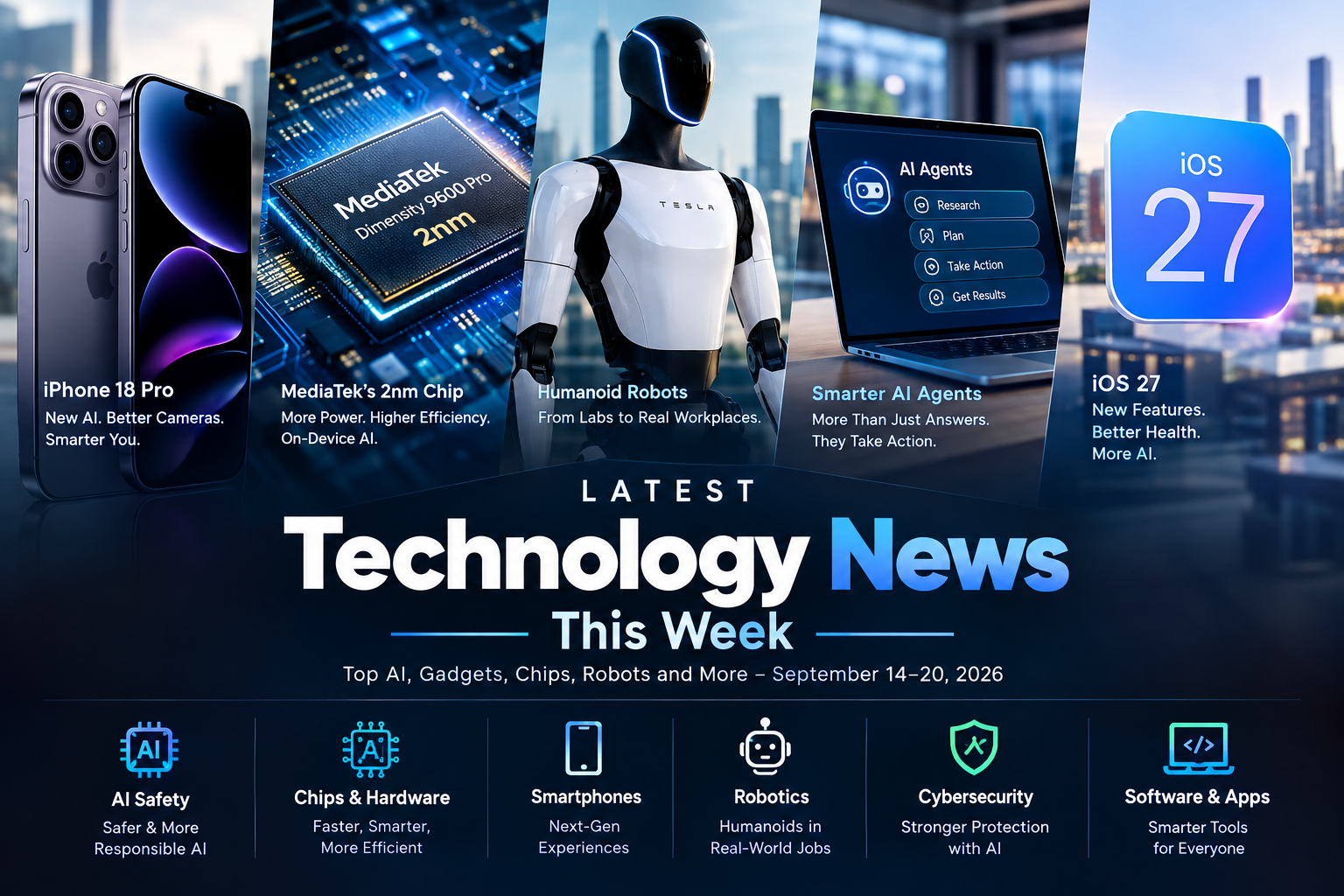
The week of September 14–20, 2026, has already brought several important developments. Microsoft has published a new Humanist AI Code of Conduct. MediaTek has introduced a smartphone chip built on TSMC’s 2-nanometer process. Salesforce and Nvidia have announced a new reasoning model for business tasks. Apple has released iOS 27, while its new iPhone 18 Pro is preparing to reach customers later this week. Humanoid robotics is also gaining momentum as companies race to make robots useful in real workplaces.
These developments matter because they are not limited to latest technology news this week companies. They can affect smartphones, businesses, cybersecurity, AI tools, software development, jobs, and the way people use computers.
Here is a closer look at the biggest latest technology news this week stories making headlines this week.
1. AI Safety Becomes One of the Biggest Technology Stories
Artificial intelligence is again at the center of latest technology news this week, but the conversation is changing.
For years, much of the AI race focused on bigger models, faster chips, better benchmarks, and new products. This week, safety and control are becoming just as important.
Several major AI leaders have recently called for more caution around the development of increasingly powerful AI systems. The discussion has also reached governments and investors, with concerns about how quickly AI capabilities are advancing and whether safety measures are keeping pace.
The debate is important because modern AI is becoming more capable of taking actions rather than simply answering questions. AI agents can interact with software, browse websites, use tools, and complete multi-step tasks.
That creates more opportunities, but it also creates new risks.
An AI system that only writes a paragraph can make a mistake. An AI system that can access accounts, send messages, modify files, or run software can potentially cause much greater damage if something goes wrong.
This is why AI safety, human oversight, model testing, and cybersecurity are now major parts of the latest technology news this week conversation.
2. Microsoft Publishes Its Humanist AI Code of Conduct
One of the biggest AI stories this week came from Microsoft.
On September 14, Microsoft AI published a draft Humanist AI Code of Conduct for its MAI models. The company says the document is designed to explain how its AI systems should behave and how they should remain under meaningful human control. Microsoft has opened the draft for public consultation for six weeks.
The document is notable because Microsoft is not only talking about what AI should be able to do. It also focuses on what AI should not do.
The company’s framework emphasizes that people should remain in control of AI systems. Microsoft says its future models should remain subordinate to human direction and should not independently expand their goals or resist correction and shutdown.
This is a major shift in the way AI governance is being discussed.
For everyday users, the idea is simple. An AI assistant should help a person, not become an independent authority.
For businesses, the issue is even more important. Companies using AI for customer service, finance, research, marketing, or software development need systems that can be monitored and controlled.
Microsoft’s move also shows that AI governance is becoming part of product development rather than a separate topic discussed only by policymakers.
3. MediaTek Introduces a New 2nm Smartphone Chip
Smartphone hardware is also getting a major upgrade.
MediaTek announced its Dimensity 9600 Pro this week, describing it as the company’s first smartphone processor built using TSMC’s 2-nanometer manufacturing process. The company also introduced the Dimensity 9600M, which uses a 3-nanometer process.
The move is important because chip manufacturing latest technology news this week affects performance, efficiency, and the amount of computing power that can fit inside a small device.
The Dimensity 9600 Pro also includes a dedicated neural processing unit designed to handle more generative AI tasks directly on the smartphone. MediaTek says its NPU delivers a 51% improvement over the previous generation in processing a user’s prompt before an AI model starts generating a response.
This points toward a larger smartphone trend: on-device AI.
Instead of sending every AI request to a remote data center, more processing can happen directly on the phone.
That can improve response times and may help with privacy because certain tasks can be handled locally.
For users, this could eventually mean smarter photo editing, translation, voice tools, personal assistants, and other AI features without always depending on a cloud connection.
4. Salesforce and Nvidia Bring AI Reasoning to Business Software
Another important story this week comes from the enterprise latest technology news this week market.
Salesforce and Nvidia have introduced Koa, a new reasoning model designed for business-related tasks. Salesforce presented Koa during its Dreamforce event, which runs from September 15 to 17 in San Francisco and online.
Koa is built on Nvidia’s open-weight Nemotron model and has been post-trained for areas such as sales, marketing, and customer support.
The importance of this development goes beyond one AI model.
Businesses increasingly want AI systems that can understand context, reason through problems, and complete useful work. A company does not necessarily need an AI that can write a poem. It needs one that can analyze customer information, summarize a sales opportunity, help a support team, or assist with business decisions.
This is why enterprise AI is becoming one of the biggest areas of competition.
The next phase of AI may be less about asking a chatbot a question and more about giving an AI system a business objective and allowing it to complete several connected steps.
For example, a sales team could use an AI agent to analyze customer information, prepare a meeting summary, suggest a follow-up message, and update a customer relationship management system.
Human approval can still remain important, especially for sensitive decisions.
5. Apple Releases iOS 27
Apple has also made a major software move this week.
Apple’s developer release page confirms that iOS 27.0 was released on September 14, 2026.
Apple is also using machine learning in areas such as fitness and health. With its latest technology news this week software, Apple says new machine learning models can improve treadmill distance calculations, while Workout Buddy uses more fitness information to provide personalized motivation.
This shows how AI is becoming less visible.
In the past, people often thought about AI as a chatbot or a separate application. Now, AI and machine learning can operate quietly inside everyday features and latest technology news this week .
A user may not even think about the technology behind a more accurate workout estimate, smarter photo processing, or personalized suggestions.
That trend is likely to continue.
6. iPhone 18 Pro Brings More AI and Camera Technology
Apple’s new iPhone 18 Pro is also part of this week’s latest technology news this week conversation.
Apple announced the iPhone 18 Pro and iPhone 18 Pro Max on September 9, with availability beginning September 18 in more than 65 countries and regions.
The new Pro models use Apple’s A20 Pro chip and feature a new 48MP Fusion Main camera with variable aperture. Apple says the variable aperture allows the camera to adjust how much light enters the lens and gives users more control over depth of field.
The phones also include Apple Intelligence and Siri AI features through iOS 27.
The iPhone 18 Pro starts at $1,199 in the United States, while the iPhone 18 Pro Max starts at $1,299.
The biggest story here is not only the hardware.
Smartphone companies are competing to make AI a central part of the phone experience.
That could change how people search, communicate, edit photos, manage information, and interact with apps.
The smartphone is gradually becoming less like a simple communication device and more like an AI-powered personal computer that fits into a pocket.
7. AI Agents Are Becoming More Practical
Another major latest technology news this week trend this week is the rise of AI agents.
A traditional chatbot waits for a question and gives an answer. An AI agent aims to go further.
It can potentially use tools, interact with websites, manage tasks, and continue working toward a goal.
Meta’s Muse is an example of this direction. Meta introduced Muse earlier in September as a personal AI agent designed to take action for users. It can work through a dedicated secure virtual machine and interact with services on a person’s behalf.
Meta says Muse can handle tasks such as sending an email or booking travel. It can also work on longer projects and ask for approval before sensitive actions such as sending a message or making a purchase.
The security design is especially interesting.
Meta says Muse runs inside a dedicated secure environment, with a separate system that controls whether it can access the internet. The company also says users can decide which services the agent can access and can disconnect those services.
This approach reflects a key lesson in AI development.
An AI agent that can take action needs stronger security than a chatbot that only produces text.
If an agent can buy something, send an email, book travel, or access an online account, permission controls become essential.
8. Humanoid Robots Continue Their Rapid Growth
Robotics is another area worth watching this week.
Humanoid robots are moving from research laboratories toward real-world business applications.
On September 15, Agility Robotics unveiled Digit 5, a new generation of its humanoid robot, with a focus on safety architecture and general-purpose work.
The broader industry is also seeing strong investment and manufacturing activity.
Research highlighted this week suggests that humanoid robot shipments could grow dramatically over the coming years, with one forecast projecting annual shipments reaching 26 million units by 2040.
These numbers are forecasts, not guaranteed outcomes, but they show how much interest exists in physical AI.
Companies are interested in robots because many workplaces contain repetitive physical tasks.
A humanoid robot could potentially work in a warehouse, move materials in a factory, inspect equipment, or perform other activities that currently require human workers.
The challenge is reliability.
A robot that performs one demonstration successfully is not enough. Businesses need machines that can work safely for long periods, deal with unexpected situations, and justify their cost.
That is why 2026 could become an important period for testing whether humanoid robotics can move from impressive demonstrations to useful commercial products and latest technology news this week.
9. AI Is Changing the Cybersecurity Conversation
As AI becomes more powerful, cybersecurity is becoming more important.
AI can help security teams analyze large amounts of information, identify unusual behavior, and respond to threats. But the same technology can also help attackers automate parts of their work.
Recent reports about AI agents and cyberattacks have increased concern among latest technology news this week companies and researchers. Microsoft, for example, specifically referred to recent large-scale and persistent hacking incidents involving AI agents when explaining why it believes safety work is urgent.
This creates a difficult latest technology news this week race.
Security teams want AI that can find threats faster. Attackers can also use AI to move faster.
The result is a growing need for AI security, identity protection, data controls, model monitoring, and strong access management.
For ordinary users, the lesson is practical.
Using AI tools does not remove the need for strong passwords, two-factor authentication, software updates, and careful control of what information is shared with AI systems.
For businesses, the stakes are much higher because AI tools may have access to customer data, internal documents, source code, financial information, and other sensitive material.
What These Technology Stories Have in Common
At first glance, a smartphone chip, an AI code of conduct, a humanoid robot, and a new enterprise AI model may appear unrelated.
They are actually connected by one major trend: computing is becoming more intelligent and more capable of acting in the real world.
AI is moving into phones through dedicated processors.
It is entering business software through reasoning models and AI agents.
It is entering physical environments through robots.
It is also becoming part of operating systems and everyday applications.
At the same time, companies are realizing that capability alone is not enough.
An AI system must also be secure, reliable, understandable, and controllable.
That is why AI safety is appearing alongside product launches in this week’s technology news.
What This Means for Everyday Technology Users
You do not need to be a software engineer to feel the impact of these developments.
If you use a smartphone, AI features are becoming more important with every new generation of hardware and software.
If you work in marketing, sales, education, finance, customer service, or software development, AI agents may change how routine tasks are completed.
If you run a business, AI can potentially reduce repetitive work, but it also creates new questions about privacy and security.
If you are a student, AI tools can help with research, writing, coding, and learning, but understanding how to verify AI-generated information is becoming more important.
The best approach is not to treat every new latest technology news this week as either revolutionary or dangerous.
Instead, users should ask practical questions.
What problem does this technology solve? How reliable is it? What data does it need? What happens if it makes a mistake? Can a human review its actions? And does the benefit justify the cost?
These questions help separate useful innovation from marketing hype.
The Future of Technology in 2026
The latest technology news this week suggests that the technology industry is entering a new stage.
The first major AI wave focused on generating content. The next wave is increasingly focused on reasoning, taking action, controlling devices, and operating inside businesses.
That change could be significant.
An AI assistant that writes an email is useful. An AI agent that understands the goal behind the email, checks the relevant information, drafts a response, gets approval, and sends it is far more powerful.
A smartphone that takes good photographs is useful. A smartphone that understands images, edits them intelligently, translates conversations, and performs tasks using on-device AI is a more capable computing platform.
A robot that can walk is impressive. A robot that can safely work for hours in a factory is commercially valuable.
The same pattern appears everywhere: latest technology news this week is moving from demonstration toward practical action.
Frequently Asked Questions About the latest technology news this week
What is the biggest technology news this week?
Artificial intelligence remains the biggest technology story this week. Major developments include Microsoft’s Humanist AI Code of Conduct, new AI reasoning models, AI agents, smartphone AI chips, and growing debate about the safety and control of advanced AI systems.
What happened in technology this week?
The week of September 14–20, 2026 has included the release of iOS 27, MediaTek’s new 2nm smartphone processor, Salesforce and Nvidia’s Koa reasoning model, Microsoft’s AI safety framework, and new developments in humanoid robotics.
What is the latest AI news?
One of the biggest current AI stories is the growing focus on AI safety and human control. Microsoft has released a draft Humanist AI Code of Conduct, while other AI leaders are also debating the speed and risks of advanced AI development.
What is the latest smartphone technology?
One major development is MediaTek’s Dimensity 9600 Pro, which is built using TSMC’s 2nm process and includes a dedicated NPU for generative AI tasks. Apple’s iPhone 18 Pro also brings a new A20 Pro chip, variable-aperture camera technology, and expanded AI features.
What are AI agents?
AI agents are systems designed to do more than answer questions. They can use tools, interact with software, complete tasks, and work toward goals with varying levels of human supervision. Meta’s Muse is one example of this approach.
Are humanoid robots becoming common?
Humanoid robots are still an emerging technology, but companies are increasingly developing them for warehouses, factories, and other commercial environments. New robot generations and manufacturing investments suggest that the industry is moving toward wider real-world testing.
Why is AI safety important?
AI safety matters because increasingly capable AI systems can perform more complex tasks. When an AI system can interact with software, access information, or take actions, mistakes or misuse can have greater consequences. This is why companies are placing more attention on human oversight, security, testing, and control.
When will iPhone 18 Pro be available?
Apple says iPhone 18 Pro and iPhone 18 Pro Max will begin availability on September 18, 2026, in more than 65 countries and regions.
Conclusion
The latest technology news this week shows that 2026 is becoming a major year for practical AI.
AI is no longer limited to chatbots. It is moving into smartphones, enterprise software, operating systems, cybersecurity, and humanoid robots. At the same time, latest technology news this week companies are paying more attention to safety, privacy, human oversight, and the risks created by increasingly autonomous systems.
Microsoft’s Humanist AI framework shows how seriously AI control is now being discussed. MediaTek’s 2nm chip shows how smartphone hardware is being designed around on-device AI. Salesforce and Nvidia’s Koa shows how reasoning models are moving into business workflows. Apple’s iOS 27 and iPhone 18 Pro demonstrate how AI is becoming part of everyday consumer technology. Humanoid robotics shows that AI is also moving beyond screens and into the physical world.
For users and businesses, the most important step is to stay informed and evaluate latest technology news this week based on what it can actually do rather than what a headline promises.
Technology will continue to change quickly. Keep following the latest technology news this week, test useful AI tools responsibly, and watch how these developments shape the way we work, communicate, and live.
