
Discover 7 important facts about Tesla Optimus robot, including its AI technology, key features, potential uses, challenges, and future possibilities.
Humanoid robots are becoming an important part of discussions about artificial intelligence and automation, and Tesla’s Optimus robot is one of the projects attracting attention. Designed to perform certain physical tasks, Optimus aims to combine robotics, AI, and machine vision to help with repetitive or labor-intensive work. As development continues, people are interested in how the robot works, what it may be able to do, and where it could be used in the future. This guide explores seven key facts about Tesla’s Optimus robot, its technology, potential applications, and challenges.
The idea of a robot that can walk, see, understand its surroundings, and perform useful physical work once sounded like science fiction. Today, that idea is becoming a serious engineering project. Tesla’s Optimus robot is one of the most closely watched humanoid robots in the world, built around artificial intelligence, computer vision, advanced motors, and robotic control.
Tesla describes Optimus as a general-purpose, bipedal, autonomous humanoid robot designed to handle unsafe, repetitive, or boring tasks. The company is developing the robot as part of its wider AI and robotics strategy.
But what exactly is Tesla Optimus? How does it work? What could it do in factories and homes? And when might people actually be able to use one?
This guide explains the Optimus robot in simple terms and looks at where Tesla’s humanoid robot project stands today.
What Is the Optimus Robot?
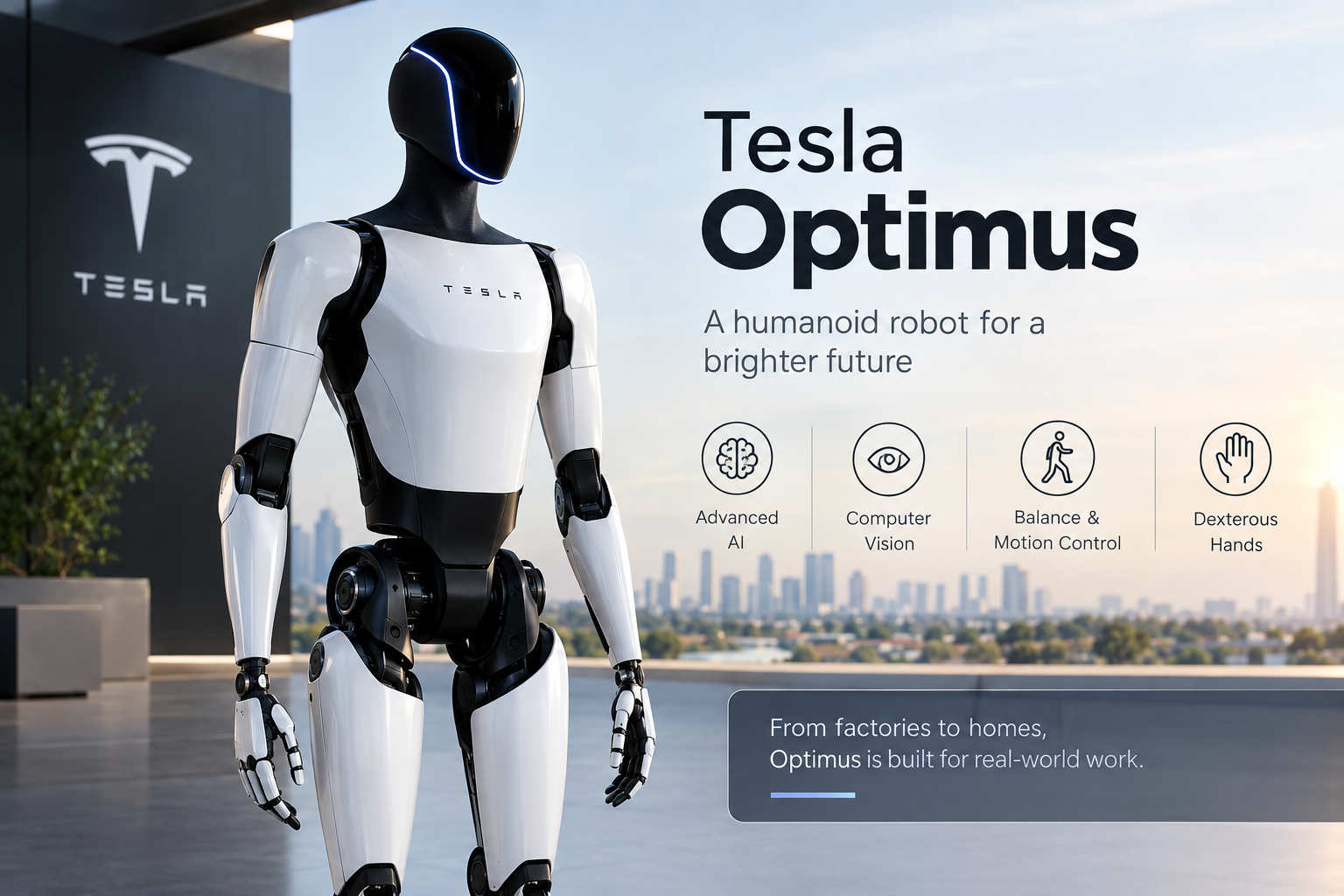
The Tesla Optimus robot, also called Tesla Bot, is a humanoid Optimus Robot being developed by Tesla. It is designed to have a human-like body so it can work in environments created for people.
That design choice is important. Most industrial robots are built for specific tasks and usually operate in controlled areas. A humanoid robot has a different goal. It can potentially walk through human spaces, use tools designed for people, pick up objects, move between locations, and perform different tasks without requiring an entirely new workplace.
Tesla says its long-term goal is to create a general-purpose autonomous Optimus Robot that can perform dangerous, repetitive, and boring jobs.
The project also connects closely with Tesla’s experience in artificial intelligence. Tesla already develops computer vision, neural networks, AI inference hardware, motors, batteries, and control systems for its vehicles. The company believes some of these technologies can also support humanoid robotics.
Why Is Tesla Building a Humanoid Robot?
The main reason is simple: many jobs require physical movement.
Factories, warehouses, construction sites, and other workplaces contain tasks that can be tiring, repetitive, or unsafe for people. A robot could potentially handle some of these activities while workers focus on tasks that require judgment, communication, creativity, or specialized skills.
For example, imagine a factory worker repeatedly moving the same type of component from one location to another. If a humanoid robot becomes reliable enough, it could perform that repetitive movement for long periods.
Tesla’s vision goes beyond factories. The company has also presented Optimus as a robot that could eventually help with everyday activities and household tasks.
However, there is an important difference between demonstrating a robot performing a task and having a commercially available robot that can safely perform thousands of different tasks. That gap is one of the biggest challenges facing Tesla and the entire humanoid robotics industry.
How Does Tesla Optimus Work?
A humanoid robot needs much more than motors and metal parts. It needs a system that can understand the environment, make decisions, maintain balance, and control its body.
Tesla’s Optimus Robot development therefore combines several major technologies.
Artificial Intelligence
AI is at the center of Optimus.
The robot needs to process information from its sensors and decide what actions to take. A simple instruction such as “pick up that object” can involve many steps.
The robot has to identify the object, estimate its position, move toward it, control its arms and hands, grip it correctly, and maintain balance while moving.
Tesla has discussed building foundation models for robotics that connect visual information to physical actions. At Tesla’s 2026 CVPR event, the company described work involving large-scale multimodal models for controlling robots from visual input to physical movement.
This approach is sometimes described as embodied AI. Instead of AI existing only inside a computer or smartphone, embodied AI allows intelligence to interact with the physical world.
Computer Vision
Optimus needs to see its environment.
Computer vision allows an AI system to process visual information and identify objects, surfaces, people, and other parts of its surroundings.
This is especially important for a humanoid robot because the physical world is unpredictable. A box may be in a different position than expected. A person may walk in front of the robot. The floor may contain an obstacle.
The robot therefore needs to constantly understand what is happening around it.
Tesla already has extensive experience developing vision-based AI for vehicles, and the company says its AI approach is being applied across vehicles and Optimus Robot.
Balance and Motion Control
Walking on two legs is much harder than moving on wheels.
A robot must constantly adjust its body to remain stable. Even small changes in weight or surface conditions can affect balance.
Optimus needs sophisticated motion planning and control systems to coordinate its legs, arms, hands, and body.
Tesla specifically identifies balance, navigation, perception, and interaction with the physical world as key software challenges forOptimus Robot.
Sensors and Actuators
A humanoid robot also needs hardware that can detect movement and generate physical force.
Sensors provide information about the robot’s position and surroundings. Actuators and motors then create movement.
The system must coordinate these components in real time. If Optimus reaches for an object, its software has to control multiple joints at once while maintaining stability.
That makes humanoid robotics a combination of mechanical engineering, electrical engineering, software development, AI, and control systems.
What Can the Optimus Robot Do?
The capabilities of Optimus Robot are still developing, so it is important not to confuse Tesla’s future goals with currently proven consumer capabilities.
Tesla’s stated objective is a general-purpose robot rather than a machine designed for only one job.
In practical terms, the robot could eventually be useful for tasks such as moving objects, handling materials, performing repetitive factory work, and assisting with other physical activities.
Tesla has also discussed using Optimus within its own manufacturing operations. In 2025, the company said it was building Optimus Robot on a pilot production line and working toward wider deployment of robots doing useful work in its factories.
This is a sensible starting point because factories offer a more controlled environment than a typical home.
A robot working in a factory can be trained for specific workflows. Its surroundings can also be organized to make navigation easier.
Optimus Robot in Manufacturing
Manufacturing could be one of the most important early markets for humanoid robots.
Factories already use industrial robots, but these machines are usually designed for specific tasks. Optimus takes a different approach by aiming to be more flexible.
Imagine a manufacturing facility where a robot can move parts between workstations, pick up containers, inspect objects, or perform repetitive handling tasks.
If one robot can perform several jobs instead of only one, companies may have more flexibility when production needs change.
Tesla’s own factories provide a useful testing environment for this idea. The company has said its robotics program is moving toward production, with a dedicated Optimus production facility under construction.
Tesla’s January 2026 filing stated that Gen 3 Optimus Robot was intended as its first design aimed at mass production, with production planned before the end of 2026 and eventual planned capacity of up to one million robots per year. These are company plans, not a guarantee that those production levels will be reached.
That distinction matters when evaluating the future of Optimus.
Could Optimus Work in Homes?
Home use is one of the most exciting possibilities for a humanoid robot.
A robot designed around a human body could theoretically perform tasks such as carrying objects, organizing items, helping with household chores, or assisting people with routine activities.
Tesla’s own materials have described Optimus in the context of daily tasks and household chores.
But homes are much harder environments for robots than factories.
Every home is different. Furniture moves. Children and pets move unpredictably. Objects can be fragile. Floors can have different surfaces. People may give vague instructions.
A robot that works well in a factory may still struggle in an ordinary home.
For that reason, widespread home use will depend on major improvements in reliability, safety, cost, and general-purpose AI.
Tesla Optimus vs Traditional Robots
The biggest difference between Optimus Robot and many traditional industrial robots is flexibility.
A traditional robotic arm may be extremely good at welding a specific component or moving an object between two fixed positions. It can perform its assigned task quickly and repeatedly.
But changing that robot’s job may require new programming, new hardware, or changes to the production line.
A humanoid robot is designed with a broader goal.
Because Optimus has a human-like body, Tesla hopes it can work in spaces already designed for humans. The same robot could potentially learn different tasks through software and AI.
This flexibility is one of the main reasons humanoid robots have attracted so much attention.
What Makes Optimus Different From Other Humanoid Robots?
Tesla is not the only company developing humanoid robots.
Several robotics companies are working on machines designed for warehouses, factories, research laboratories, and other environments.
Tesla’s major advantage is its existing AI and manufacturing ecosystem.
The company already works on neural networks, computer vision, AI chips, batteries, electric motors, power electronics, and large-scale manufacturing. Tesla argues that many of these technologies can support its robotics program.
Tesla also has access to data and AI engineering experience from its vehicle business. Its 2026 technical presentation highlighted work on foundation models for robotics and embodied AI.
Still, having strong AI and manufacturing experience does not automatically solve every robotics problem.
Humanoid robots face difficult challenges involving dexterity, safety, balance, reliability, energy use, and real-world decision-making.
How Much Will the Optimus Robot Cost?
The final consumer price of Optimus has not been established as a standard retail price.
There have been many online estimates and predictions about what the robot could eventually cost. These numbers should be treated carefully unless Tesla officially confirms them.
Price will depend on the cost of motors, batteries, sensors, processors, hands, actuators, manufacturing, software, and maintenance.
Tesla’s planned scale is important here. If the company can produce humanoid robots in very large numbers, manufacturing costs could potentially fall.
Tesla’s January 2026 filing discussed a long-term planned capacity of one million Optimus robots per year. Again, this is a stated target rather than evidence that one million units are currently being produced.
When Will Tesla Optimus Be Available?
This is one of the most common questions about the robot.
Tesla is moving toward larger-scale production, but that does not mean Optimus Robot is already a normal consumer product.
Tesla’s filings indicate that Gen 3 is being developed as a mass-production design, with production planned before the end of 2026.
The first major applications are likely to focus on controlled environments and Tesla’s own operations.
A consumer version for ordinary households would require additional development, testing, safety validation, manufacturing scale, and a reliable business model.
Therefore, anyone claiming that Optimus Robot will definitely be available for every household on a specific date should be treated with caution unless Tesla confirms it.
The Biggest Challenges Facing Optimus
Humanoid robotics is an extremely difficult engineering problem.
The first challenge is reliability. A robot may work perfectly during a demonstration but still fail when it encounters thousands of unexpected situations.
The second challenge is safety. A machine with human-like strength and movement must operate safely around people.
The third challenge is dexterity. Human hands are incredibly capable. We can pick up a tiny object, open different types of containers, use tools, and adjust our grip without thinking about every movement.
Teaching a robot to perform those actions reliably is difficult.
Another challenge is battery life. A humanoid robot needs energy to power motors, processors, sensors, and communication systems. The battery must provide useful operating time without making the robot too heavy.
Cost is another major issue. A robot may be technically impressive, but mass adoption will depend on whether its economic value is greater than its purchase, maintenance, and operating costs.
Will Optimus Replace Human Workers?
The effect of humanoid robots on employment is likely to be more complicated than simple job replacement.
Some repetitive physical tasks may become increasingly automated. Companies may use robots for work that is dangerous, physically exhausting, or difficult to staff.
At the same time, new jobs may grow around robot manufacturing, maintenance, programming, AI training, safety, system integration, and robotics operations.
The impact will also vary by industry.
A warehouse worker whose main task involves repetitive movement may face more automation pressure than someone whose job depends heavily on communication, creativity, negotiation, or complex human judgment.
The more useful question may therefore be how humans and Optimus Robot will work together rather than whether robots will replace every worker.
Why Optimus Matters for Artificial Intelligence
Optimus is important because it pushes AI beyond screens.
A chatbot can generate text. An image model can create pictures. A software agent can interact with digital applications.
A humanoid robot has to deal with the physical world.
It must understand space, movement, objects, gravity, friction, balance, timing, and human behavior.
This is why embodied AI is becoming an important area of research.
Tesla’s 2026 CVPR presentation described work on foundation models for robotics and systems that connect multimodal AI models to physical robot control.
If this technology improves, robots could potentially learn a much wider range of tasks instead of being programmed separately for every movement.
Optimus Robot and the Future of Work
The future of work may involve humans and robots sharing the same environments.
Consider a warehouse where people manage inventory, quality checks, customer needs, and unusual situations while humanoid robots handle repetitive transportation tasks.
Or imagine a factory where robots perform physically demanding work while human engineers supervise production and solve problems.
This model could increase productivity without requiring every task to become fully automated.
The real value of Optimus Robot will therefore depend not simply on whether it can walk or pick up objects, but on whether it can perform useful work consistently, safely, and at a reasonable cost.
Is Tesla Optimus Really Autonomous?
Tesla describes Optimus as an autonomous humanoid robot, but autonomy should not be confused with unlimited intelligence.
An autonomous robot needs to perceive its environment and make decisions without constant human control.
However, autonomy in the real world is usually limited by the task, environment, software, safety systems, and operating conditions.
A robot may be autonomous when performing a specific factory task but still require supervision when facing an unfamiliar situation.
This is why real-world testing is so important.
Tesla is continuing to develop the AI and software stack needed for balance, navigation, perception, and physical interaction.
What Could Optimus Mean for Businesses?
For businesses, the biggest attraction is productivity.
If a humanoid robot can work for long periods and perform repetitive tasks with consistent accuracy, it could reduce the amount of human labor required for certain operations.
However, businesses will need to compare the full cost of automation with the value created.
A company would need to consider the robot’s purchase cost, software, maintenance, charging, supervision, safety, downtime, and integration with existing systems.
The business case becomes much stronger when a robot can perform multiple useful tasks instead of only one.
That is why Tesla’s general-purpose approach is so important.
The Future of Tesla Optimus
The future of Optimus will depend on execution.
Tesla has ambitious plans for humanoid Optimus Robot, including mass production and eventual large-scale deployment. Its latest filings show that the company is preparing production infrastructure and developing Gen 3 as a design intended for mass production.
But robotics is not only a manufacturing challenge. It is an AI challenge, a safety challenge, and a reliability challenge.
The most important milestone will not simply be seeing more Optimus robots on a production line. The bigger test will be whether they can perform valuable tasks reliably without constant human intervention.
If Tesla succeeds, Optimus could become one of the most significant robotics platforms of the next decade.
If the technology proves too expensive or unreliable, adoption could take much longer.
Frequently Asked Questions About Optimus Robot
What is the Optimus robot?
Optimus Robot is Tesla’s general-purpose humanoid robot. Tesla says it is being developed as a bipedal autonomous robot capable of performing unsafe, repetitive, or boring tasks.
What is Tesla Optimus designed to do?
Optimus is designed for general-purpose physical work. Potential applications include manufacturing, material handling, repetitive tasks, and eventually household activities.
Is Optimus available to buy?
Optimus is not currently a normal consumer product with an established retail price and broad public availability. Tesla is developing production capability and has stated plans for mass production.
When will Optimus be mass produced?
Tesla’s January 2026 filing said Gen 3 was intended as its first design for mass production, with production planned before the end of 2026. The company also described eventual planned capacity of one million robots per year.
Can Optimus work in a factory?
Factory work is one of the key areas Tesla is targeting. Tesla has previously discussed deploying Optimus Robot for useful work in its factories.
Will Optimus be able to do household chores?
Tesla has presented household tasks as a potential use for Optimus. However, reliable household automation is much harder than performing controlled tasks in a factory, so widespread home use will require further development.
Is Optimus fully autonomous?
Tesla’s goal is an autonomous humanoid robot, but the capabilities of current prototypes should not be treated as unlimited autonomy. Real-world autonomy depends on the task, environment, software, and safety systems.
Why is the Optimus robot important?
Optimus represents the combination of humanoid robotics and advanced AI. If Tesla can make it reliable and affordable at large scale, it could change how businesses approach physical automation.
Conclusion
The Optimus robot is much more than a machine that can walk like a human. Tesla is trying to combine artificial intelligence, computer vision, robotics, batteries, motors, software, and large-scale manufacturing into one general-purpose platform.
The most interesting part of Optimus Robot is its potential flexibility. Instead of building one robot for one task, Tesla wants a humanoid machine that can learn and perform many different types of physical work.
The project is still developing, and some of Tesla’s biggest goals remain future plans rather than proven commercial results. Still, the company’s push toward Gen 3 and mass-production preparation shows that Optimus is becoming a serious part of Tesla’s long-term AI and robotics strategy.
As humanoid robots become more capable, the way we think about automation may change. Factories, warehouses, offices, and eventually homes could become environments where humans and intelligent machines work side by side.
Want to keep up with the latest developments in AI, robotics, and emerging technology? Follow the latest Optimus updates and explore how humanoid robots are shaping the next generation of automation.
