

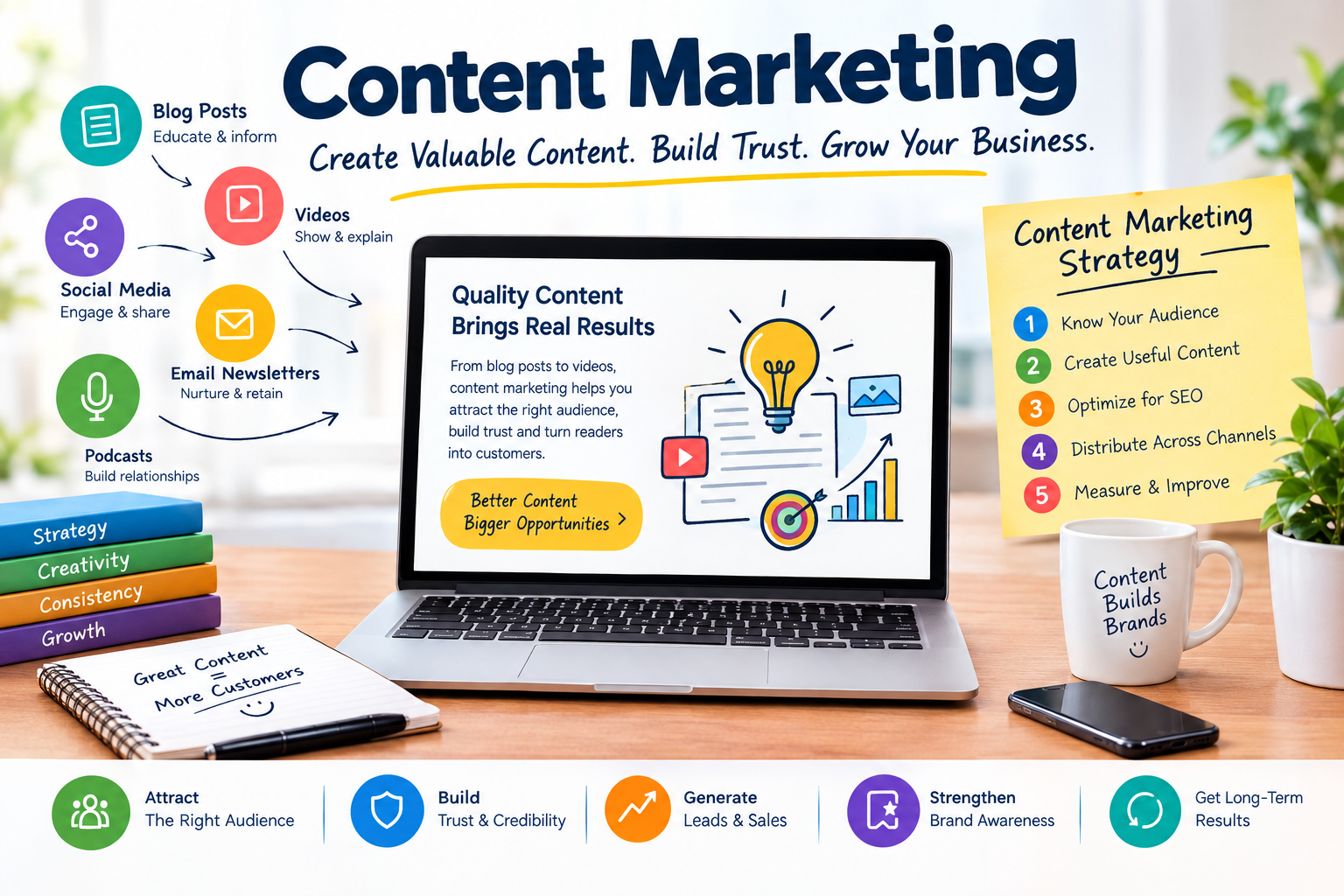
Discover 9 powerful content marketing strategies for 2026 to attract the right audience, increase engagement, generate leads, and drive more conversions.
Content marketing remains an important way for businesses to attract the right audience, build trust, and generate long-term results. In 2026, successful content marketing is about more than publishing blog posts regularly. Businesses need useful, relevant, and audience-focused content that answers real questions and supports customers throughout their buying journey. From SEO and social media content to video, AI-assisted creation, and personalized experiences, the right strategies can help brands increase visibility, strengthen engagement, generate qualified leads, and turn more visitors into customers.
Content marketing is no longer just about publishing blog posts and hoping people find them. Today, customers can discover a brand through Google, social media, videos, email, podcasts, online communities, and many other channels.
This makes content marketing more important than ever, but it also makes it harder to do well.
A business can publish dozens of articles and still get little traffic. Another company can publish fewer pieces but attract a steady stream of visitors, leads, and customers because its content solves real problems.
The difference is strategy.
Effective content marketing starts with understanding your audience. It then connects useful content with the questions people ask, the problems they face, and the decisions they need to make.
According to Content Marketing Institute research, 87% of B2B marketers said content marketing helped create brand awareness, while 74% said it helped generate demand or leads. However, only 22% described their content marketing as extremely or very successful.
That gap shows an important lesson: creating content is easy. Creating content that produces business results requires planning, quality, consistency, and measurement.
What Is Content Marketing?
Content marketing is a marketing approach that uses useful and relevant content to attract a specific audience, build trust, and support business goals.
Instead of directly telling people to buy something in every message, content marketing gives them information that helps them make better decisions.
For example, a software company could publish a guide explaining how to automate repetitive tasks. A fitness company could create a beginner’s workout guide. A technology website could explain how artificial intelligence works in simple language.
The content provides value first.
When readers find the information useful, they may return to the website, subscribe to an email list, follow the brand on social media, or eventually become customers.
This makes content marketing different from traditional advertising.
An advertisement often asks for attention immediately. Content marketing tries to earn attention by being useful.
Why Is Content Marketing Important?
People research products and services before making many purchasing decisions.
They may search Google, watch YouTube videos, read reviews, compare products, visit company websites, and ask questions on social media.
Content gives businesses a way to become part of that research process.
A well-written article can answer a question before a customer contacts a sales team. A case study can show how a product helped another business. A tutorial can demonstrate expertise. A video can explain a complicated product in a few minutes.
Content can also continue working after it is published.
A useful article may bring search traffic months or even years after publication if it remains relevant and competitive.
That long-term potential is one reason businesses continue to invest in content marketing.
HubSpot’s 2025 blogging research found that 65% of marketers work at companies that maintain blogs, 93% of those marketers consider blogging important or very important to their marketing strategy, and half reported higher blogging ROI in 2024 than the previous year.
How Content Marketing Works
Content marketing usually follows a simple customer journey.
First, people become aware of a problem.
Then they search for information.
After that, they compare possible solutions.
Eventually, they choose a product, service, or company.
Content can support each stage.
A beginner-friendly article can create awareness. A detailed comparison can help with evaluation. A product guide can answer final questions. A case study can provide evidence and confidence.
This means businesses should not create content only for people who are ready to buy.
Some of the most valuable content reaches people much earlier in the decision process.
Content Marketing and SEO
Search engine optimization and content marketing work closely together.
SEO helps search engines understand content and helps users discover it. Content provides the information that users are looking for.
For example, suppose a company sells project management software.
Instead of publishing an article titled “Our Project Management Software,” it could create useful articles about project planning, team communication, task management, project risks, productivity, and workflow automation.
These topics can attract people who have problems that the software may eventually solve.
Good SEO content should satisfy search intent rather than simply repeat keywords.
If someone searches for “how to create a project timeline,” they probably want instructions. A page that spends most of its time promoting software may not satisfy that intent.
The better approach is to answer the question clearly and then explain where a relevant tool may help.
Understanding Search Intent
Search intent is the reason behind a search query.
Someone searching for “what is content marketing” probably wants an explanation.
Someone searching for “best content marketing tools” is likely comparing solutions.
Someone searching for “content marketing agency pricing” may be closer to making a purchase.
Understanding this difference can improve your content strategy.
Before writing an article, ask what the searcher actually wants.
Then create content that answers that need.
This simple step can prevent businesses from producing articles that rank for keywords but fail to satisfy readers.
The Main Types of Content Marketing
Content marketing includes many formats.
Blog posts remain useful because they can answer detailed questions and attract search traffic.
Videos are valuable because they can explain ideas quickly and demonstrate products visually.
Case studies can show real outcomes and build credibility.
Email newsletters can keep a brand connected with people who have already shown interest.
Social media posts can distribute ideas and start conversations.
Webinars can provide deeper education and direct interaction.
Podcasts can build relationships with audiences who prefer audio.
The best format depends on the audience and topic.
Content Marketing Institute’s 2025 B2B research found that 92% of B2B marketers used short articles or posts, 76% used videos, and 75% used case studies or customer stories. The research also found that marketers rated video as the most effective content type among those measured.
Blog Content Marketing
A business blog can become a long-term source of organic traffic and customer education.
However, simply publishing articles is not enough.
Every article should have a clear purpose.
For example, a technology company might create a series of articles covering beginner AI concepts, business applications, AI tools, automation, and common implementation problems.
Over time, these articles can establish the site as a useful resource.
Strong blog content should be easy to read, accurate, useful, and specific.
Instead of saying that automation “saves time,” explain what type of work it can automate and show a practical example.
Specific information creates more value than vague marketing language.
Video Content Marketing
Video has become an important part of modern content strategies.
A short video can explain a product feature, demonstrate a process, answer a common question, or share an expert opinion.
It does not always require a large production budget.
A simple screen recording can work for software tutorials. A smartphone can be enough for educational short-form videos. A presentation can become a webinar.
The key is not expensive equipment.
The key is useful information and clear delivery.
B2B research from Content Marketing Institute found that 58% of marketers rated videos among the content types producing the best results, ahead of case studies and customer stories at 53%.
Social Media Content Marketing
Social media can help distribute content and create direct relationships with an audience.
A business can turn one long article into several smaller pieces of content.
For example, a detailed article about SEO could become a short video explaining one SEO mistake, an Instagram post with a quick tip, a LinkedIn discussion, and an email newsletter.
This approach is called content repurposing.
It helps businesses get more value from content without creating every piece from scratch.
Content Marketing Institute reported that 89% of B2B marketers used organic social media to distribute content, while 84% used corporate blogs and 71% used email newsletters.
Email Content Marketing
Email remains useful because it gives businesses direct access to an audience that has chosen to hear from them.
A newsletter can share educational articles, product updates, case studies, industry news, and useful resources.
The goal should not be to send promotional emails every day.
A better approach is to provide consistent value.
For example, a marketing agency could send one practical SEO lesson each week. A SaaS company could send productivity tips. An online education business could share learning resources.
Useful emails build trust.
Content Marketing for Small Businesses
Small businesses often assume that content marketing requires a large team.
It does not.
A small company can focus on a narrow topic and produce content based on real customer questions.
Suppose a local accounting firm frequently receives questions about bookkeeping.
Instead of writing generic posts about “business success,” it could create articles explaining bookkeeping basics, common accounting mistakes, invoice management, tax preparation, and cash-flow planning.
These topics are directly connected to customer needs.
The firm could then turn each article into a short video, social media post, and email.
One useful idea can become several pieces of content.
Content Marketing for SaaS Companies
SaaS businesses can use content marketing throughout the customer journey.
Educational content can introduce a problem. Comparison articles can help buyers evaluate solutions. Tutorials can show how a product works. Case studies can demonstrate real results.
For example, an email automation platform could publish content about abandoned carts, customer segmentation, lead nurturing, email personalization, and campaign measurement.
The product naturally connects to these topics without turning every article into an advertisement.
This approach can attract people who already have problems the software is designed to solve.
Content Marketing for Technology Websites
Technology websites have a huge range of possible topics.
They can cover AI, cybersecurity, software, cloud computing, smartphones, data centers, automation, productivity tools, emerging technologies, and digital trends.
However, competition can be intense.
A technology site can stand out by choosing specific topics instead of trying to cover everything.
For example, instead of writing another general article about artificial intelligence, a site could explain how AI is being used in a particular industry or how a specific type of AI tool works.
Narrower topics can create clearer audience value.
Creating a Content Marketing Strategy
A strong strategy starts with goals.
A company may want more organic traffic, leads, sales, brand awareness, email subscribers, or customer retention.
The goal determines what content should be created.
Next, define the target audience.
Understand what they need, what problems they face, what questions they ask, and what influences their purchasing decisions.
Then research topics.
Keyword research can help identify search demand, but customer questions should also guide the process.
After that, create an editorial plan.
Decide what topics will be published, when they will be published, who will create them, and how they will be distributed.
Finally, measure results and improve the strategy.
Content marketing should not be a set-and-forget activity.
Creating Helpful Content
Helpful content answers the reader’s question clearly.
It should not force the reader to search through several paragraphs to find a simple answer.
Use clear headings and short paragraphs.
Explain technical terms when necessary.
Give practical examples.
Use accurate information.
When making claims about statistics, research, products, or technical features, use reliable sources.
Most importantly, write for people first.
Search engines can help people discover content, but people decide whether the content is useful.
E-E-A-T and Content Quality
Google’s E-E-A-T concept stands for experience, expertise, authoritativeness, and trustworthiness.
These ideas are useful when creating content because readers want to know whether they can trust the information they are reading.
Experience can come from practical involvement with a subject.
Expertise means demonstrating real knowledge.
Authoritativeness can come from recognition, credible references, and a strong reputation.
Trustworthiness involves accuracy, transparency, and honest communication.
For example, an article about software could include real testing observations instead of repeating the manufacturer’s description.
A finance article should rely on credible sources and avoid unsupported claims.
A health article should use reliable medical sources and make clear when professional advice is needed.
Content quality is not just about word count.
The Role of AI in Content Marketing
Artificial intelligence is changing how marketing teams create and manage content.
AI tools can help with brainstorming, research organization, outlines, editing, transcription, translation, and content repurposing.
But using AI does not remove the need for human judgment.
Content still needs fact-checking, editing, original insights, and a clear understanding of the audience.
HubSpot’s recent marketing research reports that 80% of marketing teams use AI for content creation and 75% use AI for media production.
This shows how common AI has become, but widespread use does not mean every AI-generated article is useful.
The strongest approach is to use AI as a productivity tool while keeping human expertise and quality control at the center.
Content Repurposing
Creating every piece of content from zero can take a lot of time.
Repurposing makes the process more efficient.
Imagine you publish a 2,000-word article about email marketing.
That article can become a short video, a LinkedIn post, a newsletter, a social media carousel, and a podcast discussion.
The core idea remains the same, but the format changes.
This helps businesses reach people who prefer different content channels.
It also gives strong ideas more opportunities to reach the right audience.
Content Distribution
Creating content is only half the job.
People need to discover it.
Distribution can include organic search, social media, email, communities, partnerships, video platforms, newsletters, and paid promotion.
The right channels depend on your audience.
For example, a B2B company may focus heavily on LinkedIn and email, while a consumer fashion brand may prioritize Instagram, TikTok, and visual search.
Content should be distributed where the target audience already spends time.
Measuring Content Marketing Results
One of the biggest challenges in content marketing is measurement.
Traffic is useful, but it does not tell the whole story.
A page can receive thousands of visitors and generate no leads.
Another page may receive fewer visitors but produce valuable customer inquiries.
Useful metrics can include organic traffic, engagement, email subscriptions, lead generation, conversion rates, assisted conversions, returning visitors, and revenue influenced by content.
Content Marketing Institute found that 56% of surveyed B2B marketers cited difficulty attributing ROI to content efforts, while the same percentage cited difficulty tracking customer journeys.
This is why content goals should be connected to business goals from the beginning.
Common Content Marketing Mistakes
One major mistake is creating content without a clear audience.
Another is publishing too much low-value content.
More articles do not automatically mean more success.
A third mistake is focusing entirely on keywords.
Keywords are useful for understanding search demand, but content should answer real questions rather than repeat phrases.
Another mistake is ignoring distribution.
Even excellent content can remain invisible if nobody knows it exists.
Businesses also make the mistake of expecting immediate results.
Content marketing often takes time because search visibility, audience trust, and brand recognition develop gradually.
How to Build a Simple Content Marketing Plan
Start with one audience and one main business goal.
Research the questions that audience asks.
Choose a small group of topics that connect naturally to your products or services.
Create detailed, useful content around those topics.
Publish consistently without sacrificing quality.
Repurpose strong content into other formats.
Distribute it through the channels your audience uses.
Track performance.
Then improve your strategy based on real data.
This process is simple, but it is far more effective than publishing random articles every week.
Real-Life Example of a Content Marketing Strategy
Imagine a small SaaS company that sells appointment scheduling software.
Instead of publishing only product announcements, it creates content around appointment management.
It publishes an article explaining how to reduce missed appointments. It creates a video showing how online scheduling works. It publishes a case study about a business that improved its booking process. It sends an email with scheduling tips.
Each piece addresses a different customer need.
The product is still present, but the content does not feel like constant advertising.
This creates a connected content ecosystem.
Content Marketing Trends for 2026
Content marketing is moving toward more useful, human, and channel-specific experiences.
AI will continue to support content workflows, but businesses will need stronger editorial standards as generic content becomes easier to produce.
Short-form video will remain important. HubSpot reports that 60% of marketers use short-form video in their content strategy, making it the most widely used content format in its recent research.
At the same time, written content remains valuable for topics that require depth, research, and explanation.
The future is not simply about choosing between blogs and video.
Strong brands will combine formats.
A detailed article can support a video. The video can introduce the article. An email can bring readers back to both.
The most effective strategy is often a connected content system rather than a single content format.
Frequently Asked Questions
What is content marketing in simple words?
Content marketing means creating useful information that attracts and helps a specific audience. The content can include articles, videos, emails, social media posts, podcasts, guides, and case studies.
Why is content marketing important?
Content marketing helps businesses attract potential customers, answer questions, build trust, increase brand awareness, generate leads, and support sales. Its value depends on the quality of the content and how well it matches audience needs.
What are the main types of content marketing?
Common types include blog posts, videos, case studies, email newsletters, social media content, podcasts, webinars, ebooks, guides, and research reports.
Is content marketing good for SEO?
Yes. Useful content can help a website attract organic search traffic when it satisfies search intent and provides valuable information. SEO and content marketing work best when they are planned together.
How long does content marketing take to work?
Results vary. Some content can gain traffic quickly, while competitive search topics may take much longer. Building authority, trust, and a consistent audience usually requires ongoing effort.
Is blogging still important for content marketing?
Yes. Blogging remains useful for answering detailed questions and attracting organic traffic. HubSpot’s 2025 research found that 65% of marketers worked at companies with blogs, and 93% of those marketers considered blogging important or very important to their marketing strategy.
Can small businesses use content marketing?
Yes. Small businesses can start with a narrow audience and focus on answering real customer questions. They do not need to publish large amounts of content to create value.
How does AI affect content marketing?
AI can help marketers research, brainstorm, draft, edit, repurpose, and organize content. However, human review is important for accuracy, originality, expertise, and audience relevance.
What is the difference between content marketing and traditional advertising?
Traditional advertising usually pays to place a promotional message in front of an audience. Content marketing focuses on creating useful information that attracts people and builds a relationship over time.
How do you measure content marketing success?
Success can be measured through metrics such as organic traffic, engagement, leads, email subscribers, conversions, customer acquisition, assisted conversions, and revenue influenced by content.
What makes content marketing successful?
Successful content marketing starts with a clear audience and goal. It then combines useful content, strong distribution, consistent publishing, good measurement, and continuous improvement.
Conclusion
Content marketing is not simply about writing more articles.
It is about creating useful experiences that help people solve problems, understand options, and make better decisions.
The strongest content strategies begin with the audience. They use SEO to improve discovery, different content formats to reach people across channels, and reliable information to build trust.
They also measure results instead of assuming that more traffic automatically means more success.
The data shows why this matters. Content Marketing Institute found that 87% of B2B marketers reported brand awareness benefits from content marketing and 74% reported demand or lead generation benefits.
But the same research shows that many marketers struggle to make their strategies highly effective.
That means there is an opportunity for businesses that are willing to focus on quality.
Do not create content simply because your competitors are publishing.
Create content because your audience needs it.
Research their questions, understand their problems, provide useful answers, and distribute those answers through the channels they already use. Then measure what works and improve it over time.
Whether you run a small business, SaaS company, technology website, agency, or personal brand, start with one clear audience and one useful topic today.
Create something genuinely helpful, make it easy to find, and give your audience a reason to come back. That is the foundation of content marketing that lasts.
