

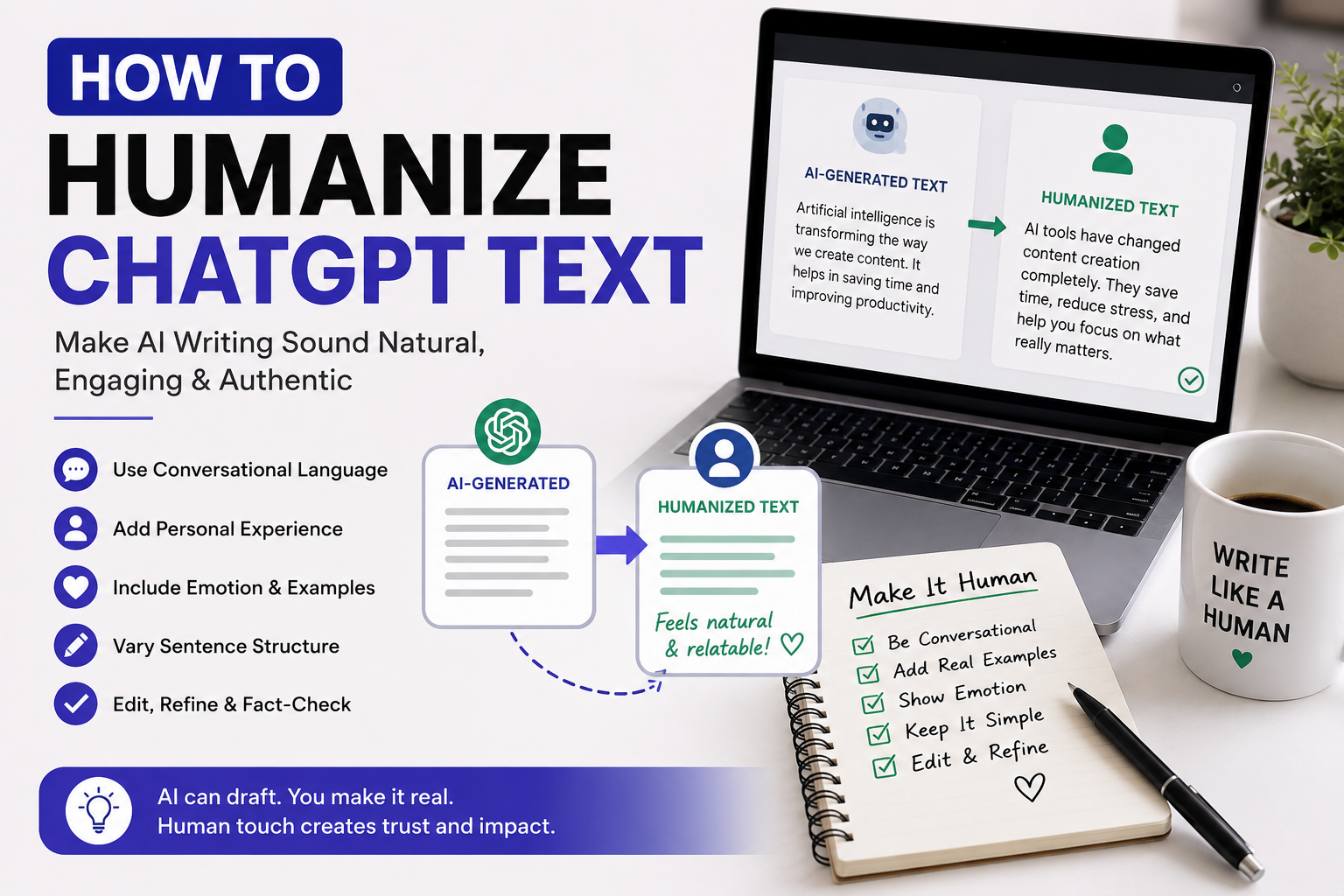
Learn how to humanize ChatGPT text in 2026 with 15 powerful techniques to make AI writing sound more natural, authentic, engaging, and reader-friendly.
How to Humanize ChatGPT Text in 2026
AI writing tools such as ChatGPT can help create content quickly, but AI-generated text may sometimes sound repetitive, overly formal, or less personal. Learning how to humanize ChatGPT text can make AI-assisted writing feel more natural, authentic, and engaging. In 2026, writers, students, marketers, and businesses can combine AI efficiency with human editing, personal experience, clear language, and a natural writing style. The goal is not simply to change words, but to improve the overall quality and usefulness of the content for real readers.
Artificial intelligence has changed content creation forever. Writers, marketers, students, and businesses now use AI tools every day to create articles, emails, product descriptions, and social media posts in minutes. While this saves time, there is one common problem many people face: AI-generated content often sounds robotic.
In 2026, AI-generated content is everywhere—but making it sound human is what truly sets your writing apart. While tools like ChatGPT can produce fast and informative text, the challenge lies in adding personality, emotion, and authenticity. Humanized content builds trust, improves engagement, and connects better with readers. Whether you’re a blogger, marketer, or student, refining AI text into natural, conversational language is a valuable skill. In this guide, we’ll explore practical ways to make AI writing sound more human and relatable.
Readers can quickly notice when content feels generic, repetitive, or emotionally flat. Search engines are also becoming better at identifying low-quality AI content that lacks originality and real human value. That is why learning humanize ChatGPT text has become one of the most important skills in digital writing.
Humanizing AI content does not mean hiding the use of AI. It means improving the writing so it feels authentic, relatable, and useful to real people. When done correctly, AI-assisted content can become more engaging, rank better on Google, and create stronger trust with readers.
In this guide, you will learn practical ways to make humanize ChatGPT text sound more natural, emotional, and human without losing speed or productivity.
Why AI Content Often Sounds Robotic
AI tools generate text by predicting patterns from massive datasets. They are excellent at organizing information, but they still struggle with emotional depth, personal experience, and natural conversational flow.
Most AI-generated writing includes repetitive sentence structures, overly formal language, and generic transitions and humanize ChatGPT text . It often lacks personality and sounds too polished. Human writing, on the other hand, includes variation, emotion, storytelling, opinions, and small imperfections that make it feel real.
For example, AI may write:
“Businesses can improve productivity by using automation tools.”
A human writer is more likely to say:
“Many businesses save hours every week simply by automating repetitive tasks.”
The second version feels more natural because it sounds conversational and specific.
Understanding this difference is the first step toward creating better AI-assisted content.
Why Humanized Content Matters for SEO
Google’s Helpful Content system focuses heavily on content quality, expertise, usefulness, and reader satisfaction. Pages created only to manipulate rankings rarely perform well long term.
humanize ChatGPT text humanized AI content performs better because it improves readability and engagement. Readers stay longer on pages that feel genuine and easy to understand. Lower bounce rates and better user interaction can positively influence search visibility.
Natural writing also helps build authority. Readers trust content that sounds thoughtful and realistic instead of automated and repetitive.
As AI-generated content becomes more common, the ability to humanize ChatGPT text is increasingly important in 2026. Readers expect content that feels authentic, engaging, and written by a real person rather than a machine.
This matters even more in competitive industries like SaaS, content marketing, and the best account based marketing marketing agency niche, where trust and expertise directly impact conversions.
Start With Better AI Prompts
One of the easiest ways to improve humanize ChatGPT text is to create stronger prompts. Weak prompts produce generic content. Detailed prompts produce more natural and targeted results.
Instead of asking:
“Write an article about email marketing.”
Try something more specific:
“Write an engaging article about email marketing for small business owners using a conversational tone with practical examples and short paragraphs.”
The more context you provide, the more human the output becomes.
You can also ask AI to mimic certain styles. For example:
“Write in a friendly tone similar to an experienced blogger.”
This creates more natural rhythm and variation.
Edit the Introduction Manually
Most AI introductions sound predictable. They often begin with broad statements like:
“In today’s digital world…”
Readers see these phrases everywhere. They immediately reduce originality.
A stronger introduction creates curiosity or emotional connection.
Instead of writing:
“Technology is changing content creation.”
You could write:
“Many readers can spot AI-generated writing within seconds, even when the grammar is perfect.”
This feels more direct and relatable.
Your introduction should sound like a real person speaking humanize ChatGPT text to another person, not a machine summarizing a topic.
Use Personal Experience and Real Examples
Human writing feels authentic because it includes experience. AI cannot truly share real emotions, failures, or observations.
Adding examples from real situations instantly improves credibility.
For instance, instead of saying:
“AI tools improve productivity.”
You could write:
“A freelance writer managing five clients can reduce research time by several hours each week using AI-assisted outlines.”
Specific examples create stronger emotional connection and make content more memorable about humanize ChatGPT text.
Even simple observations help. Mention common frustrations, small successes, or practical scenarios readers recognize from their own lives.
Break Perfect Sentence Patterns
AI often creates sentences with identical rhythm and structure. This makes content feel unnatural.
Human writers naturally mix short and long sentences and humanize ChatGPT text. They ask questions. They pause. They sometimes use fragments for emphasis.
For example:
“AI can save time. But speed alone is not enough.”
That variation sounds far more human than consistently long academic sentences.
When editing AI content, intentionally change sentence length throughout the article. Read the text aloud to identify robotic rhythm.
If every sentence sounds similar, rewrite some sections conversationally.
Remove Repetitive Words and Phrases
ChatGPT frequently repeats certain expressions like:
- In today’s digital landscape
- It is important to note
- Additionally
- Furthermore
- Unlock the potential
- Seamlessly
Overusing these phrases makes content sound automated.
Replace repetitive transitions with natural alternatives. Sometimes you do not need a transition at all.
For example:
“Many businesses now rely on AI tools. These tools help reduce repetitive work.”
Simple writing often feels more human than overly formal language.
Add Emotion Naturally
Real people write with emotion. They show excitement, concern, curiosity, or frustration.
Emotion helps readers connect with content on a deeper level.
For example:
“Writers often feel frustrated when AI-generated articles sound cold and repetitive.”
This sentence feels more relatable than a purely factual statement.
However, avoid exaggerated emotional language. Subtle emotion works best because it feels believable.
Use Conversational Language
One of the best ways to humanize ChatGPT text is to write like you speak.
Formal writing can feel distant. Conversational writing creates connection.
Instead of saying:
“Individuals should optimize their content strategy.”
Try:
“People should improve the way they create content.”
The second version feels clearer and more natural.
Contractions also help. Words like “you’re,” “it’s,” and “don’t” create smoother flow and improve readability.
Include Opinions and Perspective
Human writing contains perspective. AI-generated text often tries to sound neutral about everything.
Adding thoughtful opinions creates stronger authority.
For example:
“Many marketers rely too heavily on AI-generated drafts without editing them properly humanize ChatGPT text. That usually hurts content quality.”
This feels more authentic because it reflects judgment and experience.
You do not need extreme opinions. Even mild perspective makes writing sound more human.
Use Storytelling Techniques
Stories instantly make content feel natural and engaging.
You can use short stories, client examples, or realistic scenarios.
For example:
“A small ecommerce brand published AI-generated blog posts for six months but struggled to gain traffic. After rewriting the content with a more conversational tone and real customer examples, engagement improved noticeably.”
This approach keeps readers interested while also building trust.
Storytelling works especially well in tutorials, marketing blogs, and educational content.
Improve Readability
Complex writing often sounds robotic because it feels unnatural to everyday readers.
Humanized content should be easy to scan and understand quickly.
Use short paragraphs, simple vocabulary and humanize ChatGPT text, and clear formatting.
Avoid unnecessary jargon unless your audience expects technical language.
A readability score above 80 usually means the content feels smooth and accessible.
This also improves SEO because users spend more time reading content they understand easily.
Add Human Imperfections Carefully
Perfect grammar is not always necessary. Real people sometimes write casually.
You can occasionally use sentence fragments, rhetorical questions, or conversational pauses.
For example:
“And honestly, that is where many AI articles fail.”
This creates personality without reducing professionalism.
Do not overdo it. Small imperfections help content feel natural, but too many can hurt credibility.
Fact-Check Everything
AI sometimes generates inaccurate or outdated information. humanize ChatGPT text content also means making it trustworthy.
Always verify statistics, trends, and claims before publishing.
Reliable content builds authority and supports Google’s E-E-A-T principles.
If you mention industry data, ensure it comes from credible sources.
Readers trust writers who provide accurate information and realistic insights.
Use AI as a Drafting Assistant, Not a Final Writer
The best content creators treat AI as a tool, not a replacement for human thinking.
AI is excellent for generating outlines, brainstorming ideas, summarizing information, and speeding up research.
But final editing should always involve humanize ChatGPT text human judgment.
The most successful writers combine AI efficiency with human creativity, emotional intelligence, and experience.
That balance creates content that performs well in both search engines and real-world reader engagement.
Best Tools to Humanize AI Content
Several tools can help improve AI-generated writing. However, none should replace manual editing completely.
Grammarly helps improve readability and humanize ChatGPT text sentence flow. Hemingway Editor simplifies overly complex writing. QuillBot assists with rewriting repetitive phrases.
Some platforms specifically market themselves as AI humanizers. These tools rewrite AI-generated text to sound more natural.Humanizing AI writing involves improving tone, adding natural language patterns, incorporating personal insights, and enhancing readability.
Whether you’re creating blog posts, marketing copy, or website content, making AI-generated text sound natural can boost user engagement, credibility, and search performance. This guide explores the best strategies to transform ChatGPT text into content that feels real, relatable, and genuinely human.
Still, the best results usually come from human editing because authenticity cannot be fully automated.
Common Mistakes to Avoid
Many people try too hard to make AI content sound human. This can create new problems.
Overusing slang makes writing feel forced. Adding random emotional phrases can reduce professionalism. Excessive rewriting may also remove clarity.
Another mistake is relying entirely on AI humanizer tools without reviewing the output manually.
Good humanized content Humanize ChatGPT Text should feel natural, not artificially casual.
Balance is important.
How Humanized Content Improves Engagement
Readers respond better to content that feels personal and relatable.
humanize ChatGPT text increase trust because readers feel they are learning from a real person rather than a machine.
This often leads to:
Higher time on page
More social shares
Better conversions
Improved SEO performance
Stronger audience loyalty
Businesses that publish authentic content consistently usually build stronger long-term authority online.
This is especially important in industries where competition is intense and trust directly influences buying decisions.
The Future of AI Writing
AI writing tools will continue improving rapidly. Future models will likely sound more natural than current systems.
However, human creativity will still matter.
People connect with experiences, emotions, stories, and perspectives. These qualities are difficult to automate completely.
Writers who learn to combine AI efficiency with authentic communication will have a major advantage in content marketing, blogging, SEO, and online business.
The future is not human versus AI.
The future is human-enhanced AI writing.
Conclusion
Learning how to humanize ChatGPT text is no longer optional for serious content creators. AI-generated writing can save time, but raw output often feels robotic and generic. Readers want authenticity, clarity, and emotional connection.
The best approach is to use AI for speed while applying human creativity during editing. Strong introductions, conversational tone, real examples, emotional depth, and varied sentence structure all help content feel more natural.
humanize ChatGPT text content performs better because it creates trust. It keeps readers engaged, improves SEO performance, and supports long-term authority.
If you want your AI-assisted content to stand out in 2026, focus less on sounding perfect and more on sounding real.
FAQs
How do I make ChatGPT text sound more human?
You can make humanize ChatGPT text sound more human by editing sentence structure, adding personal examples, using conversational language, and removing repetitive AI phrases.
Can Google detect AI-generated content?
Google focuses more on content quality than how it was created. Helpful, original, and trustworthy content can still rank well even if AI assisted the writing process.
What is the best tool to humanize AI content?
Tools like Grammarly, Hemingway Editor, and QuillBot can improve readability, but manual human editing usually produces the best results.
Why does AI writing sound robotic?
AI writing often sounds robotic because it follows predictable language patterns, repetitive phrasing, and lacks emotional depth or personal experience.
Is humanized AI content good for SEO?
Yes. Humanized AI content improves readability, engagement, and trust, which can positively affect search rankings and user experience.
Should I fully rely on AI writing tools?
No. AI tools work best as assistants for drafting and brainstorming. Final editing should always include human review for originality, accuracy, and authenticity.
