
Discover 23 best Conversion Rate Optimization Tools to increase conversions, boost sales, and optimize your website for maximum ROI.
Introduction
Getting people to visit your website is not the hardest part anymore. The real challenge is turning those visitors into customers. Many businesses spend money on ads and SEO but still struggle to generate sales. The problem is not traffic. The problem is conversion.
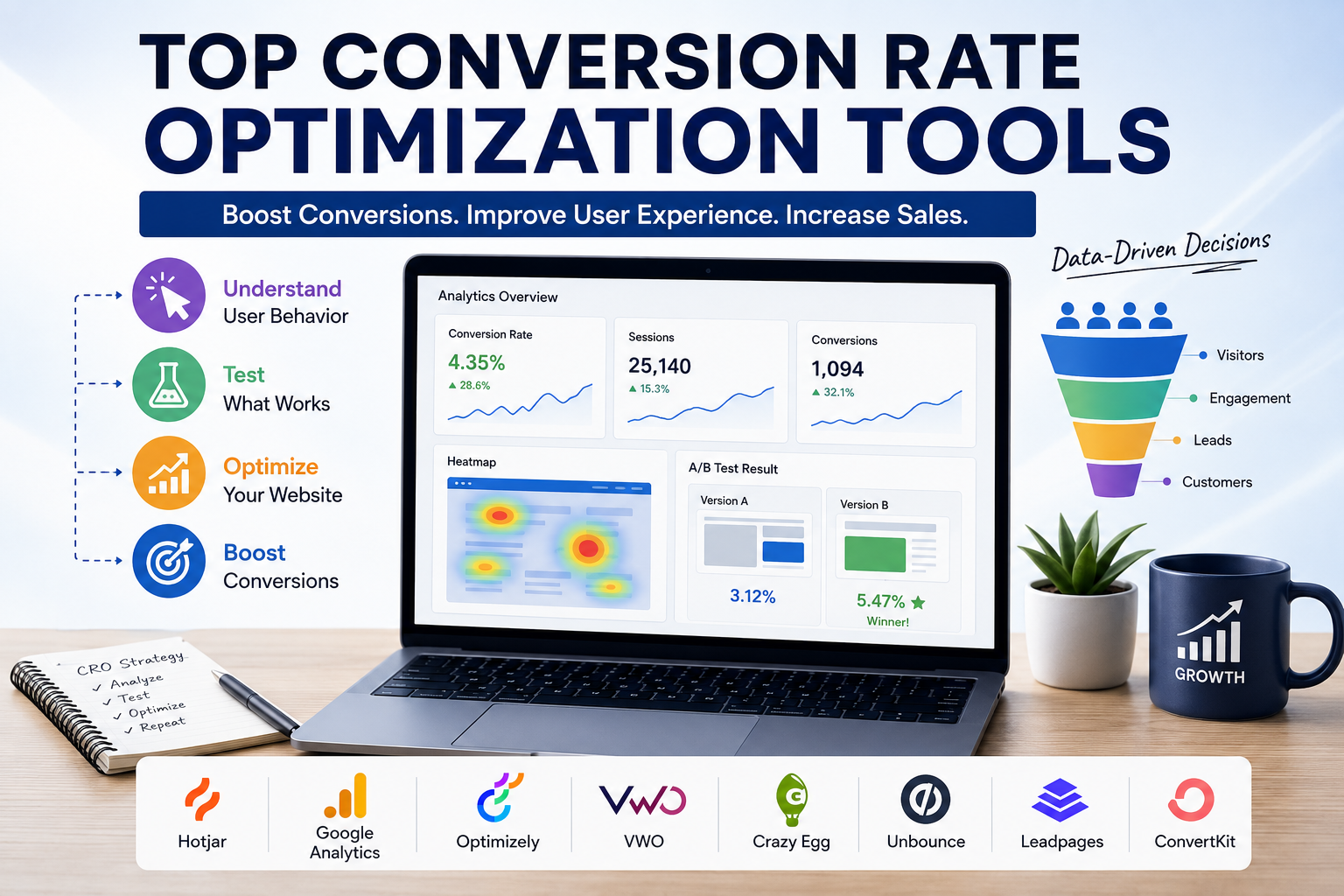
In 2026, conversion rate optimization (CRO) tools have become essential for businesses looking to turn website visitors into paying customers. With increasing competition in the digital space, simply driving traffic is not enough—optimizing user experience, testing strategies, and analyzing behavior are key to boosting conversions. Modern Conversion Rate Optimization Tools offer features like A/B testing, heatmaps, user session recordings, and AI-driven insights to help businesses make smarter decisions. In this guide, we’ll explore 23 powerful CRO tools that can help you increase sales and maximize your return on investment.
This is where conversion rate optimization tools become powerful. These tools help you understand what your visitors are doing, why they leave, and what changes can convince them to stay and take action.
Instead of guessing, you make decisions based on real data. This leads to better results, higher revenue, and smarter growth.
In this guide, you will learn about the top conversion rate optimization tools, how they work, and how to use them effectively in 2026.
What Is Conversion Rate Optimization Tools
Conversion rate optimization tools, often called CRO, is the process of improving your website to increase the percentage of visitors who complete a specific action.
That action could be buying a product, signing up for a newsletter, downloading a file, or filling out a contact form.
For example, if 100 people visit your website and 2 people buy something, your conversion rate is 2 percent. If you improve your website and now 4 people buy, your conversion rate becomes 4 percent.
This may seem like a small change, but it can double your revenue without increasing traffic.
CRO focuses on user behavior, design, speed, trust, and messaging. It removes friction and makes it easier for users to take action.
Why Conversion Rate Optimization Tools Matter
Without tools, you are working blindly. You may think your website looks good, but your users might be confused.
Conversion rate optimization tools show you what is really happening on your website. They provide insights into clicks, scrolling behavior, user journeys, and drop-off points.
These tools also allow you to test different versions of your pages. You can compare results and choose the best-performing version.
Businesses that use CRO tools effectively often see major improvements in sales, engagement, and user satisfaction.
Heatmap Tools for Visual Insights
Heatmap tools are one of the easiest ways to understand user behavior. They create visual maps of how users interact with your website.
You can see where users click the most, how far they scroll, and which sections they ignore.
This information helps you place important elements like call-to-action buttons in high attention areas.
For example, if users are not scrolling down, your main message should be placed higher on the page.
Heatmaps also help identify design problems. If users are clicking on non-clickable elements, it means your design is confusing.
Fixing these issues can instantly improve conversions.
Session Recording Tools
Session recording tools allow you to watch real user interactions on your website. You can see exactly how visitors move their mouse, where they hesitate, and where they leave.
This gives you a deeper understanding of user behavior. Instead of guessing, you observe real actions.
For example, if users keep abandoning the checkout page, session recordings can reveal the exact reason.
It could be a confusing form, unexpected charges, or slow loading speed.
Fixing these small issues can lead to big improvements.
A/B Testing Tools
A/B testing is one of the most effective CRO strategies. It allows you to test two versions of a page and compare performance.
You can test headlines, images, button colors, layouts, and even pricing.
For example, changing a simple headline can increase conversions significantly.
The key is to test one change at a time so you can clearly understand what works.
Over time, continuous testing leads to better results and higher conversion rates.
Analytics Tools for Data Tracking
Analytics tools are the backbone of conversion optimization. They track important metrics such as traffic sources, bounce rate, and user flow.
These tools help you understand where your visitors come from and what actions they take.
You can identify which pages perform well and which need improvement.
For example, if a page has high traffic but low conversions, it means something is wrong.
Analytics tools help you find the problem and fix it.
Personalization Tools
Modern users expect personalized experiences. They do not want generic content. They want something that matches their needs.
Personalization tools use data to show relevant content to each user.
For example, returning visitors can see special offers, while new visitors see introductory messages.
This makes users feel valued and increases the chances of conversion.
Personalization is especially powerful in ecommerce, where product recommendations can boost sales.
Landing Page Optimization Tools
Landing pages are often the first impression of your business. A poorly designed landing page can drive users away.
CRO tools help you create high-converting landing pages with better design, faster speed, and clear messaging.
They also allow you to test different layouts and track performance.
A strong landing page focuses on one goal and removes distractions.
Clear headlines, strong visuals, and simple calls to action make a big difference.
Popup and Lead Generation Tools
Popups are often misunderstood, but when used correctly, they can increase conversions.
They help capture leads, promote offers, and guide users toward action.
For example, exit-intent popups appear when a user is about to leave the site.
This gives you one last chance to convert them.
Timing, design, and message are important. A well-designed popup feels helpful, not annoying.
Form Optimization Tools
Forms are a critical part of conversion. If your form is too long or complicated, users will leave.
Form conversion rate optimization tools help simplify forms and improve completion rates.
They show which fields cause users to drop off.
For example, removing unnecessary fields can increase conversions instantly.
Clear instructions, simple design, and fast loading forms create a better user experience.
AI-Powered CRO Tools
Artificial intelligence is changing how CRO works. AI tools analyze large amounts of data quickly and provide smart recommendations.
They can predict user behavior, automate testing, and optimize content.
This saves time and improves accuracy.
AI tools are especially useful for businesses with large traffic and complex data.
They help identify patterns that humans might miss.
Real-Life Success Example
A small ecommerce store was struggling with low conversions. They used heatmaps and found that users were not scrolling down to see product details.
They moved important information higher on the page and simplified the checkout process.
Within weeks, their conversion rate optimization tools increased significantly.
Another company used A/B testing to test two different headlines. One headline performed much better and doubled their sign-ups.
These examples show that small changes can lead to big results when guided by data.
How to Choose the Right CRO Tools
Choosing the right tools depends on your needs.
If you want to understand user behavior, start with heatmaps and session recordings.
If you want to improve performance, use A/B testing tools.
If you need deeper insights, use analytics tools.
It is important to choose tools that are easy to use and fit your budget.
Start small and expand as your business grows.
Benefits of Conversion Rate Optimization Tools
CRO tools help improve user experience by identifying problems and fixing them.
They increase conversions without increasing traffic.
This means better results with the same resources.
They also help you make data-driven decisions, reducing risk and improving outcomes.
Over time, these improvements lead to steady growth.
Common CRO Mistakes
One common mistake is making changes without testing. This can lead to worse results.
Another mistake is ignoring mobile users. Most traffic today comes from mobile devices.
A poor mobile experience can hurt conversions.
Focusing only on design and ignoring user behavior is another issue.
Successful CRO requires both design and data.
Importance of Website Speed
Website speed has a direct impact on conversion rate optimization tools. Slow websites frustrate users and increase bounce rates.
Even a small delay can reduce conversions.
CRO tools help identify performance issues and improve speed.
A fast website creates a smooth experience and encourages users to stay.
CRO for Ecommerce Businesses
Ecommerce businesses rely heavily on conversions.
Features like product recommendations, reviews, and simple checkout processes can boost sales.
CRO tools help analyze shopping behavior and improve the buying experience.
This leads to higher revenue and customer satisfaction.
CRO for SaaS Businesses
SaaS companies focus on sign-ups and subscriptions.
CRO tools help optimize landing pages, pricing pages, and onboarding flows.
Clear messaging and simple design are key.
Testing different strategies helps improve conversion rate optimization tools and retention.
Future of Conversion Rate Optimization Tools
The future of CRO is focused on automation and personalization.
AI will play a bigger role in analyzing data and making decisions.
Voice search and mobile optimization will also become more important.
Businesses that adapt to these trends will stay ahead of the competition.
Conclusion
Conversion rate optimization tools are essential for any online business.
They help you understand your users, improve your website, and increase conversions.
Instead of spending more money on traffic, you focus on getting better results from existing visitors.
Start using CRO tools today and take your business to the next level.
Test regularly, learn from data, and keep improving.
FAQs
What are conversion rate optimization tools
These are tools that help conversion rate optimization tools the percentage of website visitors who complete a desired action.
How do CRO tools work
They analyze user behavior, provide insights, and allow testing to improve performance.
Are CRO tools useful for beginners
Yes, many conversion rate optimization tools are easy to use and provide valuable insights even for beginners.
How long does CRO take to show results
Results can appear within weeks, depending on testing and improvements.
Which CRO tools should I start with
Start with heatmaps and A/B testing tools to understand user behavior and test changes effectively
