

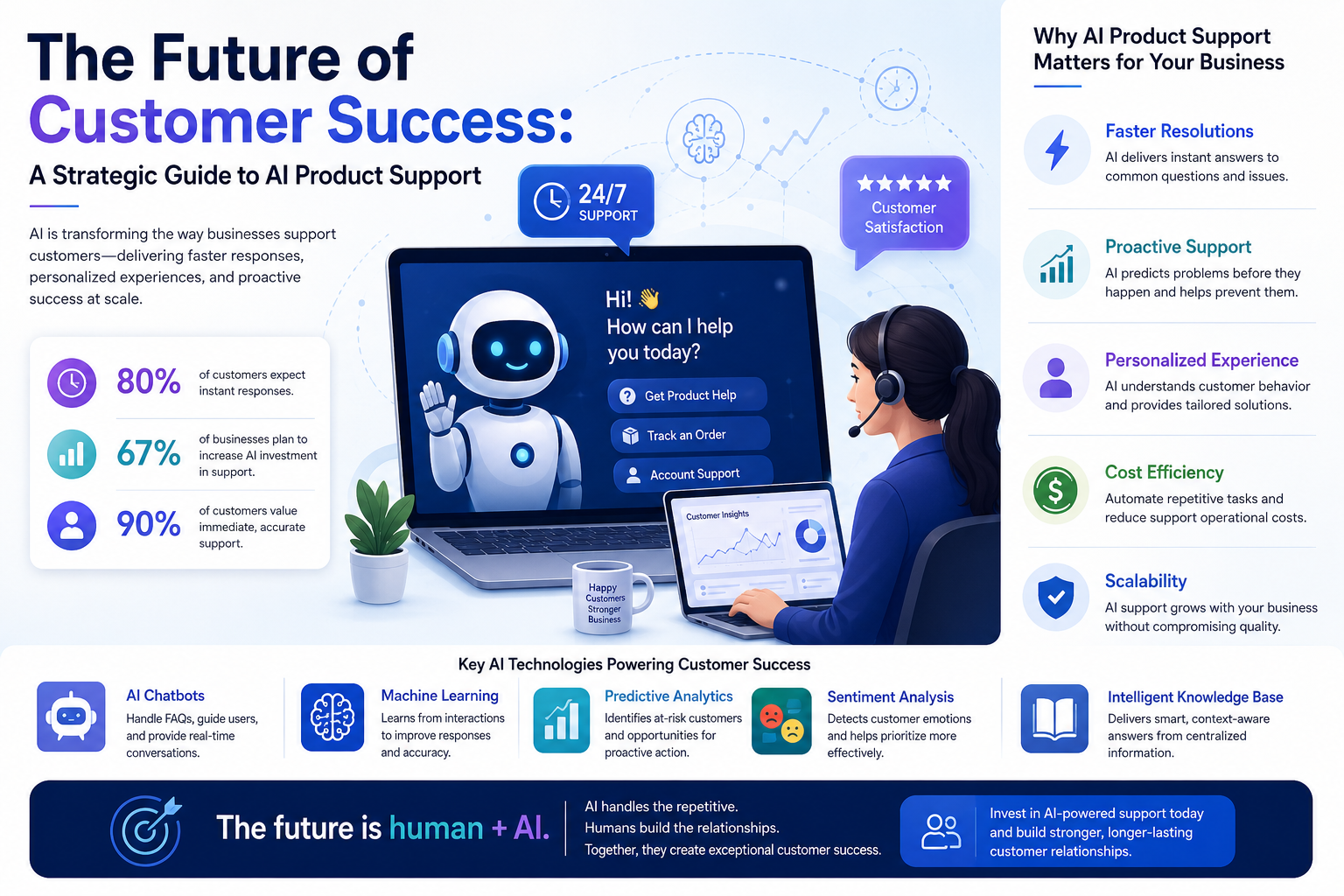
The Future of Customer Success: Concise Summary
The future of Customer Success (CS) is centered on proactive engagement, artificial intelligence (AI), predictive analytics, automation, and personalized customer experiences. Rather than simply solving customer problems, modern Customer Success teams use data-driven insights to prevent churn, increase product adoption, improve customer health scores, and maximize customer lifetime value (CLV). Businesses that invest in Customer Success will strengthen retention, generate recurring revenue, and build long-term customer loyalty.
Introduction
Customer Success has rapidly evolved from a post-sales support function into one of the most strategic departments within modern organizations. As Software-as-a-Service (SaaS), subscription-based businesses, and digital platforms continue to grow, companies recognize that acquiring customers is only half the battle—keeping them successful is what drives sustainable revenue.
Today’s customers expect personalized experiences, proactive communication, and measurable business outcomes. Organizations that fail to deliver these expectations face higher churn rates and slower revenue growth.
The future of Customer Success lies at the intersection of artificial intelligence, automation, customer intelligence, and human relationships. Companies that embrace these technologies while maintaining authentic customer interactions will outperform competitors in customer retention, expansion revenue, and brand advocacy.
What Is Customer Success?
Customer Success is a proactive business strategy focused on helping customers achieve their desired outcomes while using a company’s product or service.
Unlike traditional customer support, which reacts to problems after they occur, Customer Success aims to anticipate customer needs before issues arise.
Its primary objectives include:
- Customer retention
- Product adoption
- Customer onboarding
- Renewal management
- Revenue expansion
- Customer satisfaction
- Relationship management
- Business value realization
Successful Customer Success Managers (CSMs) become trusted advisors rather than support representatives.
Why Customer Success Matters More Than Ever
Increasing competition has made customer retention more valuable than customer acquisition.
Research consistently shows that retaining existing customers costs significantly less than acquiring new ones, while loyal customers generate higher lifetime value through renewals, upgrades, and referrals.
Customer Success contributes directly to:
- Reduced customer churn
- Higher Net Revenue Retention (NRR)
- Increased Annual Recurring Revenue (ARR)
- Improved Customer Lifetime Value (CLV)
- Stronger customer loyalty
- Better product adoption
- Increased upselling opportunities
Organizations now view Customer Success as a revenue-generating function rather than a cost center.
Major Trends Shaping the Future of Customer Success
1. Artificial Intelligence Will Transform Customer Success
Artificial Intelligence is becoming the foundation of modern Customer Success.
AI enables organizations to analyze customer behavior, identify risks, recommend next-best actions, and automate repetitive tasks.
AI-powered Customer Success platforms can:
- Predict churn risk
- Recommend personalized outreach
- Generate customer health scores
- Analyze customer sentiment
- Identify expansion opportunities
- Summarize meetings automatically
- Draft customer communications
Rather than replacing Customer Success Managers, AI enhances productivity by eliminating administrative work.
2. Predictive Analytics Will Replace Reactive Management
Modern Customer Success teams increasingly rely on predictive analytics instead of waiting for customer issues.
Machine learning algorithms analyze:
- Product usage
- Login frequency
- Support tickets
- Customer engagement
- Renewal history
- Feature adoption
- Survey responses
These signals help identify customers likely to churn long before they consider canceling.
3. Hyper-Personalization Will Become the Standard
Customers expect personalized experiences.
Future Customer Success strategies will leverage customer data to deliver:
- Personalized onboarding
- Custom success plans
- Tailored product recommendations
- Individual training paths
- Context-aware communication
Personalization increases customer satisfaction while improving retention.
Automation enables Customer Success teams to manage larger customer portfolios without sacrificing quality.
Common automated workflows include:
4. Automation Will Improve Efficiency
- Welcome emails
- Onboarding sequences
- Renewal reminders
- Health score alerts
- Product education campaigns
- Customer surveys
Automation allows CSMs to focus on strategic conversations rather than repetitive tasks.
5. Customer Health Scores Will Become More Sophisticated
Traditional health scores relied on simple metrics.
Future health scoring models will include:
- Product usage
- Customer satisfaction
- NPS
- Support interactions
- Executive engagement
- Business outcomes
- Financial indicators
- AI-generated risk assessments
These dynamic scores provide more accurate predictions.
6. Digital Customer Success Will Continue Growing
Not every customer requires one-on-one management.
Digital Customer Success combines:
- Automated onboarding
- Self-service knowledge bases
- Interactive tutorials
- In-app guidance
- AI chatbots
- Educational webinars
This approach enables scalable customer engagement while reducing operational costs.
The Role of Customer Success Managers in the Future
Although AI is automating repetitive work, the role of Customer Success Managers will become more strategic.
Future CSMs will focus on:
- Business consulting
- Executive relationship management
- Strategic planning
- Value realization
- Customer advocacy
- Revenue growth
- Expansion strategy
Human empathy and trust remain irreplaceable.
Emerging Technologies Driving Customer Success
Several technologies are reshaping Customer Success operations.
Artificial Intelligence
Provides predictive insights and workflow automation.
Machine Learning
Identifies behavioral patterns across millions of customer interactions.
Customer Data Platforms (CDPs)
Create unified customer profiles across every touchpoint.
Business Intelligence
Transforms customer data into actionable insights.
CRM Systems
Integrate sales, marketing, and Customer Success teams for a complete customer view.
Conversational AI
Improves customer engagement through intelligent chatbots and virtual assistants.
Key Metrics That Will Define Future Customer Success
Organizations increasingly rely on measurable outcomes.
Essential metrics include:
- Customer Lifetime Value (CLV)
- Customer Health Score
- Customer Retention Rate
- Net Revenue Retention (NRR)
- Gross Revenue Retention (GRR)
- Customer Satisfaction Score (CSAT)
- Net Promoter Score (NPS)
- Product Adoption Rate
- Expansion Revenue
- Churn Rate
- Time to Value (TTV)
These metrics provide a holistic view of customer success performance.
Challenges Facing Customer Success
Despite technological advancements, organizations continue to face several challenges.
Data Silos
Disconnected systems limit visibility into customer behavior.
Scaling Personalized Experiences
Growing customer bases require automation without losing personalization.
AI Adoption
Organizations must balance automation with authentic human relationships.
Cross-Department Collaboration
Customer Success increasingly depends on collaboration between Sales, Marketing, Product, and Support.
Best Practices for Future-Proof Customer Success
Organizations should adopt several strategies to remain competitive.
Invest in AI Responsibly
Use AI to augment—not replace—human expertise.
Focus on Business Outcomes
Measure success based on customer achievements rather than product usage alone.
Build a Customer-Centric Culture
Every department should contribute to customer success.
Continuously Measure Customer Health
Monitor engagement using real-time analytics.
Encourage Customer Education
Provide webinars, certification programs, documentation, and community resources.
Leverage Voice of the Customer
Collect feedback regularly to improve products and services.
Industries Benefiting from Customer Success
Customer Success is expanding beyond SaaS into many sectors, including:
- Software as a Service (SaaS)
- Financial Services
- Healthcare
- E-commerce
- Telecommunications
- Manufacturing
- Education Technology (EdTech)
- Cybersecurity
- Cloud Computing
- Artificial Intelligence Platforms
The Future Outlook
Over the next decade, Customer Success will become one of the most influential functions in every growth-focused organization.
AI-powered insights, predictive analytics, automation, and personalized engagement will allow businesses to deliver exceptional customer experiences at scale.
However, technology alone is not enough.
Organizations that combine intelligent automation with trusted human relationships will build stronger customer loyalty, improve retention, and drive long-term profitability.
The future belongs to companies that proactively help customers achieve measurable success—not simply resolve issues.
Frequently Asked Questions (FAQs)
What is the future of Customer Success?
The future of Customer Success focuses on AI-driven insights, predictive analytics, automation, proactive engagement, and personalized customer experiences that improve retention and business growth.
Will AI replace Customer Success Managers?
No. AI will automate repetitive tasks, while Customer Success Managers will focus on strategic consulting, relationship building, and helping customers achieve business outcomes.
Why is Customer Success important?
Customer Success improves customer retention, increases recurring revenue, enhances product adoption, reduces churn, and strengthens long-term customer loyalty.
Which technologies are transforming Customer Success?
Artificial Intelligence, Machine Learning, Customer Data Platforms (CDPs), CRM systems, predictive analytics, conversational AI, and business intelligence tools are driving the next generation of Customer Success.
What skills will future Customer Success professionals need?
Future Customer Success professionals will benefit from analytical thinking, communication, relationship management, strategic consulting, data interpretation, AI literacy, and business acumen.
Conclusion
Customer Success has evolved into a strategic growth engine for modern businesses. As artificial intelligence, predictive analytics, automation, and customer intelligence continue to advance, organizations can deliver more proactive, personalized, and scalable customer experiences.
The companies that thrive in the coming years will combine technology with genuine human relationships, using Customer Success not only to retain customers but also to create advocates, expand revenue, and achieve sustainable long-term growth. Investing in Customer Success today is an investment in the future resilience and competitiveness of your business.
