
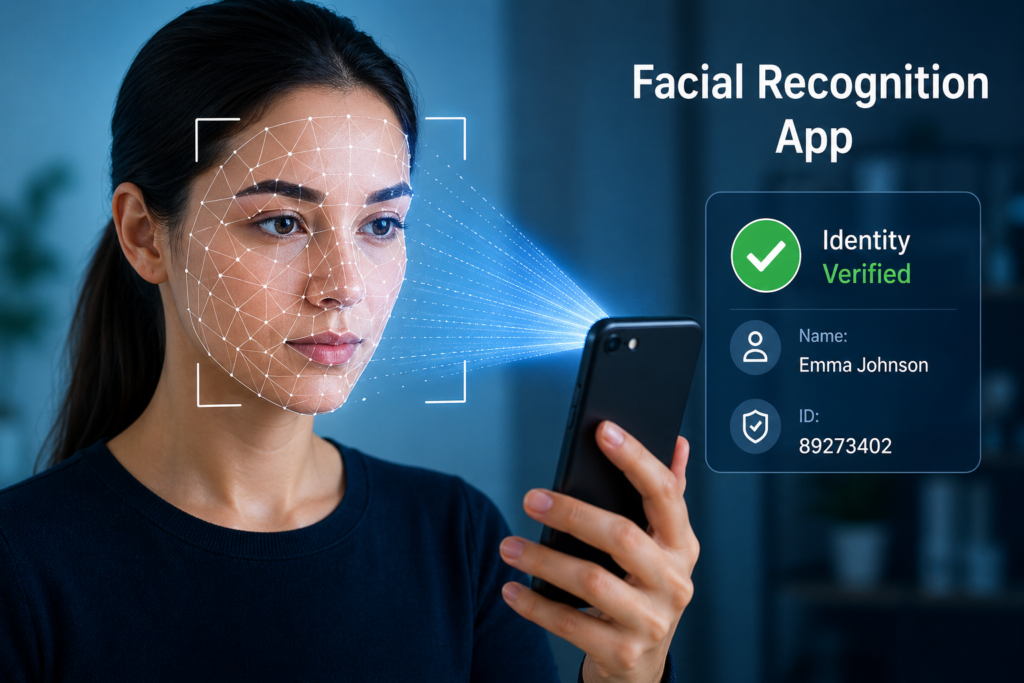

Learn how Facial Recognition App in 2026 work, their benefits, risks, real-world uses, and how to build or choose one in 2026.
Introduction
You look at your phone, and it unlocks instantly. You walk into an airport, and your identity is verified without showing a passport. This is not science fiction anymore. Facial Recognition App in 2026 is now part of everyday life, shaping how we interact with technology.
From smartphones to banking systems, facial recognition is becoming a core feature. It promises speed, security, and convenience. At the same time, it raises serious questions about privacy and ethics. Understanding this balance is essential in today’s digital world.
This guide explains everything you need to know about facial recognition apps in a clear and practical way. You will learn how they work, where they are used, their advantages, and the challenges they bring.
What Is a Facial Recognition App in 2026?
A facial recognition app is a software application that identifies or verifies a person by analyzing facial features from an image or video. It uses artificial intelligence and machine learning to compare a face against a database and determine a match.
You may also hear the term facial identification app, which refers to the same concept. These apps can either confirm identity, like unlocking a phone, or identify unknown individuals, such as in surveillance systems.
At its core, the app converts a face into digital data and compares it with stored records. This process happens within seconds.
How Facial Recognition Technology Works
Facial recognition apps rely on artificial intelligence and machine learning. The process involves several steps that happen within seconds.
Face Detection
The system first scans an image or video to detect a human face. It identifies key elements such as eyes, nose, and mouth.
Face Mapping
Once a face is detected, the system measures unique features. It calculates distances between facial points and creates a digital map.
Feature Encoding
The app converts this map into a mathematical representation. This is often called a faceprint.
Matching
The faceprint is compared with stored data in a database. If a match is found within a certain confidence level, the identity is confirmed.
Output Decision
The system decides what action to take. It may unlock a device, approve a transaction, or identify a person.
Modern facial recognition systems use deep learning models trained on large datasets. This improves accuracy and speed significantly.
The system decides whether to grant access or identify the person.
Modern systems are powered by AI frameworks like TensorFlow and PyTorch. You can explore them
Types of Facial Recognition App in 2026
Different industries use facial recognition apps in different ways. Each type serves a specific purpose.
Authentication Apps
These apps verify identity for login or access control. Smartphones use this feature to unlock screens.
Security and Surveillance Apps
These systems monitor public spaces and identify individuals for safety purposes.
Social Media Applications
These apps detect and tag faces in photos automatically, improving user experience.
Retail and Marketing Apps
Businesses use facial recognition to analyze customer behavior and preferences.
Healthcare Systems
Hospitals use facial recognition to identify patients and manage records efficiently.
Real-World Use Cases
Facial recognition apps in 2026 are already transforming many industries.
Smartphones use facial recognition for secure access. Companies like Apple Inc. have made it mainstream.
In smartphones, facial recognition replaces passwords and improves security. It allows users to access devices quickly and safely.
Airports use facial recognition to speed up check-in and boarding. Passengers can move through checkpoints without showing physical documents.
Banks use facial recognition for identity verification in mobile apps. This reduces fraud and enhances trust.
Retail stores use facial recognition app in 2026 to study customer behavior. This helps improve product placement and customer experience.
Law enforcement agencies use facial recognition to identify suspects and solve crimes faster. However, this use also raises ethical concerns.
Benefits of Facial Recognition Apps
Facial recognition app in 2026 offer several advantages that make them attractive across industries.
They provide fast and convenient access. Users do not need to remember passwords or carry ID cards.
They improve security by using unique biological features that are difficult to copy.
They enhance user experience by making interactions smooth and quick.
They help prevent fraud in financial systems by verifying identities accurately.
They support automation, reducing manual work and saving time.
These benefits make facial recognition app in 2026 a powerful tool in modern technology.
Challenges and Risks
Despite its benefits, facial recognition app in 2026 also has serious drawbacks.
Privacy is a major concern. Many users are unaware of how their facial data is collected and used.
Data breaches can be dangerous. Unlike passwords, facial data cannot be changed once stolen.
Bias in algorithms can lead to inaccurate results. Some systems perform poorly on certain demographic groups.
There is also a risk of misuse. Facial recognition can be used for mass surveillance without consent.
Legal regulations are still developing, which creates uncertainty for businesses.
Understanding these risks is important for responsible use.
How Accurate Is Facial Recognition?
The accuracy of facial recognition app in 2026 depends on several factors.
Lighting conditions can affect image quality. Poor lighting reduces accuracy.
Camera quality also matters. High-resolution cameras capture better details.
Algorithm performance plays a key role. Advanced AI models provide higher accuracy.
In controlled environments, modern systems can achieve over 95 percent accuracy. However, real-world conditions can lower performance.
Continuous improvements in AI are helping reduce errors and improve reliability.
Building a Facial Recognition App in 2026
Building a facial recognition app in 2026 requires technical knowledge and careful planning.
If you are a developer or student working on a project, understanding the development process is important.
Start by selecting a programming language. Python is a popular choice due to its strong AI libraries.
Use machine learning frameworks such as TensorFlow or PyTorch to develop your model.
Collect a dataset of facial images. Ensure it is diverse and ethically sourced.
Train the model to detect and recognize faces. This step requires time and computing power.
Integrate the model into an application using APIs or mobile frameworks.
Test the app under different conditions to ensure accuracy and reliability.
Implement security measures to protect user data.
For students working on final year projects, facial recognition app is a strong and practical choice.
Best Practices for Using Facial Recognition App in 2026
To use facial recognition responsibly, follow these principles.
Always obtain user consent before collecting facial data.
Store data securely using encryption techniques.
Limit data usage to specific purposes and avoid misuse.
Ensure your system is tested for bias and fairness.
Comply with local and international data protection laws.
Transparency builds trust, so clearly inform users how their data is used.
Future of Facial Recognition Apps
The future of facial recognition is promising and complex.
Facial recognition is evolving rapidly. In the coming years, expect major advancements.
Artificial intelligence will continue to improve accuracy and reduce bias.
Integration with augmented reality will create new user experiences.
Edge computing will allow faster processing directly on devices.
Regulations will become stricter, improving privacy protection.
Facial recognition will expand into new areas such as education, smart cities, and personalized services.
Businesses and developers must adapt to these changes carefully.
Conclusion
A facial recognition app is a powerful tool that combines artificial intelligence with real-world applications. It is a powerful innovation that is changing how we interact with technology.
It offers speed, security, and convenience across many industries. However, it also raises important questions about privacy and ethics. The key is to use this technology responsibly.
If you plan to use or build a facial recognition app, focus on responsible implementation. Prioritize user trust, data protection, and transparency.
The future of this technology depends on how well we balance innovation with ethical considerations. Start exploring today, but build with care.
If you are a student, developer, or business owner, now is the time to explore facial recognition. Focus on building solutions that are secure, fair, and transparent.
Start learning, start building, and use this technology to create meaningful impact in the digital world.
FAQs
What is a facial recognition app?
A facial recognition app is software that identifies or verifies a person using their facial features.
How does a facial recognition app work?
It detects a face, maps its features, converts them into data, and compares them with stored records to find a match.
What is a facial recognition app used for?
It is used for identity verification, security, surveillance, and enhancing user experiences in apps and devices.
Is facial recognition app safe to use?
It can be safe if implemented with strong security measures, encryption, and user consent. However, risks exist if data is misused.
Can facial recognition be fooled?
Some systems can be tricked using photos or masks, but advanced apps use depth sensors and AI to prevent this.
Do facial recognition apps store your data?
Many apps store facial data as encrypted mathematical representations, not actual images. Policies vary by provider.
Is facial recognition legal?
Laws differ by country. Some regions have strict regulations, while others are still developing policies.
Can facial recognition be hacked?
While advanced systems are secure, no system is completely risk-free. Strong encryption reduces the chances of hacking.
How accurate is facial recognition technology?
Modern systems can be highly accurate, often above 95 percent in ideal conditions, but performance varies in real-world scenarios.
Can I build my own facial recognition app?
Yes, using AI frameworks and tools, developers can create their own apps. It requires knowledge of machine learning and data processing.