

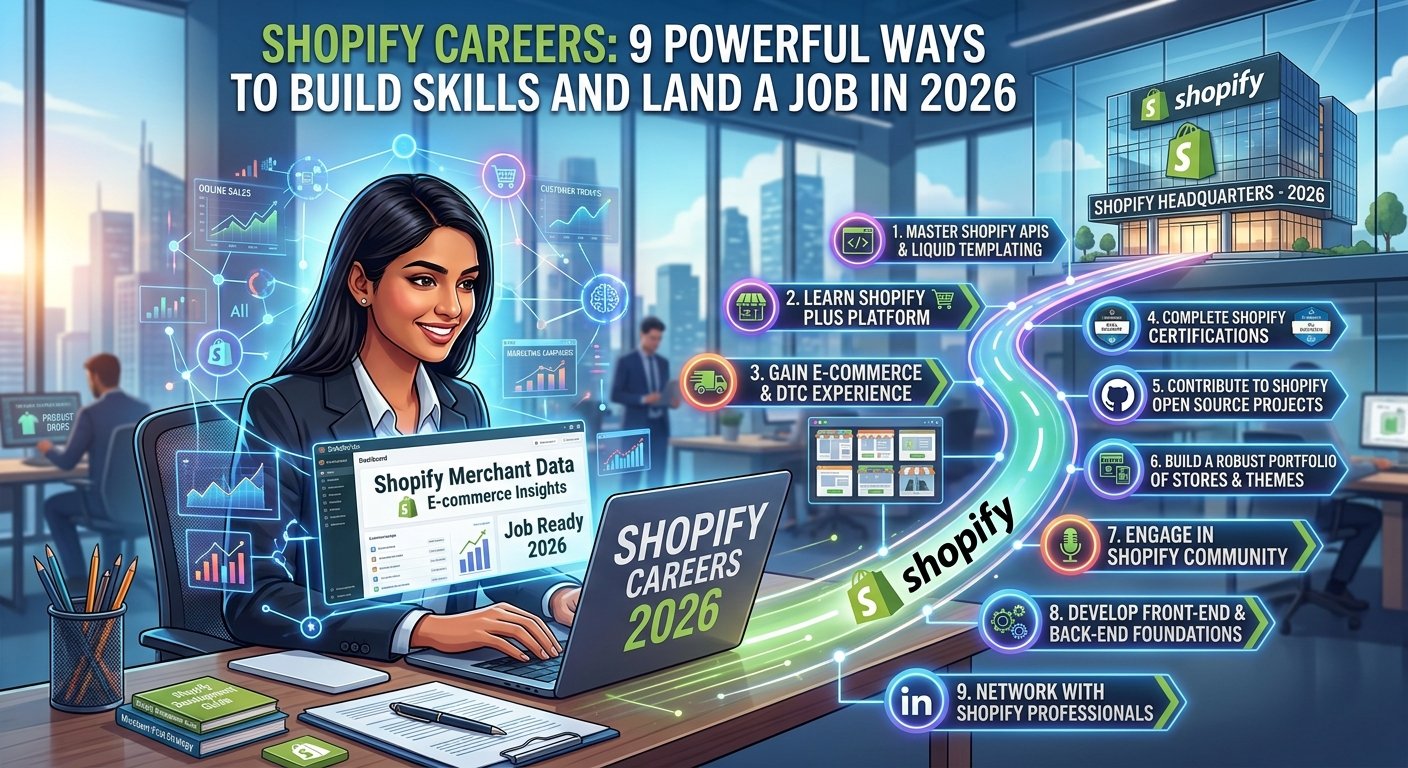
Explore Shopify careers in 2026, discover in-demand skills, understand the hiring process, and learn how to prepare for your next Shopify job.
If you are searching for a technology career that combines software, e-commerce, artificial intelligence, design, data, and entrepreneurship, Shopify careers may be worth exploring. Shopify is a major commerce technology company that supports millions of merchants around the world and continues to build products for online and offline commerce.
But getting a job at Shopify takes more than sending a resume. The company looks for people who can solve problems, learn quickly, communicate clearly, and work well in an environment where priorities can change.
Shopify says it has grown to around 8,000 employees and powers more than $1 trillion in sales for millions of merchants across 175 countries. Its careers site also highlights roles across engineering, data, design, product, commercial teams, finance, growth, legal, operations, partnerships, support, and technical services.
So, how can you prepare for Shopify careers in 2026? Let’s explore the skills, strategies, job types, hiring process, and practical steps that can help you become a stronger candidate.
What Are Shopify Careers?
Shopify careers include a wide range of professional opportunities connected to commerce technology. Many people associate Shopify with software engineering, but the company hires across many disciplines.
Its current careers platform lists opportunities in areas such as software engineering, applied machine learning, infrastructure engineering, security engineering, data engineering, product data science, technical program management, design, product management, sales, customer success, marketing, finance, legal, operations, partnerships, and support.
This means you do not necessarily need to be a programmer to build a Shopify careers.
For example, someone with strong communication and business skills might explore sales, partnerships, customer success, or marketing. A person with analytical skills could look toward data science or finance. A creative professional might explore product design or brand design.
The important point is to understand where your existing skills fit and then develop the skills that your target role requires.
Why Are Shopify Jobs Attractive in 2026?
The technology industry is changing quickly, and commerce companies increasingly depend on cloud platforms, automation, data, and artificial intelligence.
Shopify’s own careers information shows a strong focus on technology and AI. The company describes itself as technical at its core and says product thinking and the use of AI are important parts of how its teams work.
For technology professionals, this creates opportunities to work on large-scale systems and products used by businesses around the world.
For example, an engineer may work on software that supports merchants at scale. A data professional may analyze information that helps teams make product decisions. An applied machine learning engineer may work with models that improve commerce experiences.
The internship program also highlights areas such as software engineering, data engineering, product data science, infrastructure engineering, security engineering, and applied machine learning.
9 Powerful Ways to Prepare for Shopify Careers
1. Choose One Shopify Career Path
One of the biggest mistakes job seekers make is trying to prepare for everything at once.
Instead, select one main career direction.
If you enjoy programming, software engineering may be a natural target. If you enjoy working with data, you could explore data engineering, product data science, or analytics-related roles. If you are interested in business, sales, partnerships, or customer success could be better options.
Shopify careers describes its workforce as a community of generalists while still looking for specialist expertise. Its careers site encourages applicants to think about the problems they want to solve rather than simply choosing a job title.
This is useful advice for any applicant.
Instead of saying, “I want a Shopify job,” define your goal more clearly.
For example, your goal could be, “I want to become a Shopify software engineer,” or “I want to work in Shopify’s data and analytics field.”
A specific goal makes your learning plan much easier.
2. Build Strong Technical Skills
Technical skills are important for many Shopify careers, especially engineering and data positions.
For software engineering, focus on programming fundamentals, algorithms, data structures, APIs, databases, testing, version control, and software design.
For data-related careers, learn SQL, Python, statistics, data visualization, data modeling, and data pipeline concepts.
For machine learning roles, build a stronger foundation in mathematics, machine learning algorithms, model evaluation, Python, and modern AI systems.
You do not need to learn every technology available. Your goal should be to become highly useful in the specific area you want to enter.
A strong portfolio can also demonstrate your skills better than a list of technologies on a resume.
For example, instead of writing “Python and SQL” on your resume without evidence, create a project that uses Python to analyze an e-commerce dataset and SQL to organize and query the data.
That gives recruiters something concrete to understand.
3. Create Real Projects
One of the most practical ways to prepare for Shopify careers is to build something real.
Shopify’s internship resources specifically encourage candidates to create things that solve real problems. Its guidance suggests building a project, contributing to open-source work, or creating something with Shopify APIs rather than relying only on resume claims.
This approach can make your portfolio more convincing.
Imagine two candidates applying for a junior development role.
The first candidate has completed several online courses but has no major project.
The second candidate has completed courses and built a small e-commerce application with product listings, search, checkout logic, an admin dashboard, and an API integration.
The second candidate has something practical to discuss during an interview.
Your project does not have to be huge. A small, polished project can be more useful than a large unfinished one.
4. Learn About E-Commerce
Shopify is not simply a software company. Commerce is central to its business.
That means understanding e-commerce can give you useful context.
Learn how online stores work, how merchants acquire customers, how payments work, how inventory is managed, how shipping affects customers, and how businesses use analytics.
You should also understand concepts such as conversion rate, customer acquisition, average order value, retention, payment processing, checkout, subscriptions, marketplaces, and omnichannel commerce.
This knowledge can help you think beyond technical features.
Suppose you are building a checkout feature. A technically correct solution is useful, but understanding why checkout speed, trust, payment options, and conversion matter can help you think more like a product builder.
Shopify says its work is centered on merchant success and describes its platform as serving businesses from first-time founders to global brands.
That merchant-focused perspective is important when preparing for the company.
5. Develop AI Skills
Artificial intelligence is increasingly important across technology careers, and Shopify is actively incorporating AI into its work.
Its engineering and data internship information mentions technologies including large language model post-training, reinforcement learning, and model quantization.
This does not mean every Shopify applicant needs to become an AI researcher.
However, understanding modern AI tools can be valuable.
A developer could learn how to integrate an AI API into an application. A data professional could study machine learning workflows. A marketer could learn how AI can support customer research and content analysis. A product manager could learn how AI changes product design and user experiences.
The best approach is to combine AI knowledge with your primary professional skill.
For example, instead of becoming a beginner in ten AI tools, a data analyst could focus on using AI to improve data exploration, reporting, automation, and forecasting.
6. Improve Your Problem-Solving Skills
Shopify’s careers material emphasizes builders, curiosity, high agency, and the ability to work through ambiguity.
That means problem-solving matters.
During preparation, do not only memorize interview answers. Practice explaining how you would approach unfamiliar problems.
For a technical role, this might involve coding challenges and system design exercises.
For a marketing role, it could involve creating a customer acquisition strategy.
For a product role, you might be asked to explain how you would improve a product experience.
A useful method is to break every problem into four stages: understand the problem, identify possible solutions, compare trade-offs, and explain your decision.
This makes your thinking easier to follow.
7. Build Communication Skills
Strong communication is useful even in highly technical jobs.
Engineers need to explain technical decisions. Data professionals need to explain findings. Product managers need to communicate priorities. Sales professionals need to understand customer needs.
Shopify’s hiring process can involve conversations about your experience, technical assessments, interviews, and meetings with future coworkers.
That means you should be comfortable talking about your work.
Practice answering questions such as, “Tell me about a project you built,” “What problem were you solving?” “What went wrong?” and “What would you change now?”
Avoid giving memorized answers.
Instead, explain what happened, what you did, what you learned, and what result you achieved.
8. Prepare for Shopify careers Hiring Process
Understanding the hiring process can make preparation more focused.
Shopify says applicants generally begin by applying for suitable roles. Depending on the position, the process can include an initial call, assessments or technical exercises, a Life Story interview, craft interviews, meetings with team members, and a final decision. The exact process can vary by role and team.
The company currently advises applicants to limit themselves to two applications within a 30-day period.
This makes targeted applications especially important.
Before applying, carefully read the job description. Compare your skills with the stated requirements. Identify the strongest evidence from your experience and adjust your resume accordingly.
For example, if a job emphasizes SQL, data modeling, and experimentation, your resume should make relevant experience easy to find.
Do not send the same generic resume to every position.
9. Build a Portfolio That Shows Your Work
A good portfolio can help you stand out because it shows what you can actually do.
For a developer, this might include GitHub repositories and live applications.
For a data professional, it could include dashboards, analysis projects, notebooks, or case studies.
For a designer, it could include product design projects and explanations of design decisions.
For a marketer, it could include campaign examples, growth experiments, content projects, or analytics reports.
Each project should explain the problem, your approach, the tools you used, and the result.
This is much more useful than simply writing, “I am hardworking and passionate about technology.”
Show the work.
Shopify Careers for Software Engineers
Software engineering is one of the major career areas at Shopify careers.
The company lists software engineering alongside applied machine learning, infrastructure engineering, security engineering, data engineering, and product data science under its Engineering & Data discipline.
A strong software engineering candidate should understand programming fundamentals and be able to build reliable software.
Depending on the position, relevant areas may include backend development, frontend development, APIs, distributed systems, databases, infrastructure, security, testing, and performance.
Do not try to master everything before applying.
Read the specific job description and focus on the skills connected to that position.
Shopify Careers in Data and AI
Data and AI are also important areas for people exploring Shopify careers.
Shopify’s internship program lists Product Data Science, Data Engineering, and Applied Machine Learning Engineering among its opportunities.
A data engineer may focus on pipelines and infrastructure that allow teams to work with large amounts of information.
A product data scientist may help teams understand user behavior and make better product decisions.
An applied machine learning engineer may build or improve machine learning systems.
These careers require different skill combinations, so candidates should research the exact role rather than treating “data” as one broad job category.
Shopify Careers in Sales and Marketing
Not every Shopify career requires programming.
The company’s Commercial discipline includes roles such as account executive, sales development, customer success, partner management, revenue marketing, sales acceleration, sales acquisition, and technical solution engineering.
This creates opportunities for professionals with business, communication, marketing, and relationship-building skills.
For example, a sales professional may work with merchants and help them understand how Shopify products can support their business.
A marketing professional may work on campaigns, demand generation, partnerships, or customer growth.
A technical solution engineer may combine business knowledge with technical expertise.
These roles still require strong knowledge of Shopify’s products and the needs of merchants.
Shopify Internship Opportunities
Students and early-career professionals can explore Shopify’s internship opportunities, especially in engineering and data.
Shopify’s internship program currently highlights software engineering, data engineering, product data science, infrastructure engineering, security engineering, and applied machine learning engineering.
The internship program also emphasizes practical work, learning sessions, workshops, mentoring, and opportunities to connect with other interns.
If you are a student, start preparing early.
Build projects before applications open. Practice technical skills. Improve your resume. Learn how to explain your work. Then monitor the official Shopify careers and internship pages for opportunities that match your background.
How to Make Your Shopify Resume Stronger
Your resume should make your most relevant experience easy to understand.
Start with a clear professional summary that matches your target role.
Then highlight relevant skills and, most importantly, evidence of using those skills.
Instead of writing “experienced in Python,” write something more specific, such as “Built a Python-based data analysis project that processed e-commerce sales data and generated performance insights.”
Numbers can make achievements easier to understand when they are accurate.
For example, “Reduced processing time by 30%” is stronger than “Improved performance,” provided the figure is supported by your actual work.
Keep your resume focused on the role you want.
A software engineering application and a marketing application should not look identical.
How to Prepare for a Shopify Interview
Interview preparation should start well before you receive an interview invitation.
First, research Shopify’s products, customers, business model, and technology.
Next, review the requirements of the exact position.
Then prepare examples from your experience.
A useful structure is to explain the situation, the task, your actions, and the result. This keeps your answer clear without making it sound rehearsed.
For technical interviews, practice solving problems while explaining your reasoning.
For behavioral interviews, prepare stories about teamwork, failure, learning, conflict, leadership, and difficult projects.
Shopify careers official hiring information says the Life Story interview focuses on themes from a candidate’s career journey, including what they learned and the difference they made.
That makes reflection an important part of preparation.
Think about the projects that changed how you work and the mistakes that taught you something valuable.
Are Shopify Careers Remote?
Shopify describes its current working model as “Digital by Design.” The company says employees can work wherever they work best while using its offices, known as Ports, when useful. It lists locations including Toronto, Ottawa, Montréal, New York, and Bellevue and says teams also meet for events and certain in-person work.
However, remote eligibility can vary by position and location.
If you are applying from outside the country where a role is advertised, check the exact job posting carefully. A position marked remote does not necessarily mean it is available worldwide.
Location, employment eligibility, time zones, and team requirements can all matter.
What Skills Can Help You Stand Out?
The most useful skills depend on the job, but several qualities are broadly valuable.
Technical applicants can benefit from programming, data structures, system thinking, databases, cloud concepts, AI, and testing.
Data applicants can focus on SQL, Python, statistics, experimentation, visualization, and data engineering concepts.
Business applicants can develop communication, sales, customer research, marketing analytics, negotiation, and commercial knowledge.
Across all these areas, communication, curiosity, problem-solving, adaptability, and the ability to demonstrate real work can make your application stronger.
Shopify says it looks for people who are persistently curious, able to handle change, and committed to improving their craft.
A Simple Shopify Career Preparation Plan
If you are starting from zero, avoid trying to learn everything in a few weeks.
Start by choosing one target role.
Spend the next stage learning the core skills required for that role.
Then create one practical project that proves you can apply those skills.
After that, improve your resume and portfolio.
Finally, study the job description carefully and prepare for the specific interview format associated with the role.
For example, someone targeting data engineering could learn SQL and Python, study data pipelines, build an e-commerce data pipeline project, publish the project documentation, and then apply for relevant positions.
The goal is not to look perfect.
The goal is to show consistent progress and evidence of useful skills.
Frequently Asked Questions About Shopify Careers
How do I apply for Shopify careers?
You can explore current openings through Shopify’s official Shopify careers website. Shopify recommends selecting roles that are a strong match for your experience and checking the requirements before applying.
Does Shopify hire people without a computer science degree?
A computer science degree is not automatically required for every Shopify position. Requirements depend on the specific job. Applicants should review the education and experience requirements listed in each posting and demonstrate relevant skills through work, projects, or other experience.
What jobs are available at Shopify?
Shopify hires across engineering and data, design, product, commercial teams, finance, growth, legal, operations, partnerships, support, communications, and technical services.
Does Shopify offer internships?
Yes. Shopify has internship opportunities, including roles in software engineering, data engineering, product data science, infrastructure engineering, security engineering, and applied machine learning engineering.
How many Shopify jobs can I apply for?
Shopify’s current hiring FAQ says applicants should limit themselves to two applications within a 30-day period.
What is the Shopify interview process like?
The process varies by position and team. Shopify says it may include an initial conversation, assessments or technical exercises, a Life Story interview, craft interviews, meetings with potential coworkers, and a final decision.
Does Shopify hire remote workers?
Shopify describes its work model as Digital by Design, allowing employees to work where they work best while using company locations and meeting in person when useful. Specific remote eligibility depends on the role and location.
What should I learn to get a Shopify engineering job?
Start with strong programming fundamentals and then focus on the skills mentioned in your target job description. Depending on the role, this may include software development, databases, APIs, distributed systems, infrastructure, security, data, or machine learning.
How can I get a Shopify job with no experience?
Start by building practical skills and creating real projects. Shopify’s internship resources encourage aspiring candidates to solve real problems, contribute to open-source projects, and build with Shopify APIs.
Conclusion
Building a career at Shopify starts with understanding what the company needs and matching that with your own strengths. Shopify careers span far beyond software development, with opportunities in engineering, data, AI, design, product, sales, marketing, finance, operations, partnerships, and other professional areas.
The strongest preparation is practical. Choose one career path, develop the right skills, build real projects, understand e-commerce, learn how AI is changing your field, improve your communication, and prepare specifically for the role you want.
Most importantly, do not wait until you find the perfect job posting before you start building experience. A project, portfolio, open-source contribution, or practical case study can give you something meaningful to discuss when an opportunity appears.
If Shopify is part of your career goal for 2026, start with one skill today, turn it into a real project, and keep improving your work. Then check the official Shopify Careers page regularly for positions that match your skills and experience.
